By reading, downloading, or sharing this guide you acknowledge and agree to the following:
This guide exists for education only. Nothing in it is financial, investment, trading, legal, accounting, or tax advice. Every page reflects the personal opinions and personal experience of one trader. I am not a licensed financial advisor, and this book is not a substitute for one.
Trading cryptocurrencies, memecoins above all, carries substantial risk of loss. Prices are extremely volatile. Most people who trade memecoins lose money. Past performance, including every result described in this book, is not an indication of future results. No strategy in these pages guarantees a profit, and anyone who promises you otherwise is selling something.
You are solely responsible for your decisions. Never trade money you cannot afford to lose completely. Do your own research on everything, including everything in this book. Consult a licensed professional before making financial decisions. The author accepts no liability for any loss or damage arising from the use of this material.
Transparency about my interests: this guide contains a referral code for the fomo trading platform. When you sign up with code pradaazx, you receive a discount on trading fees and I earn a share of the fees you generate. This guide also links to awakening, my own free trading community. Growing it benefits me. Both interests are restated wherever they appear. I may hold positions in assets mentioned in this book at any time, without notice.
Third-party platforms, tools, and coins are named for education, not endorsement. They change constantly: features, fees, and safety properties described here were verified in August 2026 and may differ by the time you read this. Always verify with the source.
Cryptocurrency regulation varies by jurisdiction, and some activities described here may be restricted where you live. Profits are taxable in most places. Knowing and following your local law is your responsibility.
This guide is provided "as is," without warranties of any kind, and may be updated at any time without notice.
NFA. DYOR. Trade with money you can lose, and a brain you can't.
THE DEAL
Ownership & Sharing
This guide is the original work of x.com/@pradaazx.
What you may do, freely: share it with anyone, anywhere, as much as you like, as long as it stays complete, unmodified, and credited. Send it to your friends. Post it. Print it. The whole point of this book is reach.
What you may not do: sell it, charge access to it, repackage or translate it, publish pieces of it as your own, or modify it and pass the result off as mine. Quoting short passages is fine with credit and a link back.
This guide is free. Forever. If you paid money for it, someone robbed us both. Tell me at x.com/@pradaazx.
And one warning that belongs on this page, not buried in chapter 12: scammers impersonate me. The real pradaazx will never DM you first, never charge for mentorship, never sell a course, and never, under any circumstances, ask for your seed phrase, private keys, or money. Anyone doing any of that in my name is a scammer. Block and report.
PART I · FOUNDATION
CHAPTER ONE
Introduction
why you're at this table
Let me be straight with you before you give me a single hour of your life: a PDF has never made anyone rich. Not this one, not any of them. If you're here for a shortcut, close the file now and keep your money. Seriously. What this guide can do is different, and in my opinion worth more: it can hand you five years of expensive lessons for free, so the market charges you less tuition than it charged me.
My name, the only one that matters here, is pradaazx. I've been in crypto for five years. I've traded perpetuals and memecoins. I started with 2k. I lost all of it. I loaded another 2k, the last real bullet I had, and kept going.
Then one night in 2023, in the middle of a bear market when everyone I knew had already quit, a memecoin I was holding went vertical while I slept. My 2k was worth more than 120k by morning. I sat there staring at the screen, and I understood two things at the same time. One: this game can change a family's life in a single night. Two: nobody I grew up with even knew this world existed.
That second thought is why this guide exists. We'll get to it.
First, the part most guides skip. The receipts, both colors of them.
The wins and the blood
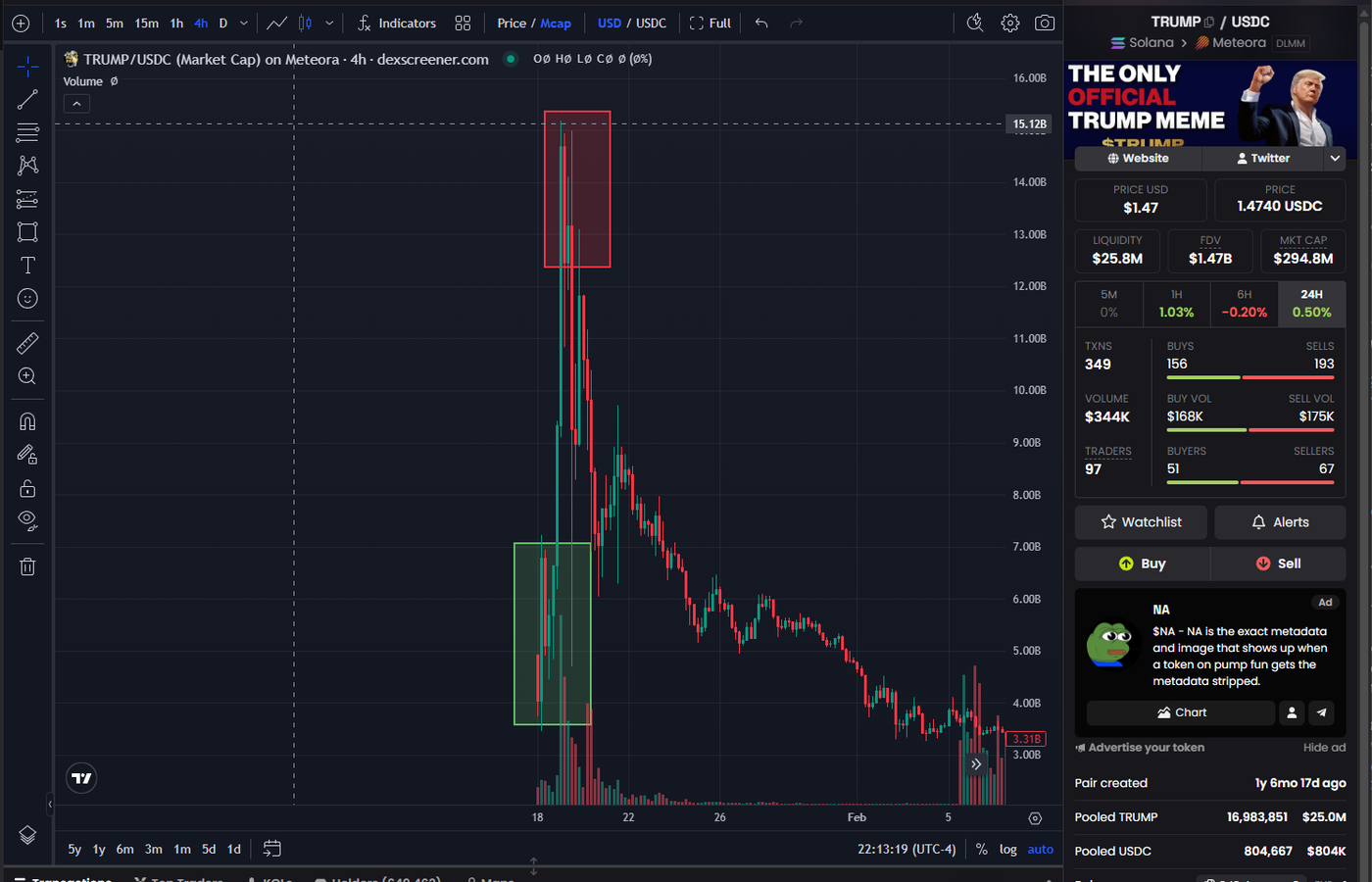
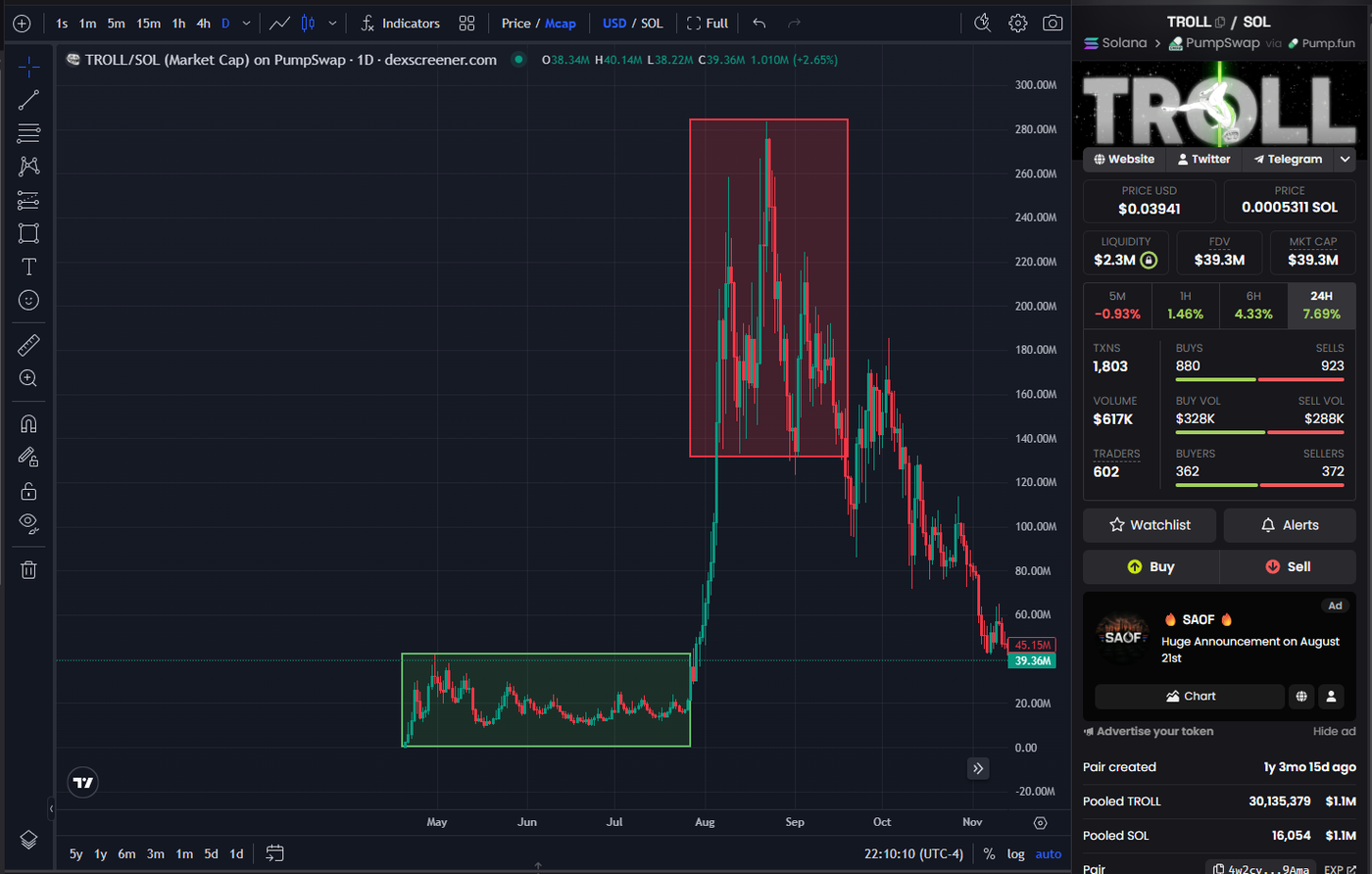
Since that night I've made millions of dollars trading memecoins. Not "portfolio screenshot" millions. Realized, life-changing money. I made around 800k on fartcoin, a coin I found when it was worth almost nothing, where I kept adding as my thesis kept proving itself. I made 400k on $TROLL after holding it for six months. I made 300k on $WIF, riding it from a 30 million market cap into the billions, the first time I ever held a coin the whole way up. I made seven figures on $TRUMP in a single night, placing buys from a restaurant table at my dad's birthday dinner.
Now the other column. The one that earned me the right to write this.
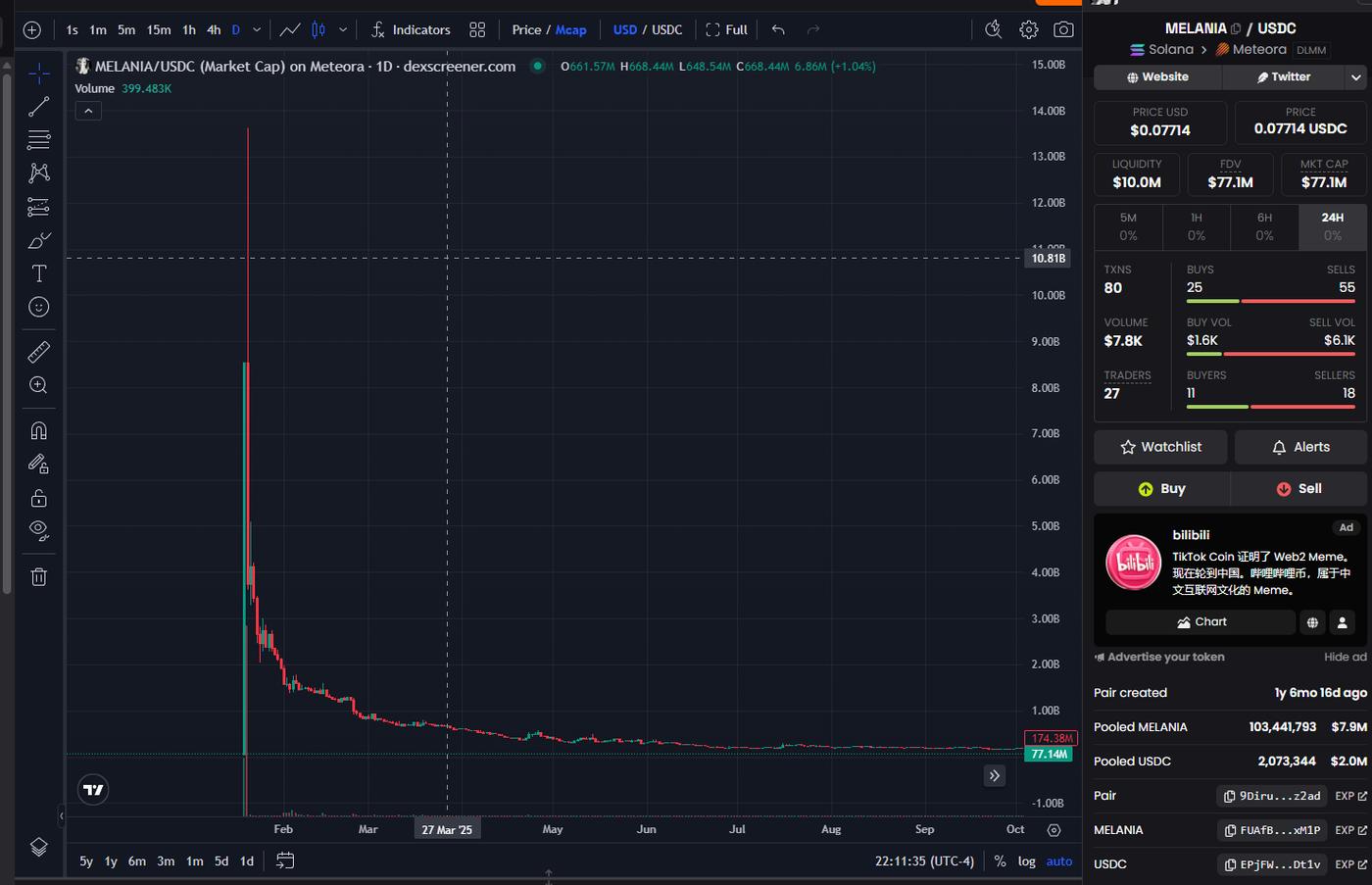
I lost 600k on $MELANIA. I bought the top: late to the hype, chasing what had already happened, while the chain lagged and my gut told me no and I did it anyway. I once lost a million dollars in a single day trading perps, because I went to sleep overleveraged on a massive position like the market owed me a favor. I have round-tripped gains, watched millions on the screen become nothing, because I held past my own thesis. More than once.
My ledger, both colors, side by side. The green column proves the game is real; the oxblood column proves I'm not selling you a fantasy. Anyone who hands you only one of these is selling you something.
I'm not telling you this to impress you or to scare you. I'm telling you because you should never take advice from someone who only shows you one column. The wins prove the game is real. The losses prove I'm not selling you a fantasy. You need both, because you're about to enter a market where most people lose money, and the ones who don't are the ones who treat it like a craft instead of a slot machine.
Why I wrote this
The world changed and most people weren't told.
There are people your age making more in a month from a phone than their parents make in a year. Not because they're smarter. Because they found out early that attention became an asset class, they learned the mechanics, and they showed up every day. Meanwhile everyone else is still being taught the 40-year plan by people the 40-year plan didn't even work for.
I think that's wrong. Not the game. The silence around it.
I'm not going to lie to you the way this industry loves to: no, there are not "millions sitting in your laptop." What's sitting in your laptop is access to the same markets, the same information, and the same tools the winners use. The gap between you and them is knowledge, screen time, and discipline. Two of those three are free, and the third one is this: the discipline chapters of this book, which are the ones most readers skip and then pay for.
My goal for you is simple and I'll say it once, plainly: I want you to have a real shot at retiring your family, and I want you to still have the money two years after you make it. Those are two different skills. This guide teaches both.
How I get paid: the ledger
Old money manners: you disclose your interest before you sit down at the table. Here's mine, all of it.
This guide is free. It will stay free. If someone charged you for it, they robbed us both. Tell me.
I make money from this guide in exactly two ways:
Who
What they get
You
10% off your trading fees when you sign up to fomo (the trading app I actually use and will walk you through in chapter 6) with code pradaazx.
Me
fomo pays me a share of the fees you were going to pay anyway. You lose nothing; I get paid for teaching you.
awakening
My free trading community. It costs nothing to join, ever. It grows my reach and my network. That's my benefit, and I'm telling you so out loud. Inside, roles are earned by real tracked profit, not by paying. You'll see traders ranked by verified PnL, and you'll know exactly whose opinion is worth what. The door: https://discord.gg/theawakening
That's the whole business model. No course upsell is coming in chapter 13. No "inner circle" for $99 a month. If I recommend a tool anywhere in this book, I'll tell you in the same sentence whether I make anything from it. And you'll notice I criticize the ones I profit from, too. Judge me on that.
How to read this book
The chapters are in this order for a reason, and the reason is scars.
Foundation comes first because every dollar I've ever seen a beginner lose was lost to something explained in Part I: a mechanic they didn't know existed, taking their money through a door they didn't know was open. Trading comes second, which means finding coins, judging the people shouting about them, reading charts, and executing. Psychology is third, and it's the part I'd make you sign for if I could, because I knew every rule in this book and still lost a million in a day when my ego took the wheel. Safety is fourth because this industry will take everything you made in the first three parts in one click if you let it. And Getting Started is last, the actual buttons, because you don't hand someone the keys before they can drive.
One more thing, and it's the most honest sentence in this book: you can't inherit a lesson. I can show you exactly where each one lives and what it cost me, but some of them you'll insist on buying yourself anyway. That's fine. That's how it works. My job is to make your version of the lesson cost 2k, not 600k.
The information is in your hands now. The work is yours.
Welcome to the table.
Make new money. Move like old money.
Next: how this machine actually works under the hood, and the doors your money can walk out of without you knowing they exist.
Reading without the app is watching, not learning.
Every walkthrough from here on happens inside fomo. Code PRADAAZX takes 10% off your fees, forever.
In chapter 1 I made you a claim: every dollar I've ever watched a beginner lose was lost to a mechanic they didn't know existed. Money walking out a door they didn't know was open.
This is that chapter. These are the doors.
Nobody loses their first money to a candle on a chart. They lose it to a slippage setting they never touched. To a pool too shallow to let them back out. To a contract where the creator kept the power to print more tokens. To forty wallets that bought before the coin was public and sold the moment our beginner clicked buy. None of that is bad luck. All of it is machinery, running in plain sight, knowable in one sitting.
So sit through this the way you'd sit through a lawyer reading a contract before you sign, because that's literally what this is. Least exciting chapter in the book; saves you the most money.
Six words before we start
Don't overthink these. You'll see each a hundred times in the next fifty pages and they'll become furniture. I just don't want a single word in this chapter to stop you.
Token: a coin living on a blockchain. Memecoins are tokens; the words are interchangeable here.
SOL: the money of the Solana network. You buy memecoins with SOL and sell back into SOL.
Wallet: your account, an app that holds your SOL and tokens and signs your transactions.
DEX: decentralized exchange. Software where tokens trade with no company in the middle. Where memecoins live.
Market cap: token price × number of tokens. The headline size of a coin.
Liquidity: the actual money in a coin's trading pool. The thing that decides whether you can get out.
Everything else gets explained the moment it appears.
Vocabulary is cheap. Pretending you already have it is expensive.
What a blockchain actually is
Strip away every buzzword and a blockchain is one thing: a shared ledger that nobody owns and everybody can read.
Picture the oldest private bank you can imagine: one giant leather ledger, every account and transfer written in ink. Now imagine thousands of identical copies of that ledger on computers all over the world, agreeing on the next line of entries every few seconds. No clerk can forge a line; ten thousand copies would contradict him. No entry can be erased. The ink is permanent by design. When you "own" a memecoin, you own a line in that ledger saying your address holds X tokens, plus a secret key proving you're allowed to move them.
Two consequences matter. First: everything is public. Every buy, every sell, every wallet's history, forever. And later you'll use that against the people trying to farm you, reading their wallets like bank statements. Second: everything is final. No fraud department, no chargeback, no branch manager. The ledger doesn't care that you clicked the wrong thing.
In plain terms: a blockchain is a bank ledger with no bank, perfectly transparent, perfectly unforgiving.
The chain doesn't know your name. It knows everything else.
Why Solana
Blockchains compete like cities, and memecoins settled on Solana for the same reasons nightlife settles in one district: it's fast and cheap to be there.
On Ethereum (the older, more institutional chain) a single swap can cost dollars in fees. On Solana a transaction costs a fraction of a cent and confirms in about a second. When a coin's whole life might be six hours, that's not a detail. It's the whole game: a $2 fee on a $50 buy is a 4% loss before the chart even moves. So the crowds came, the tooling followed (launchpads, scanners, trading apps, all built Solana-first), and now the liquidity is there because the crowds are, and the crowds are there because the liquidity is. Metas rotate, but as I write this, the trenches (the chaotic front line where brand-new coins launch and fight for attention) are on Solana. This book lives there too.
One counterweight before you fall in love: the speed that lets you enter a coin in one second lets a scammer drain a pool just as fast, and lets a bot beat you to every obvious trade. Solana is a fast car with no seatbelts. Learn the controls before you drive.
Speed serves whoever has the most practice, and that isn't you yet.
The cashier's cage: how a memecoin actually trades
Here's the part almost nobody bothers to learn, and it's the single highest-value idea in this chapter. When you buy a memecoin, you are not buying it from another person the way you'd buy a stock. There's no seller on the other side, no order book. You're trading against a liquidity pool.
The picture I want you to keep: a members' club, the old kind, mahogany and cigar smoke. In the lobby stands a brass cashier's cage holding two trays: one of the club's own chips, one of cash. There is no cashier. The cage runs itself on a single house rule, engraved on a plaque: the two trays, multiplied together, must always equal the same number.
You want chips? Put cash in the cash tray and the cage releases exactly enough chips to keep the multiplication true. Want out? Push chips in, cash comes out, same rule. Nobody sets the price. The ratio of the two trays IS the price. Every trade tilts the trays: your buy leaves more cash and fewer chips in the cage, so the next buyer pays more per chip than you did. Buying pushes price up mechanically; selling pushes it down mechanically. Not sentiment. Arithmetic.
That cage is a liquidity pool. The cash is SOL. The chips are the memecoin. The engraved rule is the actual formula these pools run on, the constant product rule: SOL times tokens equals a fixed number. (Newer pool designs exist that bend this math for efficiency, but the pools where memecoins actually live, pump.fun's PumpSwap and Raydium's classic pools, still run the engraved rule, and the intuition carries to all of them.)
In plain terms: a memecoin's price is nothing but the ratio between the SOL and the tokens sitting in its pool. Everything else (the chart, the market cap, the green candles) is a portrait of that ratio.
The math, once, with small numbers
Meet $BUTLER, a fictional cartoon-butler coin invented for this book. Its pool holds:
100 SOL
1,000,000 $BUTLER
Price = 100 ÷ 1,000,000 = 0.0001 SOL per $BUTLER: $0.02 if SOL is $200. The engraved number: 100 × 1,000,000 = 100,000,000.
Now you buy with 10 SOL. The cash tray becomes 110 SOL. To keep the multiplication at 100,000,000, the token tray must shrink to 100,000,000 ÷ 110 ≈ 909,091 $BUTLER. The difference, about 90,909 tokens, is what you receive.
Notice two things. You paid about 0.00011 SOL per token (roughly 10% above the quoted price) because your own buy tilted the trays while executing. And the new pool price is 110 ÷ 909,091 ≈ 0.000121 SOL: your one buy moved the price up about 21%. In a pool this small, a 10-SOL buy is an earthquake; in a 10,000-SOL pool it barely registers. Hold onto both. They're about to become slippage and liquidity depth, the two mechanics that quietly tax every beginner.
The cashier's cage in motion, using the exact numbers from above: a 10 SOL buy tilts the trays — more SOL, fewer $BUTLER — so the price rises about 21% mechanically, and selling those same tokens back tilts everything to where it started. Nobody set a price at any point. The ratio did all of it.
Price is a ratio, not an opinion.
Two addresses: the coin's and yours
Everything on Solana has an address: a long string of letters and numbers. Two kinds matter.
Your wallet address is your account number. Public, safe to share; people can send things to it and read its history (and they will; the ledger is public).
A contract address (CA) is the coin's fingerprint: the unique on-chain identity of the token itself. It matters more than you think, because tickers are not unique. The moment any coin gets attention, scammers launch fakes with the identical name and logo. Search "$BUTLER" on a trading app and you might see nine of them; eight are traps built for people who shop by name. The real one is the one whose exact CA came from a source you trust. Chapter 4 teaches you how to verify that source.
So the rule, and it's absolute: you buy by contract address, never by ticker. Copy the full CA, paste it, check the first and last four characters match. Every serious trader does this every time, the way a jeweler weighs gold instead of trusting the stamp.
The ticker is marketing. The contract is the coin.
Interlude: the twelve words
Pausing the mechanics, because soon you'll create a wallet, and a wallet hands you a seed phrase: usually 12 or 24 words that can regenerate the entire wallet, on any device, forever. Whoever holds those words holds everything the wallet will ever contain. The industry's old line, not your keys, not your coins, is about this key.
Chapter 12 covers security in full. But you don't touch money before you can recite these three commandments:
Your seed phrase touches paper, never a screen: no photos, no notes app, no email drafts, no cloud.
Anyone who asks for it is robbing you, no exceptions: not "support," not an airdrop site, not a verification bot, not me.
Write it, store it offline in two places, and walk away. You'll type it again the day you restore a wallet, and never for any other reason.
People lose fortunes to this: six-figure wallets drained because a fake support agent asked nicely on a bad day. Three sentences. Learn them while it's cheap.
Slippage: the tax you set yourself
Back to the cage. You already saw that your own buy moves the price against you mid-trade. That gap, between the price you were quoted and the price you actually get, is slippage.
It has two sources. The first is your own size against the pool: our 10-SOL $BUTLER buy into a 100-SOL pool cost about 10% in price impact. Same trade, bigger pool, near zero. Small pool plus big order equals paying up. Physics, not foul play.
Two buys into the same 100 SOL $BUTLER pool. The 1 SOL order fills a whisker above quote. The 10 SOL order eats through the pool's depth, so the price walks away from the buyer while the order executes: the average fill lands about 10% above the quote and leaves the pool 21% higher. That gap is slippage, paid before the chart even moves.
The second is other people's trades landing before yours. In a hot launch, hundreds of buys hit the cage in the same second, each one tilting the trays against you. Worse, bots hunt for this on purpose: they see your pending buy, buy right before you, let your order push the price up, and sell right after. You got sandwiched (front-run on both sides). You bought the top of your own trade. On fast chains this is an industry, not an accident.
Your protection is the slippage tolerance setting on every trading app: the maximum price movement you'll accept before your transaction cancels itself. Set it at 5% and any worse fill simply fails. Set it at 50% because a tutorial told you to, and you've written the bots a permission slip to take up to half your order. This is one of the doors from the cold open: the beginner who "lost money instantly, the chart didn't even move" usually met a wide-open slippage setting on a thin pool.
Rules of thumb (starting points, not laws, and check the preset before your first trade, because every trading app ships its own default and some ship them wide): established coin with deep liquidity, 1-3%. Fresh launch, you may need 10-20% to land at all, the game telling you, out loud, that entering costs real money. If a trade needs more than 20% slippage to fill, I'd rather miss it. Missing a trade costs nothing. There will be another one tonight.
The quote is an estimate. The fill is the truth.
Market cap and depth: the headline and the exit
Market cap = token price × total supply. If $BUTLER has 1,000,000,000 tokens at $0.002, that's a $2,000,000 market cap. It's the number everyone quotes, and as a measure of a coin's story, it's fine.
The ownership drill on one card, using $BUTLER's numbers from this page: what you hold divided by the market cap is your share of every token in existence, so $20,000 into a $2,000,000 coin makes you a one-percent owner of the whole supply. Run it before you buy — the same ticket into a billion-dollar coin buys you a rounding error.
Here's what it isn't: money. Nobody deposited $2M into $BUTLER. Market cap is the last price multiplied across every token, including millions that never traded at that price and never will. The real money is the liquidity in the pool, almost always a small fraction of the cap.
Drill question. Answer it before reading on. Two coins:
Coin A: $10,000,000 market cap, $20,000 of liquidity.
Coin B: $2,000,000 market cap, $300,000 of liquidity.
You hold a $5,000 position. Which coin lets you exit near the price on your screen?
…
Coin B, and it's not close. On B, your $5,000 sale is under 2% of the pool, so you exit within a couple percent of quote. On A, you're selling into a puddle: your own order craters the price as it executes and you eat a double-digit haircut, if a real exit exists at all. Coin A's headline said five times bigger; its exit was fifteen times smaller. That mismatch (big cap, dust liquidity) is also a classic manipulation fingerprint: a tiny amount of real money inflated a very large headline. Keep that thought; it returns in the bundling section.
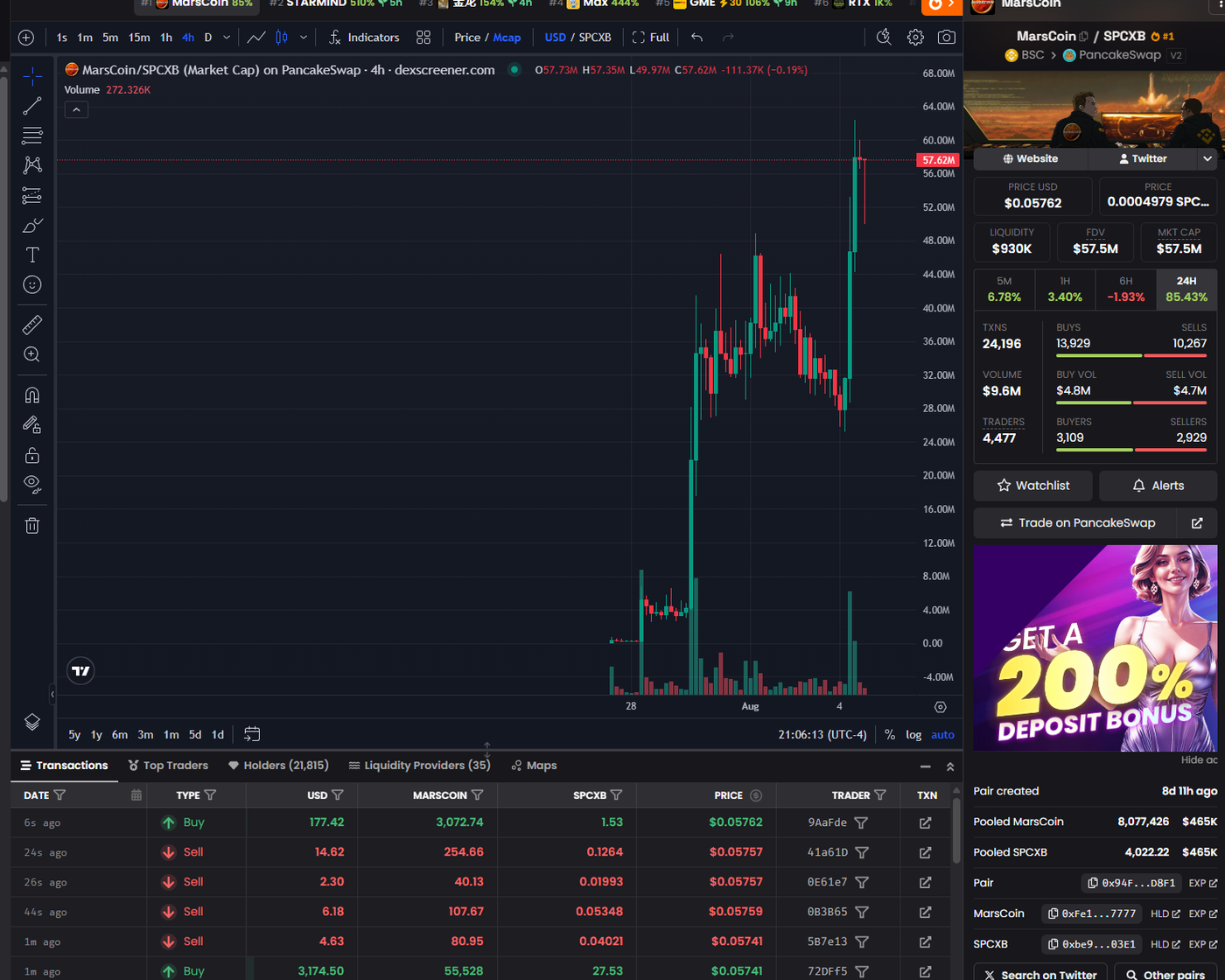
Rule of thumb: check the ratio before you buy. On a young coin, liquidity around 10% of market cap or better is the comfortable zone; under about 5% you should want a very good reason, and under 1%, Coin A territory, you're looking at a headline with no exit behind it. And size to the pool: if your exit would be more than 1-2% of the liquidity, you're not "in a coin," you're in a room where the door is smaller than you are. Here's what that check looks like in the wild:
The two numbers sit one box apart on Dexscreener: $930K of liquidity under a $57.5M market cap, about 1.6%, exactly the mismatch this section is warning you about.
Market cap tells you the story. Liquidity tells you the exit.
The paperwork check: thirty seconds that filter most rugs
A memecoin is a small piece of software, and whoever deploys it keeps certain powers unless they're explicitly given up. Three pieces of paperwork tell you most of what you need:
1. The liquidity: locked or burned? The SOL in that cashier's cage was deposited by the coin's creator, and if they still control it, they can withdraw it at will. That's the classic rug pull: the pool empties, the trays you were supposed to sell into are gone. Price to zero, permanently, in one transaction. You want the LP (the deposit receipt for the pool) burned (destroyed, so nobody can ever pull it) or locked in a time-vault. On serious launches this is standard.
2. Mint authority: revoked? If the creator kept the right to mint (print new tokens), your share can be diluted to nothing at will.
3. Freeze authority: revoked? If kept, the creator can freeze individual wallets from selling. A coin you can buy but not sell is a honeypot, a jar with a one-way lid.
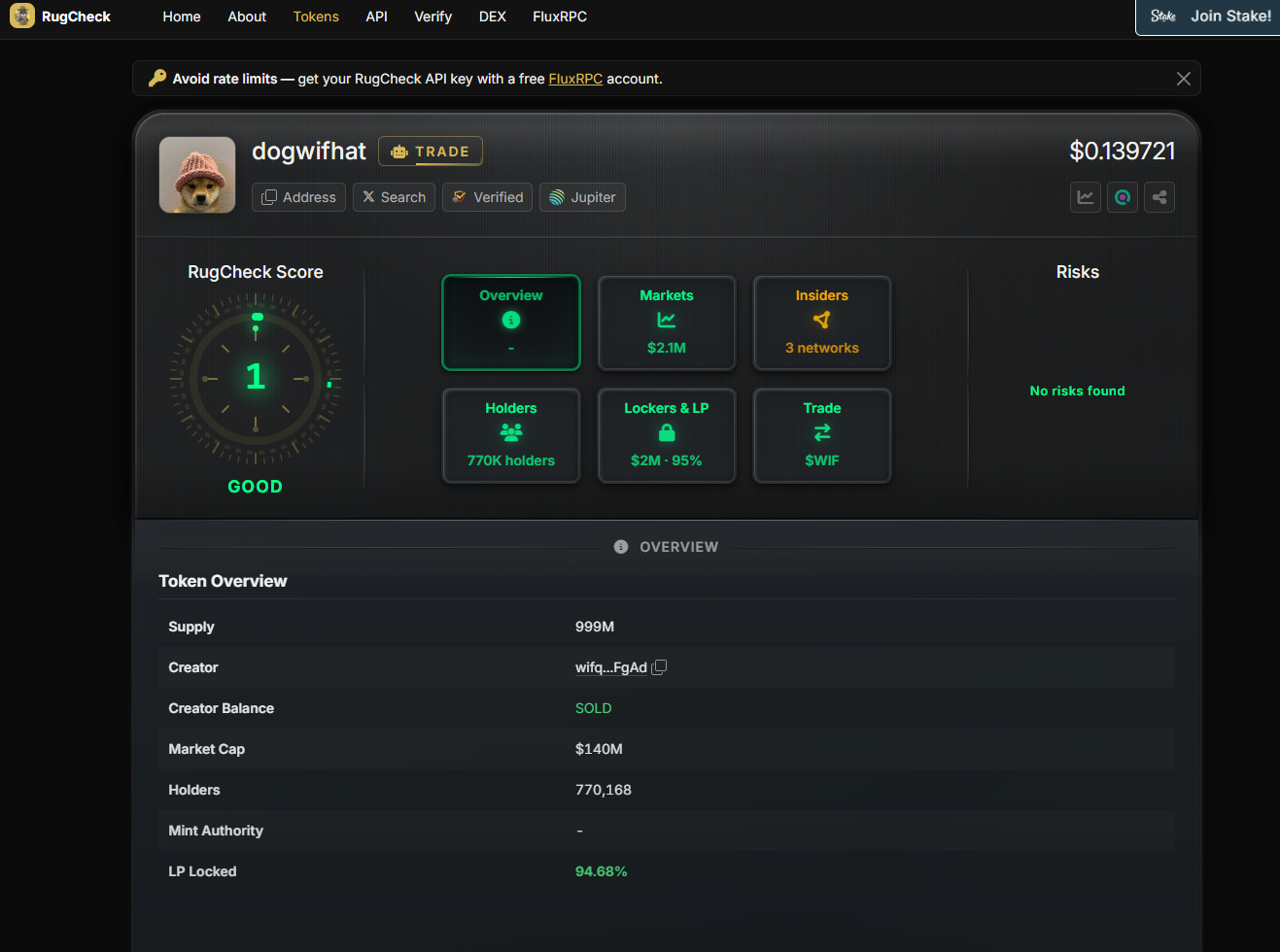
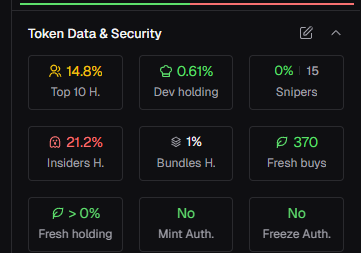
You check none of this by reading code. Paste the CA into rugcheck.xyz and it reports LP lock-or-burn status, mint and freeze authority, top-holder concentration, flagged insider networks, and a risk score. Seconds, free. And the big trading terminals (Axiom, Photon, GMGN) now print the same flags right next to the buy button, so refusing to look takes more effort than looking.
A CA pasted into rugcheck.xyz: score GOOD, no risks found; note the LP Locked line at 94.68% and the mint authority already gone.The same paperwork printed next to the buy button in a terminal: mint and freeze authority both "No," bundles at 1%, snipers and insiders already counted for you.
Two honest caveats. A clean paperwork check is a floor, not a recommendation. Most coins with perfect paperwork still die of neglect. And a passing scan doesn't rule out the softer kill: a team quietly holding half the supply doesn't need to pull liquidity. They just sell. Which is exactly where this chapter is heading.
Thirty seconds of paperwork beats a lifetime of "I got rugged."
Where coins are born: launchpads and graduation
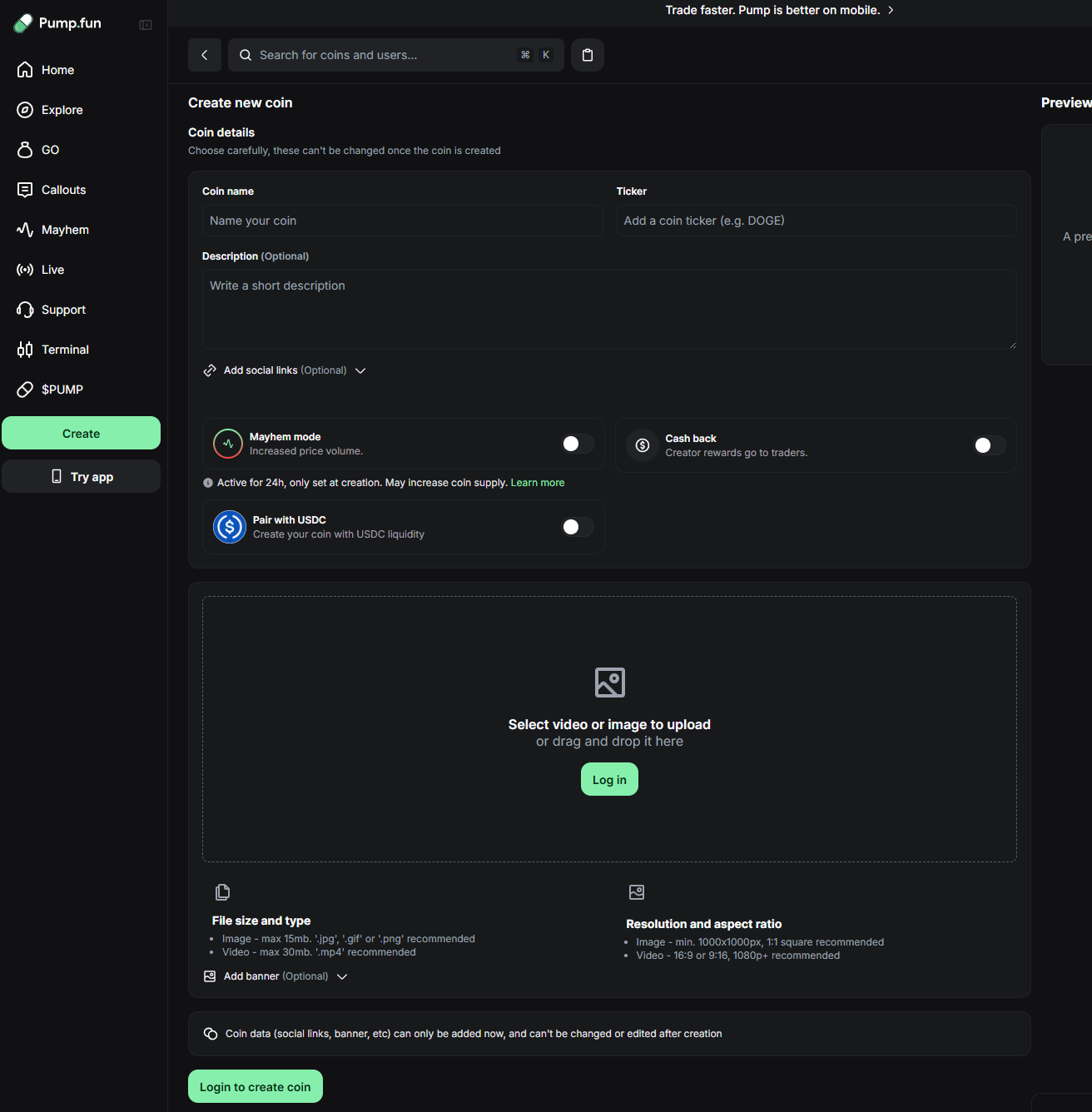
A few years ago, launching a token took technical skill. Now a launchpad (pump.fun is the giant, with challengers like LetsBonk grabbing the crown for a stretch in 2025 before pump.fun took it back) lets anyone create a coin in minutes for a few dollars: name, ticker, picture, live. The result is a firehose: tens of thousands of new coins a day as of mid-2026, with single days clearing 40,000, nearly all dead within hours. Not exaggeration; the base rate of the trenches.
The entire barrier to entry, pump.fun's create form: name, ticker, picture, launch. This is all it takes to put a coin on-chain.
New launchpad coins don't start with a liquidity pool. They start on a bonding curve: a pricing formula built into the launch contract itself. Picture the club's membership drive: the first seats are cheap, and every seat sold makes the next cost slightly more, on a schedule fixed in advance. Buy from the curve, price steps up; sell back to it, price steps down. No pool yet, no LP to pull. On the major launchpads the curve contract itself holds the money and the creator has no key to withdraw it, which gives this stage its own strange safety: the classic pull-the-pool rug can't happen while a coin is still on the curve. Don't relax. A creator sitting on a fat slice of supply can still dump it into the curve and leave you holding the bag (same funeral, different paperwork), which is why the bundle checks coming up apply from a coin's first minute of life.
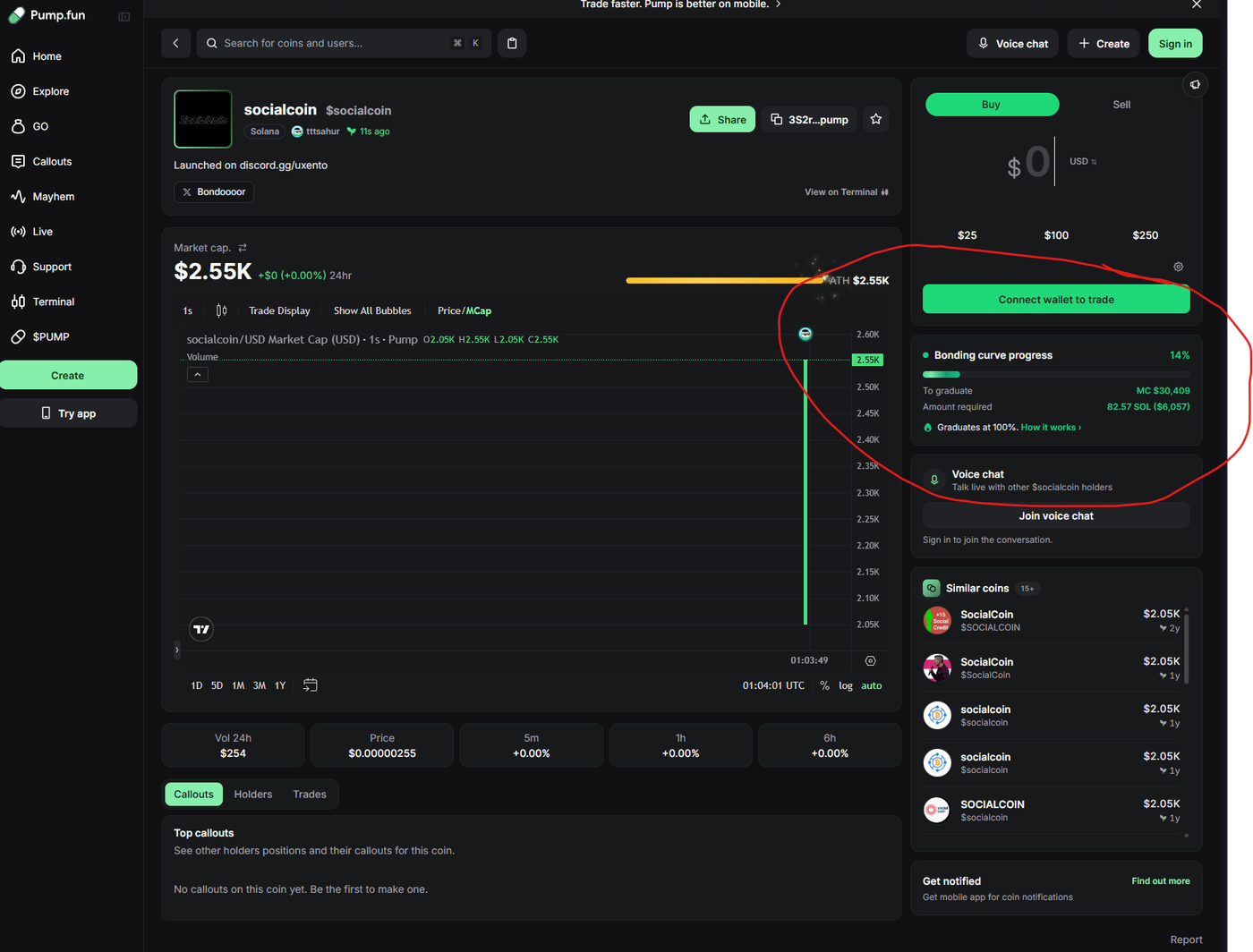
A pump.fun coin eleven seconds old; the circled panel is the bonding curve: 14% along, 82.57 SOL of net buys short of graduating to a real pool.
If enough people buy the curve to the top (on pump.fun, around a $69,000 market cap as of mid-2026, roughly 85 SOL of net buys), the coin graduates: the money raised is deposited into a real liquidity pool on PumpSwap (pump.fun's own DEX; graduations went to Raydium in the early days), the LP is burned automatically, and the coin begins its adult life as exactly the kind of pool-traded token this chapter has been teaching. Graduation is a real milestone (the coin survived infancy, which fewer than one coin in fifty ever does), and it changes the mechanics you're trading, so always know which stage a coin is in before you touch it.
The road every launchpad coin walks, drawn with pump.fun's numbers. The oxblood stretch is the rug window: no burned LP exists yet, and a creator sitting on a fat slice of supply can dump it on you at any marker. The window closes at mile 4, when the raised SOL moves into a real PumpSwap pool and the LP is burned. Fewer than one coin in fifty ever gets that far.
The launchpad era removed the technical barrier for honest degens and scammers alike. Same tool, same three minutes. Which brings us to the big one.
Every coin is born broke. Watch who feeds it first.
Bundling: the big one
If you learn one defensive skill from this book, make it this one.
Bundling is when the people behind a launch buy a large share of the supply themselves, at the very start, across many wallets, often in the same transaction that creates the coin. One team, forty wallets, half the supply, secured in the first second. To the naked eye the coin looks organically distributed. On-chain, it's one hand wearing forty gloves.
Before you treat every bundle as a crime scene: bundling is a tool, not a verdict. Legitimate teams bundle to hold treasury supply, to stop snipers (bots that mass-buy every new launch) from owning the coin instead, or to give a market maker inventory. Some of the best coins you'll ever trade had a bundled launch. The question is never "is there a bundle?" On today's launchpads there almost always is. The question is "what does it intend to do to me?" Held, vested, transparent supply is a team. Hidden, fresh-wallet, poised-to-dump supply is a trap.
How the trap works: a hypothetical, start to finish
Everything here is invented: no real coin, no real person. I'm building a scam in front of you so you recognize the pattern, because you'll see this exact movie, with better production values, in your first week in the trenches.
A developer launches $HEIRLOOM: "old money for the new generation," decent logo, website in an hour. In the launch transaction he buys 60% of the supply through 40 wallets he funded the day before, for a few hundred dollars of SOL. He spends $2,000 on mid-tier influencers ("organic gem, dev is based, LP burned") and points a volume bot at the chart so the coin trends on the scanners.
Retail arrives. The chart only goes up. Of course it does; 60% of the supply can't sell yet, because he is the 60%. Market cap sprints from $40k to $900k in two hours. Telegram is euphoric.
Then the 40 gloves squeeze. Not one dump: a cascade, wallet after wallet, faster than the pool can absorb. The developer clears roughly $400,000 of other people's money. First sell to flatline: about four minutes. The chart didn't crash because the crowd changed its mind. The crash was built into the fucking floor plan. The buyers just hadn't read it.
The detail that should actually bother you: every part of that plan was visible on-chain before retail bought a single token. The 40 wallets, their shared funding, their zero history, the bot rhythm in the volume. Nobody looked. Looking takes five minutes. Here's where to look.
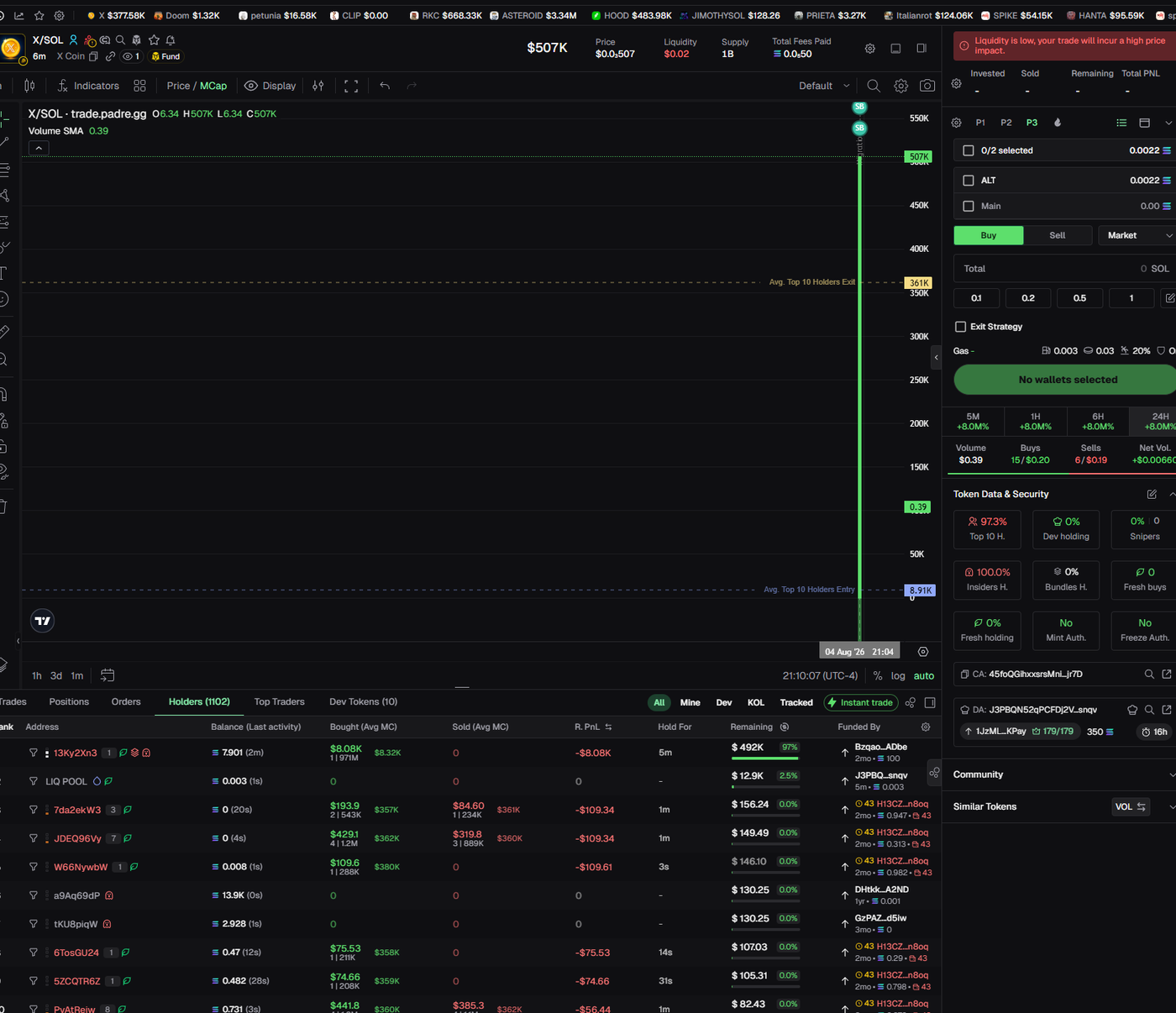
The trap, live in a terminal: top 10 holders at 97.3%, insiders at 100%, $0.02 of liquidity under a $507K chart; the app is printing the warning in red and people still buy.
The detection toolkit
Run this before any meaningful buy. All thresholds are my working defaults: tripwires that make you look closer, not laws.
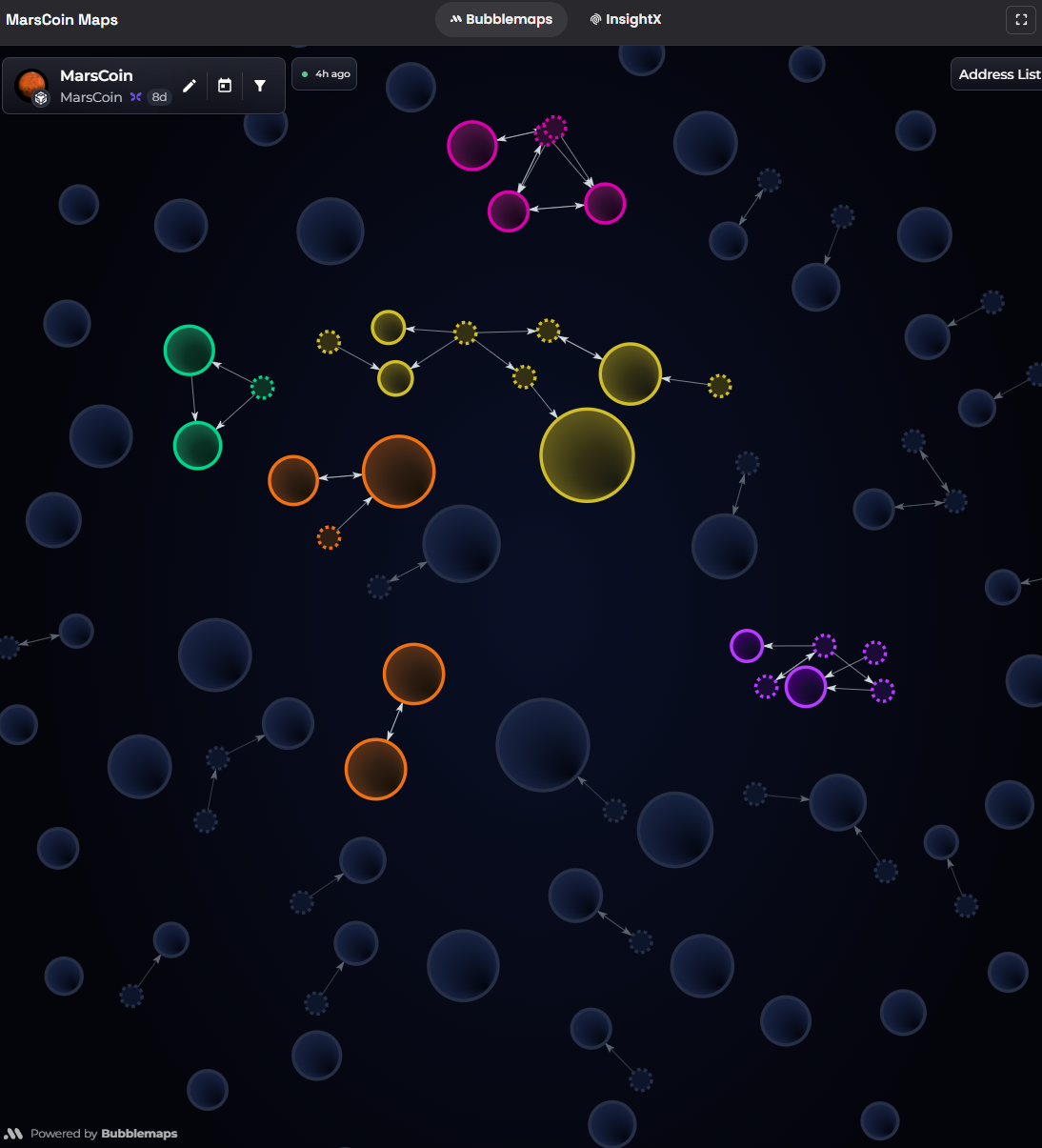
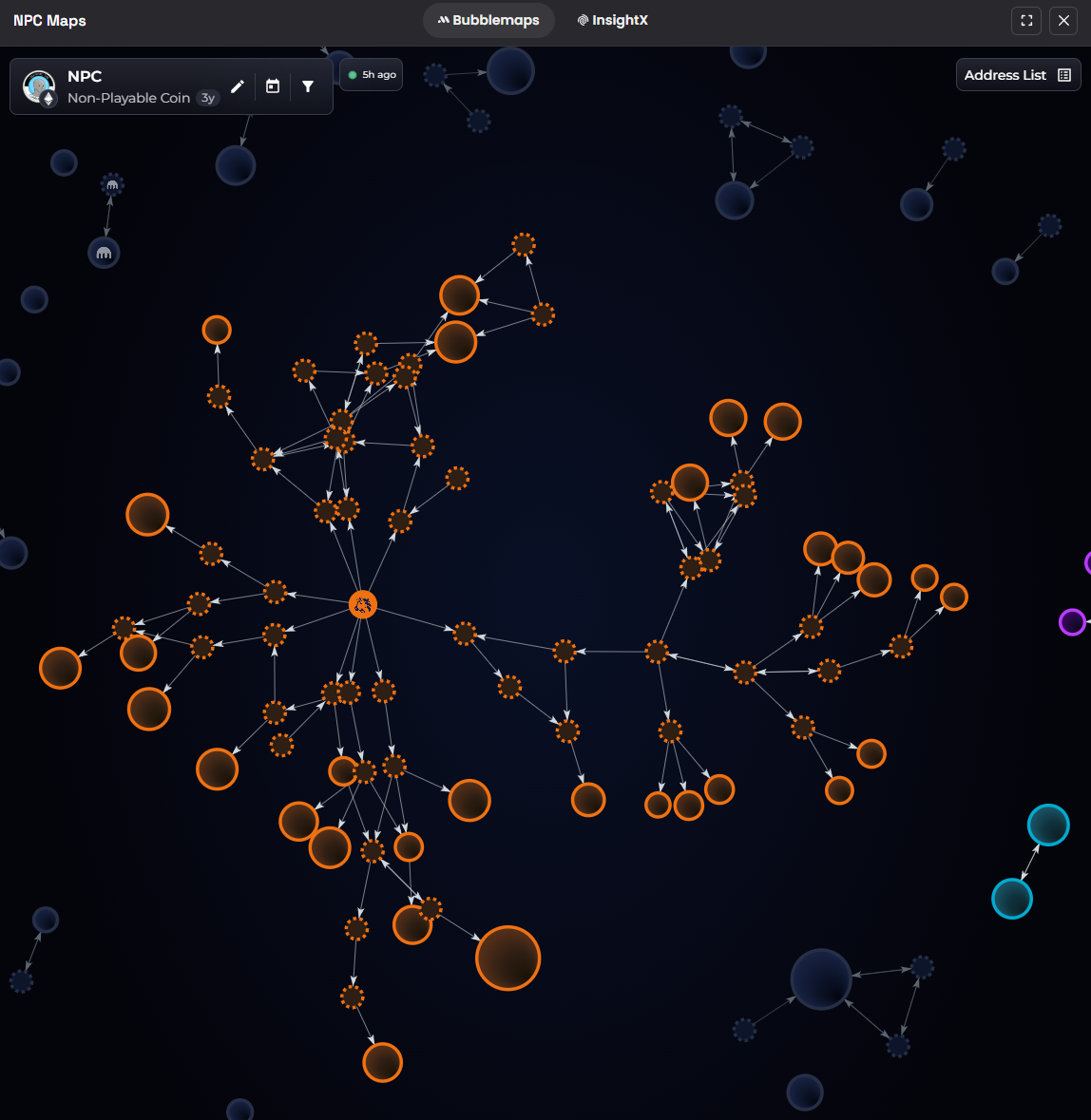
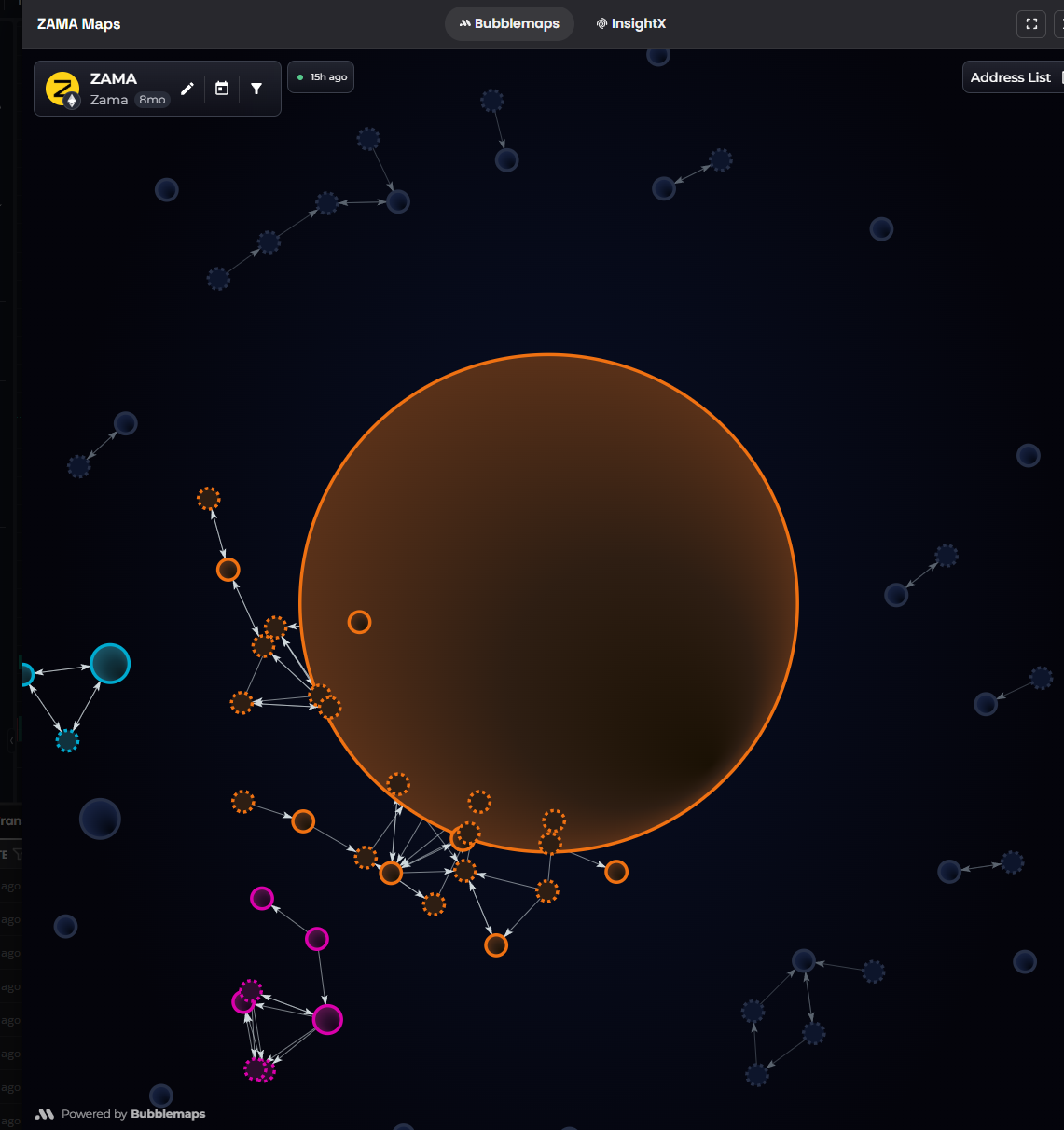
Holder map: Bubblemaps. Paste the CA into Bubblemaps (the basic map is free, and Solana is its busiest chain): wallets as bubbles, transfers as lines. Scattered bubbles are organic. A web of connected ones is a cluster: one owner, many gloves. Clusters holding 10-15% or more of supply: treat as one whale that can exit at once.
What organic looks like: scattered bubbles, a few small clusters of three or four wallets each, nothing that can exit as one.What a bundle looks like: dozens of wallets wired into a single web. One owner, many gloves, whatever the holder count claims.The other failure mode: a single wallet so large it dwarfs the map, with linked clusters feeding it, one decision away from being everyone's exit.
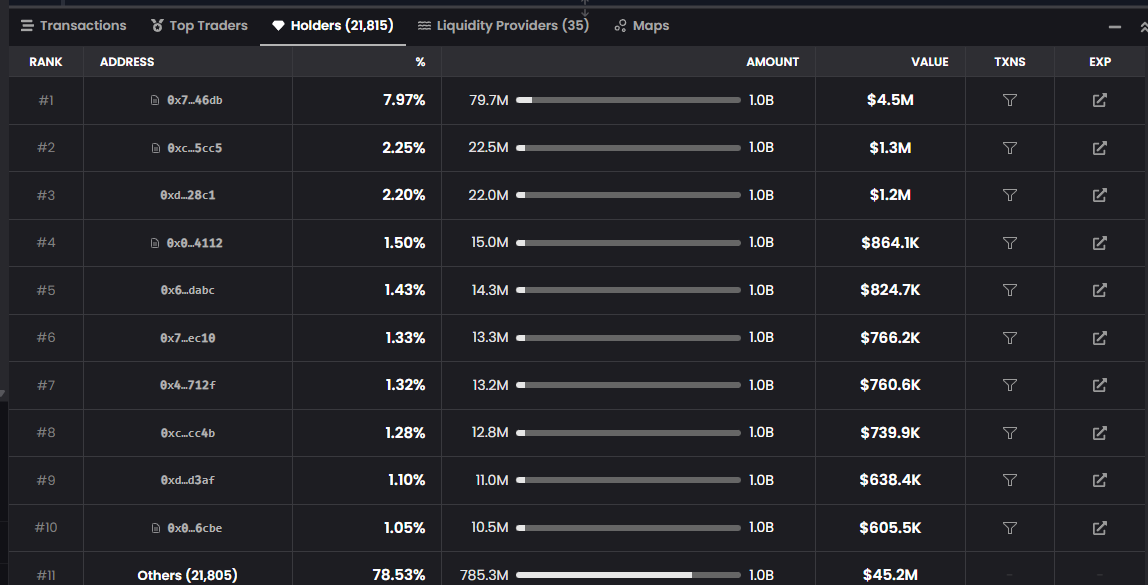
Top-holder concentration. Exclude the pool, then add up the top 10 holders. Over 25-30% in ten wallets can end the coin in one coordinated move. The trading terminals draw their own red line at about 30%, and so do I.
The top-ten check in one glance: these ten hold about 21% between them, under the 30% red line, while 21,805 other wallets hold the rest.
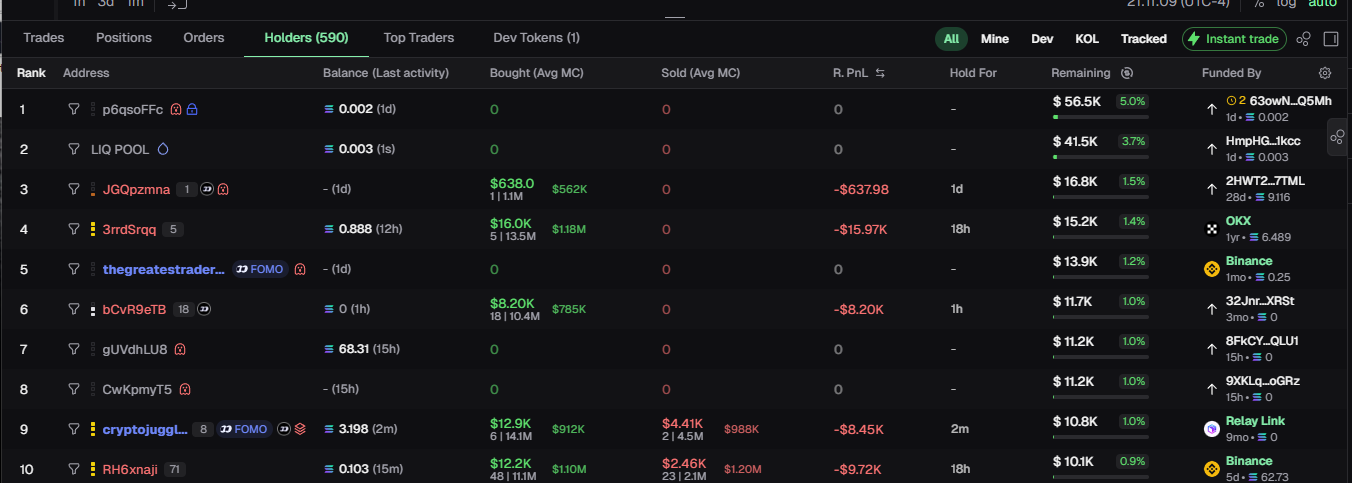
Wallet age. Click into the biggest holders. Wallets created this week, funded once, no history before this coin, all buying in the first minute: not a community, a costume. Real early buyers have months of messy, human history.
A terminal's holders tab shows every wallet's age and funding at a glance: a year-old OKX wallet, a nine-month Relay wallet, messy varied history. This is what human looks like.
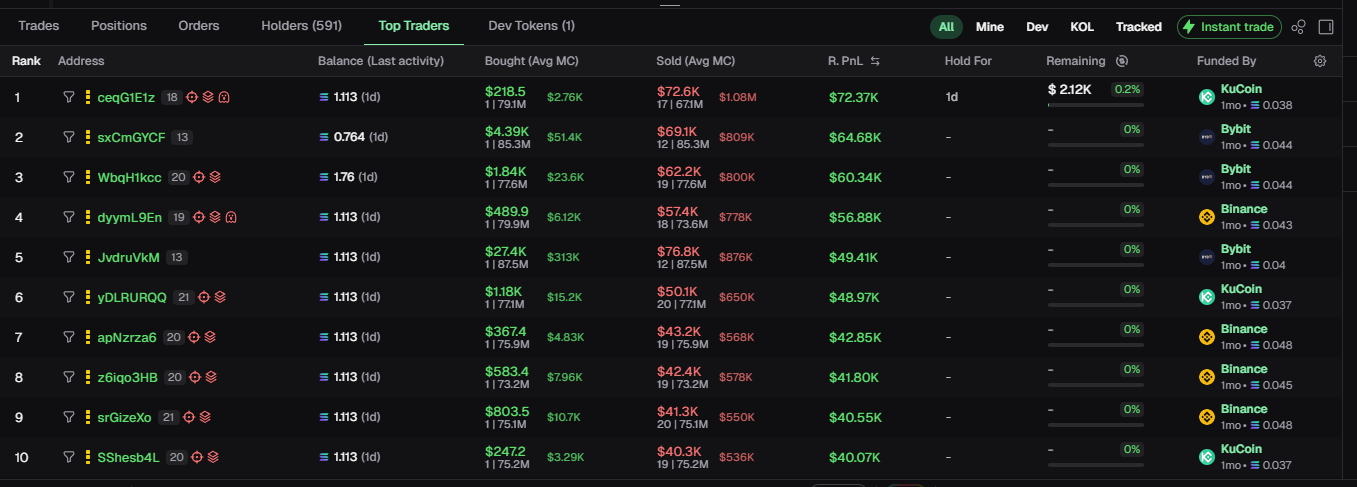
Funding origin. Follow each big holder's money one hop back. Ten "independent" wallets funded from the same source, or from the same exchange within minutes of each other, are one person. This single check unmasks most amateur bundles.
Ten "independent" top traders: all funded a month ago from the same three exchanges with matching ~0.04-SOL deposits, most holding an identical 1.113 SOL balance. One hand, many gloves.
5. **Chart rhythm.** Bots are regular; humans aren't. Identical candles in a smooth staircase, volume with a metronome pulse, round-number buys at fixed intervals: botted. Organic charts are jagged, bursty, ugly.
6. **Volume-vs-mcap sanity.** A genuinely hot young coin can trade its whole market cap in a day. But 24h volume running at several multiples of the cap (call it 5× and up) while the holder count barely moves is wash trading. Volume that doesn't create new holders isn't demand, it's choreography.
Two coins, each drawn against its own market cap: the young graduate turns over 1.5× its cap in a day while new holders keep arriving, and the $10M headline trades $150K — a ballroom with nobody in it. Volume that mints new holders is demand; a big cap without volume is scenery, and volume at many times the cap without new holders is a bot.
7. **Fees paid at entry.** Check what first-block buyers paid in priority fees (the tip that jumps the queue on Solana). Humans pay ordinary fees; coordinated snipers pay big tips to guarantee first position. A first wave of outsized tips means the launch was claimed, not discovered. Solscan shows the fee on any transaction you click into, and terminals like GMGN and Axiom tag known sniper wallets and show how much of the supply the first blocks took.
Five minutes, all free, all public. The scam in my story fails checks 1, 3, 4, 5, and 6 before a single influencer tweet.
A bundle isn't a red flag. A hidden one is.
A worked read: putting the whole chapter on one coin
Let me run the full sequence once so you see how it feels. This is illustrative: a composite with invented numbers, not a real coin, because any real example would be stale before this book reaches you. The pattern is what you're learning, not the ticker.
A coin graduates from its launchpad and starts trending. The read, in order. Paperwork: LP burned, mint and freeze revoked, no honeypot flags. Floor passed. Depth: $1.8M market cap against $180k liquidity, right at 10%: healthy; a $2k position is ~1.1% of the pool, exitable. Holders: top 10 hold 19% excluding the pool; Bubblemaps shows two small linked clusters at ~6% combined, disclosed as team treasury. Noted, not disqualifying. Wallet age: several large holders have months of prior history. Human. Chart and volume: jagged, bursty candles; 24h volume roughly 1.5× market cap with holder count climbing. Demand that mints new holders is real demand. Verdict: structurally clean, a coin you're allowed to consider. Whether you should belongs to the next chapter, because structure tells you a coin is safe to touch, never that it will go up.
Who still loses
The honest counterweight. Everything above filters scams; none of it picks winners. Most structurally perfect memecoins still go to zero, because nobody ever cared, and in this market attention is the only fundamental. Most memecoin traders lose money. The checklist's job is to make sure that when you lose, you lose to the market (a fair fight you can learn from), not to a mechanic, which is just a mugging you funded. This chapter's promise is narrow and I'll keep it: nothing in this book stops the market from beating you. It stops the machine from doing it first.
The recap
Price is the ratio of a pool's two trays: every buy tilts it up, every sell tilts it down, mechanically.
Buy by contract address, never by ticker; guard your seed phrase like the vault key it is.
Slippage is a tax you cap yourself: above ~20% to fill, walk away.
Market cap is the headline; liquidity is the exit. Check the ratio and size to the pool.
Before any real buy: paperwork check plus the seven-point bundle scan. Five minutes, every time.
The machine never hides the rules. It just waits to see who bothered to read them.
Next, chapter 3, Coin Types & What Makes Them Move: now that you know how every coin trades, you need to know why only some of them ever do.
CHAPTER THREE
Coin Types & What Makes Them Move
Early in Solana's memecoin era, I put real money into a picture of a dog wearing a knitted hat.
Say that sentence out loud at a normal dinner table and watch the faces. A cartoon dog. A pink hat. No product, no company, no revenue, no CEO. By every rule you were ever taught about money, it was worth nothing.
I bought $WIF around a 30 million market cap (chapter 2's headline number, call it "mcap" from here on; the market's total sticker price for the joke). I held it while that number climbed into the billions. The dog in the hat paid me around 300k, and along the way it outperformed almost every stock on Earth.
Before that number does anything to your pulse, hold the other side of it: the same months that produced $WIF produced thousands of other dog coins, and nearly all of them went to zero. You're hearing about the survivor. The graveyard doesn't post.
So the question that should be bothering you is why. Why does one jpeg of a dog become worth a billion dollars while a nearly identical jpeg dies at 50k? There's no balance sheet to compare. No earnings call. Nothing your economics teacher would recognize as value.
The answer is the most important idea in this entire book, so it gets its own line:
A memecoin is worth exactly the attention it holds. No more, no less.
This chapter gives you that thesis properly, then a working map of the seven kinds of coins you'll actually meet, and what makes each one move. By the end, you'll be able to look at any coin and answer the only two questions that matter: what kind of attention is this, and how long does that kind last?
The Table
In chapter 1, I welcomed you to the table. Now let me tell you what the table actually is.
Every coin is a private table in a loud restaurant. The meal served at that table is attention: eyeballs, posts, jokes, belief, volume. While attention flows to the table, everyone seated eats: the price climbs, and every remaining seat gets more expensive. When attention leaves, and it always leaves eventually, the kitchen closes, and whoever is still seated gets handed the bill.
There are exactly two ways to get a seat. You can arrive early, when the table is cheap and half-empty and looks a little sad, and there's a real chance the kitchen never opens at all. Or you can pay up for a seat late, when the table is famous and the room is packed. And everyone already seated is quietly deciding when to stand up. Because here's the part nobody says out loud: your money buying that late seat is their meal.
In plain terms: early money gets paid by late money. That is the entire machine. Every coin type in this chapter is just a different method of gathering the crowd.
The seat math
Here's a worked example, because the arithmetic is more brutal than people realize.
Say you put $1,000 into a coin at a 30 million market cap, and that coin runs to 3 billion: a 100x. Your $1,000 becomes roughly $100,000 on the screen. (Before slippage, fees, and the very real difficulty of selling size into a thin market, you never capture the poster number. Chapter 2 already warned you.)
Now say you find the same coin late, at 1.5 billion, because that's when it finally reached your feed. The identical run to 3 billion pays you a 2x. Your $1,000 becomes $2,000. Same coin. Same story. Same screenshots going around. One seat paid 100 to 1. The other paid 2 to 1.
And for the late seat to hand you a 100x, the coin would need to reach a 150 billion market cap, larger than almost every asset in crypto's history. The market does not contain enough money to pay every late buyer's dream. When you buy late, your upside isn't smaller because you're less smart than the early buyer. It's smaller because of arithmetic.
Now the mandatory counterweight: the early seat is cheap because it deserves to be. At 30 million, the overwhelming majority of coins die. The discount is the danger. Nobody sells you 100x upside at low risk. What's on sale at 30 million is a bet that usually fails, and the whole craft of chapters 4 through 9 is learning to take that bet only when the evidence stacks in your favor.
One more instrument before the taxonomy. Every narrative (the story that gives a coin its reason to be bought) runs on what I call the Narrative Clock, and the clock only has four hours on it: early, loud, late, dead. Early is when you still have to explain the joke to people. Loud is when the joke explains itself. It's on timelines you don't follow and in group chats you're not in. Late is when people who never buy anything start asking about it. Dead is the silence afterward. Every coin type below is really just a different clock speed. Before you ask anything else about a coin, ask: what time is it on this narrative?
Attention is the only fundamental. Everything else is decoration.
The seven coins you'll actually meet
The whole taxonomy on one table. Left is pure attention and a fast clock; every step right adds a pathway for attention to become price, and buys you the right to hold longer. The tag under each name is your hold behavior, and the oxblood table is the one you walk past.
1. Viral and animal coins
The purest form of the game. A meme catches (a dog, a cat, a hippo, a frog, a face) and a coin bottles it. Dogecoin started the whole lineage in 2013 as a literal joke between two developers. The modern era runs through $WIF (the dog in the hat), $POPCAT, $MOODENG (named for the baby hippo that went viral), and whatever went viral the week you're reading this. And here's the current standing of those three famous names, because it teaches the category better than any rule I could write: as of mid-2026, all three trade more than 90% below their 2024 peaks. Even the ones that made it fade when the reposts stop.
This is what the birth of a viral coin actually looks like: a Thai zoo posts a baby pygmy hippo, 6.4 million views and 16,000 reposts follow, and $MOODENG exists to bottle it.
The attention source is the meme itself, which means the coin moves at the speed of reposts. This is the fastest clock in the market: most viral coins live and die inside a week, many inside a day. A tiny minority graduate into the aristocracy (community coins, category five) when their holders stop treating the joke as a trade and start treating it as a flag.
The repost engine up close: one account that translated the zoo's Thai posts claims close to 100 million impressions in five weeks; that firehose, not the hippo, is what the coin was actually pricing.
Rule: on a fresh viral coin you are trading the meme's velocity, not its value. When the reposts slow, the candles slow. Nothing moves faster on the way up, and nothing moves faster on the way down.
2. Celebrity coins
A celebrity launches or endorses a coin and the attention arrives pre-packaged: their followers. It sounds like a cheat code. It's usually a trap.
Celebrity attention is rented, not owned. It lasts exactly as long as the celebrity keeps posting, and celebrities have short attention spans and good lawyers. The case study the whole market watched: $HAWK, the "Hawk Tuah" coin, ran to roughly a 490 million market cap within minutes of its December 2024 launch and collapsed more than 90% within hours, down to around 40 million, with blockchain analysts pointing at heavily concentrated insider supply. Smaller versions of that chart print every single week.
So here's the hard rule: celebrity coins have no lasting floor (a floor is the price level where buyers reliably step back in). Nobody's identity lives in the coin. The fans came for the person, not the ticker, and when the person stops posting, the bid simply disappears. If you touch one at all, you are trading the announcement (minutes to hours), and if you heard about it from the announcement, you're already late on the clock, which means you're not the customer at that table. You're the meal.
$TRUMP in January 2025 was the extreme edge of this category, celebrity attention at world-event scale, and I traded it; that story belongs to chapter 9. But note this now: even that coin, which topped above $70 within two days of launch, sits around 98% below that high as of mid-2026. If the loudest launch in memecoin history couldn't hold its high, the coin your favorite streamer launches on a Tuesday won't either.
3. Team and bundled coins
Behind door three: coins launched as a business by a team that controls the supply. Often the supply was bundled at launch: insiders buying a large share through many wallets in the first block, dressed up to look like organic demand. You learned to detect this in chapter 2; this is where the detection pays.
The model is simple: manufacture the appearance of a crowd. That means paid KOL posts (KOLs, "key opinion leaders," crypto influencers; chapter 5 covers them), coordinated shilling, wash-traded volume. Then sell real coins into the real buyers the appearance attracts. Not every team is a smash-and-grab; a few operate for months, market properly, and let the coin breathe. Many close the shop within the hour.
Rule: when insiders own the float, you're not early. You're scheduled. The chart moves when the team decides it moves. Check the holder distribution before entry, and size the position like the team could leave at any minute, because they can.
4. Community takeovers (CTOs)
Sometimes a dev rugs or abandons a coin and, instead of dying, the coin gets adopted. The community takes over the ticker (new socials, new mods, sometimes a new dev) and runs it themselves. The scene calls this a CTO (community takeover).
The grand ancestor of the category is Dogecoin itself: its founders walked away years before it ran into the tens of billions in 2021. The most valuable abandoned coin in history. Solana's trenches now produce CTO attempts weekly, and the cleanest case on record is $POPCAT: the original dev turned on his own holders, threatening to deface the token's metadata unless he got paid, so an artist known as Jpeggler bought the token's update and social rights off him for 35,000 USDC while the coin sat under a 100k market cap, then handed the keys to the community. That abandoned cat went on to become the first cat coin to cross a billion-dollar market cap. The dev sold his leverage for 35 grand; the holders he abandoned built the billion.
Why a CTO can work: the biggest future seller, the dev with the bag, is already gone. Why most fail anyway: a community without a leader is a committee, and committees lose marketing wars against teams who do this for a living.
Rule: never buy the announcement of a takeover. Buy evidence it worked: new holders still arriving weeks later, volume that persists without a push, output you can see from the new crew. A CTO's clock restarts slowly or not at all.
5. Community coins: the long game
This is the aristocracy of the memecoin world, and the category closest to my heart, because it's where I learned what holding actually means.
A viral coin becomes a community coin when the holders' identity fuses with the coin. You can see the moment it happens: profile pictures change. Rituals form. Lore accumulates. The coin stops being a trade people are in and becomes a flag people carry. And belonging doesn't check the chart before it posts, which is exactly what makes the attention durable.
The flywheel that separates a flag from a trade: holders post, posts pull impressions, impressions pull new buyers, and buyers who plant the flag become new posters. Nobody is paid to keep this turning, which is exactly why it keeps turning.
$WIF became that. The hat went up on thousands of profile pictures. The community crowdfunded nearly $700k of its own money, in a matter of days, just to put the dog on the Las Vegas Sphere. The ad never actually ran (the Sphere's side denied any deal was ever signed, and after about a year in limbo the organizers gave up and refunded the money), but that's almost beside the point. Strangers wired 700 grand to put a hat on a building. That is not trading behavior. That's belonging behavior.
I found $WIF the way I found most of my winners: by being online when it happened, early in Solana's memecoin run. I entered around a 30 million market cap and, for the first time in my life, I held a coin the whole way up. Not a scalp, not a double-and-out. The full ride, into the billions, for around 300k realized.
And I'll tell you what the ride actually teaches, because no chart in hindsight shows it. At every doubling, a voice tells you it's over. At 60 million: "you just 2x'd, take it." At 300 million: "this is a bubble inside a bubble." Every green week recruits sellers; every red week recruits doubters; a community coin's chart is a running argument between the people leaving and the people arriving. I won't sell you a trick for sitting through that, because I didn't have one. This was my first time, and the ride itself was the teacher. What it left me with is exactly what I'm trying to hand you in this section: I know now what a real community coin feels like on the way up, because I held one all the way through it. Holding a winner the whole way is the hardest fucking skill in this game, and I only learned it by doing it once, live, with real money.
$PEPE taught me the companion lesson. I entered at around a 120 million market cap, with size, after it had already run hard from launch. On a viral coin, 120 million is usually the after-party. On a real community coin, it was a second seating: $PEPE went on into the multi-billions. You don't need the bottom. You need the right type, and time left on the clock.
Now both counterweights, because two wins in a row is exactly when you should get suspicious of me. First: those are the two that worked. Most coins that look like community coins at 30 million are just viral coins with good manners, and they die like the rest. Second: every billion-dollar chart you've ever admired is built out of drawdowns that felt like the end; 40, 50 percent drops are standard fare on the way to the top, not a sign you were wrong. Which produces the sizing rule: only hold for the long game what you deliberately sized to watch get cut in half without selling. If a 50% drop would make you sell, your position is too big for this category. You'll be shaken out at the exact moment the real holders are proving the flag is real.
6. Utility coins
Some coins bolt an actual pathway to value onto the attention: fees (the project earns real revenue), buybacks (that revenue purchases the coin on the open market, a constant buyer under the price), and burns (coins destroyed permanently, shrinking the supply forever).
Real examples from the current era, as of mid-2026: Banana Gun's $BANANA pays 40% of the bot's trading fees to anyone holding at least 50 tokens, dropped automatically every four hours; BonkBot charges 1% per trade and routes 10% of those fees into buying and burning $BONK; and pump.fun has 50% of its net revenue locked into a contract that buys back and burns $PUMP, after torching roughly $370 million of supply in a single burn in April 2026.
Why this matters: a verifiable fee stream is a reason to hold that isn't purely social. Attention still rules the short-term price (a productive coin nobody talks about still bleeds), but there's a spring under the price that pure memes don't have.
Now the trap, and read this twice: "utility" is the most abused word in crypto. A roadmap is not revenue. A promised buyback is not a buyback. Teams learned years ago that the word utility pumps a chart as well as the real thing, for a while. Rule: if you can't verify the fees on-chain yourself, the utility is a costume, and you should classify the coin as a team coin wearing it.
7. Ownership-style coins
The newest branch: tokens explicitly framed as owning a piece of something (a share of an app's revenue, a claim on a treasury, a "stake" in a brand). It reads like stock. It almost never is stock. In most cases what you actually hold is a claim on the team's continued goodwill, not an enforceable right to anything. And the whole category sits in a securities-law gray zone that lawmakers and regulators were still arguing over as this book went to print. I'm deliberately not naming names in this category: any specific coin I bless here could be a lawsuit or a dead link by the time you read this.
Rule: read exactly what the token entitles you to, in writing, from the team's own documents. If the honest answer is "nothing enforceable," then classify it as a utility coin at best, and price the trust like the fragile thing it is.
One narrative, fifty costumes
When a narrative catches (a hippo goes viral, an election lands, an animal does anything on camera), one coin doesn't launch. Fifty launch, within hours, all wearing the same costume, all fighting over the same pool of attention. The trenches call this vamping (community slang: latching onto a narrative someone else generated and trying to drain its blood). Here's what a narrative catching looks like in the wild:
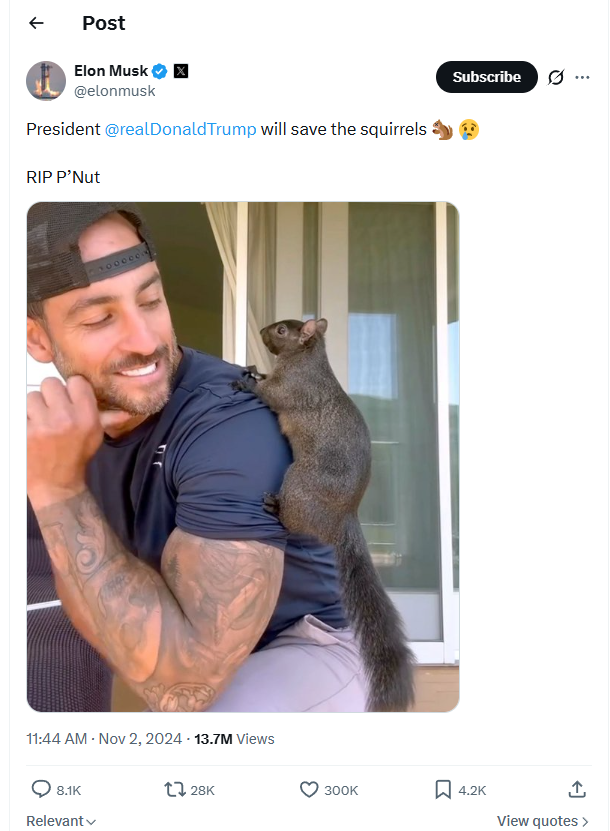
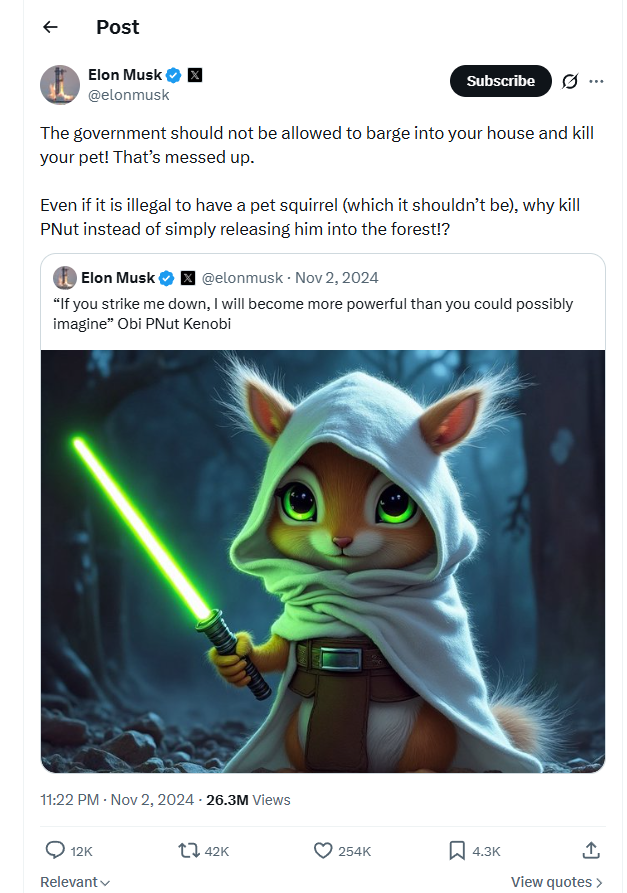
November 2, 2024: New York authorities put down a pet squirrel named Peanut days before the election, and Elon Musk folds it straight into the campaign. 13.7 million views on this post alone.Same day, same account, 26 million more views. An animal colliding with an election is exactly the kind of attention detonation that launches fifty tickers in an afternoon, and $PNUT was the one table that won the crowd.
Your job is to find the real one or stand aside. Four checks:
First is not automatically real. The first contract deployed has a head start, but attention consolidates: the winner is wherever holders, liquidity (the actual money in the pool that lets you sell; chapter 2), and a community form fastest.
Watch the consolidation, not the launch. Within 24-48 hours, one ticker usually owns the overwhelming majority of the narrative's volume. Search the narrative on Dexscreener, sort by volume, and watch which coin the flow keeps choosing.
Verify on-chain what the loud accounts actually hold. Posts are free; positions aren't. Chapter 6 teaches you to follow wallets.
The runner-up is not a discount. "The second-biggest coin of the narrative" is a machine for converting FOMO into donations. The narrative can be worth a billion and the copy still dies. The crowd only needs one table per joke.
One narrative, one winner. The rest are costumes.
The hold-time table
The whole taxonomy compresses into one grid. This is the chapter, in furniture form:
Type
Attention source
Clock speed
Your hold
Viral / animal
the meme's velocity
days
hours to days
Celebrity
rented followers
hours
the announcement only, or nothing
Team / bundled
manufactured
whenever the team decides
small and fast, eyes on holders
Community takeover
grief plus hope
slow restart, if any
only after proof of life
Community coin
owned identity
months to years
months, sized for a 50% drawdown
Utility
fees plus attention
tied to revenue
while fees are verifiable and growing
Ownership-style
promises plus attention
untested
after reading the fine print, if ever
And the rules of thumb in their hardest form:
If you can't name a coin's type in one sentence, you can't hold it overnight.
The type sets the clock; the clock sets the hold. Holding a celebrity coin like a community coin isn't patience. It's a misdiagnosis with your money.
Ask the Narrative Clock before entry: early, loud, late, or dead. Late means the never-buyers are asking. Dead means don't.
One narrative, one winner. Trade the consolidation or trade nothing.
No type is exempt from the thesis. Fees, teams, takeovers: those are pathways for value. Attention is still the engine.
What goes wrong
The base rate first, because it belongs in every chapter of this book: most memecoins go to zero, and most people who trade them lose money. A taxonomy doesn't change that. What it changes is which mistake you make, and misreading the type is the most expensive unforced error in the game.
Misread in one direction, treating a viral coin like a community coin, and you'll hold a dead joke all the way down, telling yourself it's a "long-term play" while the attention that was the entire asset walks out of the room. I have held coins to zero for reasons I'll unpack properly in the psychology chapters; believe me when I say the ride down is slower and worse than you imagine.
Misread in the other direction, treating a community coin like a scalp, and you'll sell the 100x at the first 2x, then spend months watching the flag fly without you, which does its own quiet damage to your next ten trades.
And one honesty check on everything above: this taxonomy is easy to read in hindsight and hard to read live. Everyone can classify $WIF now. Classifying it at 30 million, in real time, against thousands of lookalikes: that's the actual skill, and no chapter installs it. Screen time does. Even then, a correct read still loses sometimes, because attention is a crowd, and crowds are weather.
So here's the synthesis, said plainly one more time: every coin type is the same thing wearing different clothes. Attention, plus a pathway for that attention to become price. The kind of attention decides how long it lasts, which means the type you're holding decides how long you should hold it. Buy attention early. Know which kind you bought. Let the kind, not your feelings, set the clock.
The recap
A memecoin is worth exactly the attention it holds. Attention is the only fundamental.
Early seats are cheap because they're dangerous; late seats are expensive because of arithmetic.
Seven types, one thesis: each is a different attention source running on a different clock.
Celebrity attention is rented; community attention is owned; "utility" only counts if the fees verify on-chain.
One narrative, one winner. Name the type before you size. The type sets your hold.
Old money doesn't chase. It arrives early and waits.
Next: chapter 4, Finding Trades: Building Your Desk, where coins like these actually get found before the crowd, and why you should never hunt alone.
PART II · TRADING
CHAPTER FOUR
Finding Trades
Building Your Desk
The best trade of my life was not sent to me. Nobody called it in a channel. No influencer put it on my timeline with a rocket emoji. I found it myself, doing the least glamorous thing in this entire business: being online when nothing was happening.
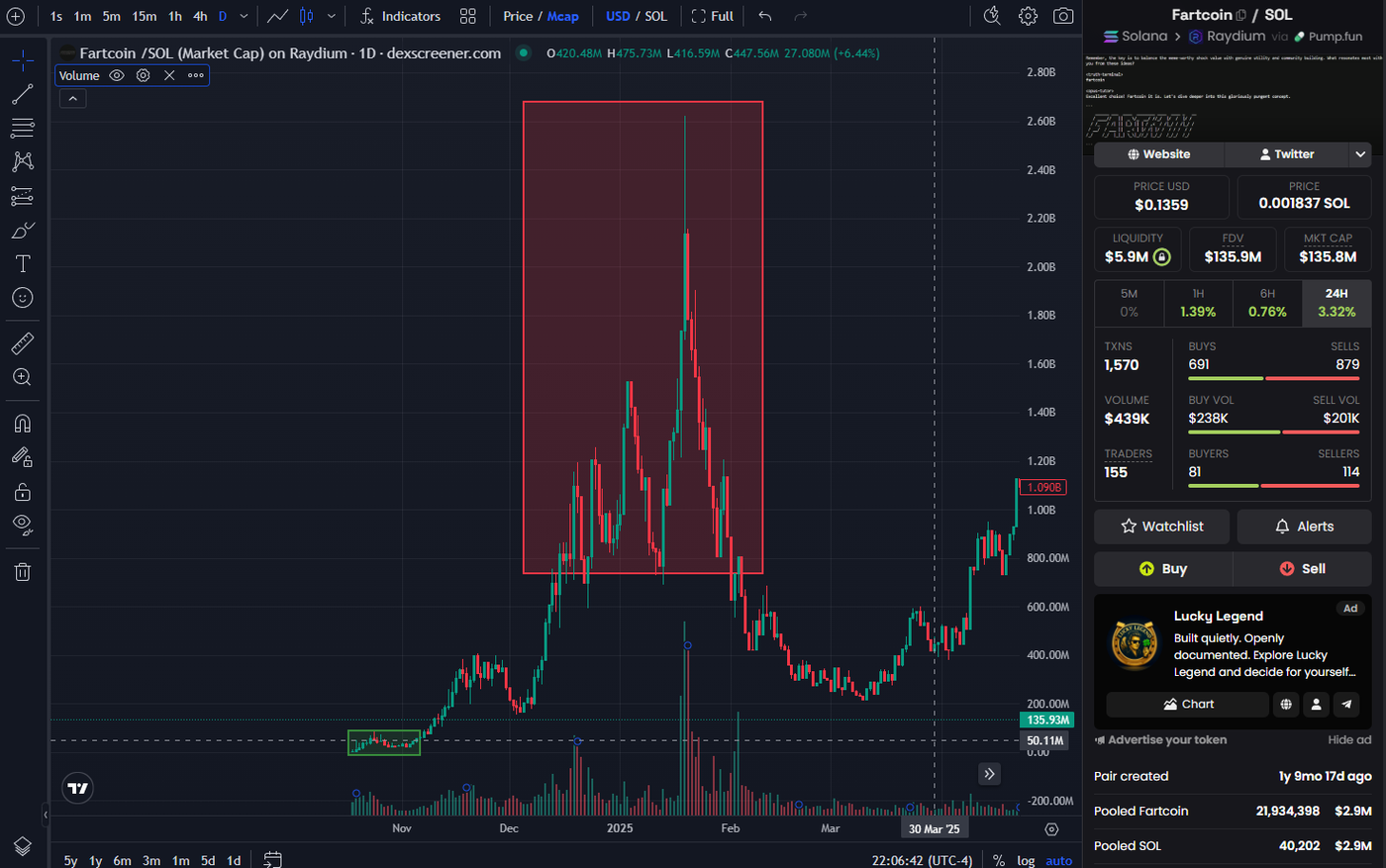
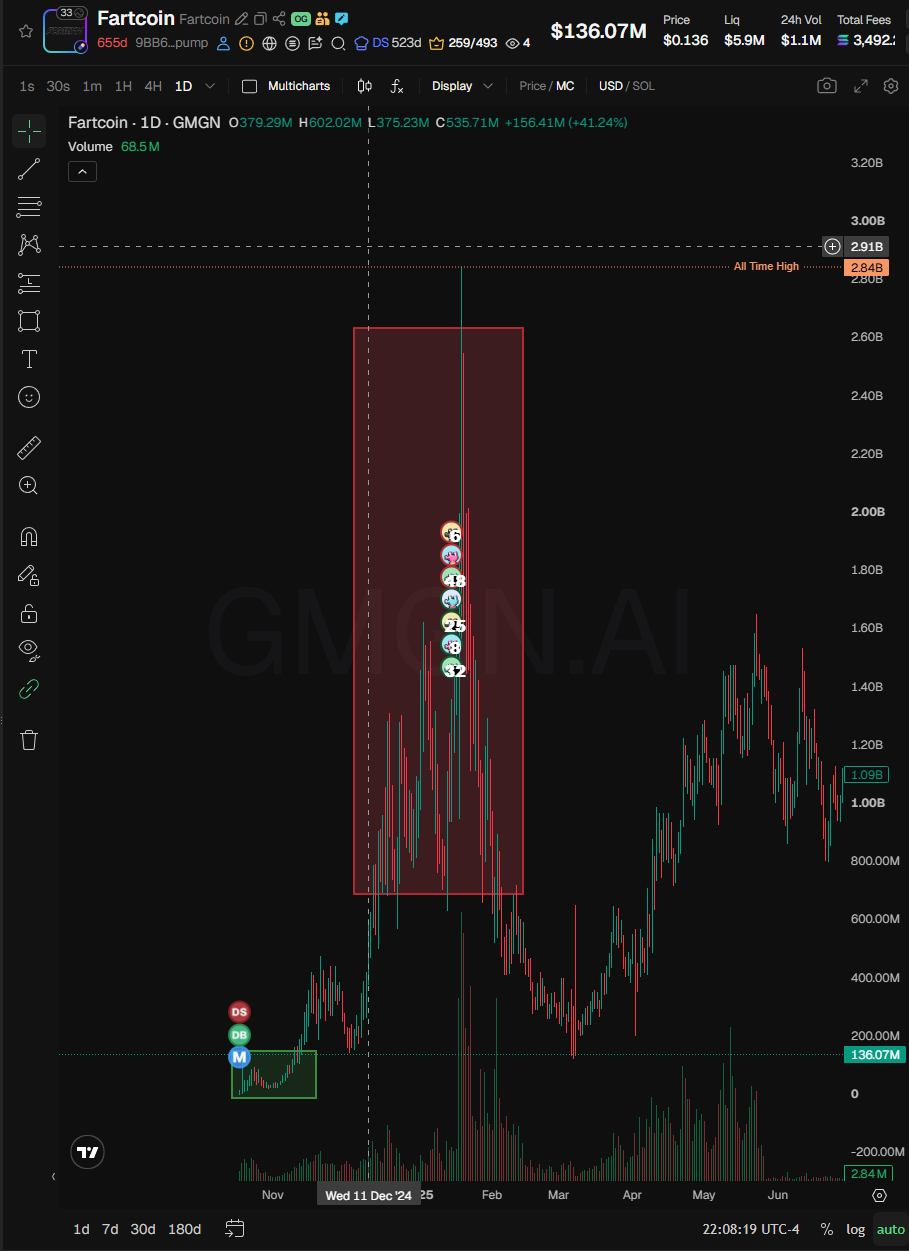
The coin was fartcoin. Yes, really. I found it when its market cap was somewhere between 200k and 2 million. A range, because I didn't buy once and pray. I bought, watched my thesis (my written reason for being in the trade, and we'll get to why written matters) prove itself, and bought more. I saw the narrative before the crowd did. I realized about 800k on that coin.
And before you print that number on the inside of your eyelids, hold it next to the ones from chapter 1: the 600k I lost on $MELANIA, the million I lost in a day on perps. I have losses as big as my wins. The 800k is not the lesson. The lesson is where the trade came from, because it came from the two things this chapter teaches: showing up, and having people.
Right place, right time is a skill. It's called showing up.
Where good trades actually come from
Every beginner asks me the same question: "where do you find these coins?" And they're always disappointed by the answer, because they're hoping I'll name a channel. A Telegram group. A Discord. Some room with a paywall where the winners are announced in advance.
That room does not exist. What exists instead, in every serious trading operation on the planet, from a bank floor in London to a group of kids on Solana, is a desk.
Picture an old trading floor. Not the movie version. The real furniture. A desk is four, five people sitting close enough to hear each other. One of them is watching the news wires. One is watching the order flow. One is on the phone. Nobody at that desk is smarter alone than they are together, and every one of them would be fired for trading on a rumor they couldn't source. The desk is not a chat room. It's a shared set of eyes with shared standards.
That's the model. Your job in this chapter is to build one, even if today you're a desk of one.
In plain terms: a desk is a small group of real traders who share information, check each other's reasoning, and cover more screen time together than any of them could alone. Small. Real. Accountable. Those three words are the whole framework.
Here's mine. In five years of trading I have never traded out of a big anonymous group chat. Not once. My desk was five friends from real life. None of them came to me as traders. I taught all five myself, one by one, and then they started trading next to me. Every one of them has gone on to make six figures and more. But the number isn't the part I want you to keep. The part I want you to keep is what we turned into: a crew catching plays together. We found coins for each other. We talked each other out of bad entries and into good ones. We covered hours: when I was asleep, someone was awake.
And notice the order of events, because it kills the best excuse in this chapter before you can reach for it: I didn't find my desk. I built it, out of five friends who didn't trade at all before I taught them. The desk you can't find is a desk you can teach into existence. (Five people making six figures in a market where most people lose is an outlier result, not a template: it cost years of shared screen time, and it exempts nobody at that desk from the base rate.)
I credit that circle with a real share of everything I've made. Not because they handed me winners. Because trading alone quietly makes you worse in ways you can't see. Alone, your bad ideas go unchallenged. Alone, your screen time has gaps. Alone, a loss has nowhere to go except around and around your own head at 4am.
Why 3 real traders beat 50,000 subscribers
Run the incentives and this stops being a mystery.
A big "alpha" channel with 50,000 subscribers has exactly one product: attention. The person running it does not make money when you win. They make money when you act: on promoted posts, on referral links, and, in the ugliest and extremely common version, on selling you their own bags. Think through the mechanics of a call in a huge channel: by the time 50,000 people have been told about a coin, who is left to buy it after you? You are the last chapter of that story. You are exit liquidity (the late buyers whose money pays out the early sellers). The caller isn't early with you. The caller is early because of you. You were never in a community. You were in a fucking queue.
Now run the same numbers on a desk of three.
Three real traders, each doing maybe six hours of genuine screen time a day, is eighteen hours of coverage: most of the clock, every day, watched by people whose incentives point the same direction as yours. When one of them sends you a coin, they gain nothing from your entry. Their coin doesn't pump because you bought 200 dollars of it. The only reason to send it is that they think it's good, and if it's not good, they hear about it from you tomorrow, and the day after, because you're not strangers. There's a cost to being wrong at a desk. That cost is called accountability, and it is the single most valuable thing no channel can sell you.
One more thing three people can do that fifty thousand can't: know you. A desk knows your position, your size, your tendencies. A desk tells you "you're chasing again." A channel tells you "next call at 8pm."
The math is lopsided and it never stops being lopsided. Three pairs of eyes with aligned incentives beat fifty thousand subscribers with opposed ones, every day of the week.
The desk from above: five pairs of eyes on the same coin, each seat catching the mistake the one next to it would have made. Hold this picture against any 50,000-subscriber channel — three real seats with aligned incentives beat the crowd every day of the week.
Building a desk from zero
"Easy for you. You had friends." Fair. Here's how you build one when you're starting from nobody.
First, understand what you're recruiting for. You are not looking for winners. You are looking for honest people who show up. A desk of three disciplined beginners who post their losses is worth more than a desk of one alleged millionaire you've never verified.
The method that works:
Hunt small and genuine on X. Skip everyone above roughly 10,000 followers. At that size the account is becoming a business, and you're back to the incentive problem. You're looking for accounts with 50 to 2,000 followers that post their own reasoning: entries with a why, exits with a number, losses with a lesson. Real losses on the timeline are the tell. Nobody fakes a red PnL (profit and loss) screenshot to look cool.
Give before you take. Don't slide into anyone's DMs asking "what are you buying." That's a leech move and they get ten of those a day. Instead, reply to their theses with something that took you effort: a detail they missed, a holder-map observation, a question that shows you did the reading. Do this for two weeks. The people worth knowing notice effort, because effort is rare.
Trade a small idea together. The desk relationship starts the first time you both look at the same coin and compare notes before either of you buys. That's the handshake.
Cap it at 3 to 7 people. Below three you don't have coverage. Above seven you have a channel: the accountability dissolves and the noise returns. Every serious desk I've seen lives in that band.
Cut fast. Anyone who shills you a coin they're already heavy in without saying so: gone, first offense. The desk runs on disclosed interest. (You may recognize that as this book's own rule. Old money manners: state what you gain.)
And once you have a desk, even a desk of two, install the habit that does most of the compounding: every time someone brings a coin, ask them why they like it and how high they think it goes. Every coin. Every time. Not to interrogate them, and not because their answer becomes your trade (their conviction is never your thesis; we'll get to that). Because the answers are reps. The first fifty times, you're just collecting opinions. Somewhere in the hundreds, you start noticing which kinds of reasons showed up before winners and which showed up before coins that went to zero, which of your people falls in love with every ticker and which one speaks up twice a month and is usually right. That's what traders mean by feel. Feel is not talent. It's a database built two questions at a time, and the desk is the fastest place to build it, because a desk answers you honestly and a channel answers you with a rocket emoji. In plain terms: interview your people about every coin, forever, and the interviews quietly become your instincts.
If you want a shortcut to a room where this is already the culture: awakening is my community. It's free. It costs nothing to join, ever, and my benefit is reach and network, which I'm telling you out loud. Roles in there are earned with posted PnL receipts (TRADER II means the person has shown over a thousand dollars actually banked, not that they paid for a colored name), so you can see whose reasoning has receipts before you weigh it. It's a good hunting ground for the two or three people who become your desk. The door (the link, the full role ladder, the walkthrough) is in chapter 13.
But hear this clearly: a community, including mine, is where you find your desk. It is not the desk. The desk is the small circle you build inside it or out of it, where everyone knows everyone's name.
The X research checklist
The desk is where ideas get checked. Here's how they get found, and how you verify anything anyone sends you, including me. This is the exact sequence, in order. It takes ten minutes once you've done it twenty times, and those ten minutes are the difference between research and gambling.
1. Search the contract address. Every token has a CA (the contract address from chapter 2, the coin's fingerprint). Copy it and paste it into X search. Not the coin's name. The ticker will drown you in spam and imposters wearing the same name. The CA search shows you every account that has posted about this exact token. What you're reading for: who was talking about it, how early, and why.
While you're in there, run the clock check: put the age of the earliest posts next to the age of the coin and the size of the market cap. If the oldest post you can find is three hours old and the coin itself is three hours old, the conversation just started, and you might genuinely be early. If the earliest posts are three days old and the cap has already multiplied, then a crowd read this story before you did, and a lot of that crowd is now holding, waiting for whoever walks in next. This is the Narrative Clock from chapter 3 printed right on the screen: post age against coin age tells you what time it is. One honest complication: old is not automatically dead. Some coins take weeks to make their full move (the fartcoin chart later in this chapter is one long argument for patience). But when you buy into an old conversation at a high cap, know exactly what you are: not the discoverer, the confirmation. Size the position and set your expectations accordingly.
2. Skip the bot posts. Half of what comes back will be automated garbage, and you need to learn its smell fast: identical phrasing across many accounts, rocket-and-flame emoji walls, accounts days old with numbers for names, replies that don't respond to anything. Bots exist to simulate a crowd. If you can't tell bots from people yet, don't worry: the shortcut is that bots never reason. They announce.
3. Find the human theses. Somewhere in the results are real people explaining why they bought, in sentences, with an actual argument. These posts are the ore you're mining for. Read every one. You're not looking for agreement; you're looking for the strongest version of the case for and against.
4. Verify the poster on Solscan. Talk is free; the chain isn't. If a poster shares their wallet, or their trades are findable, look them up on Solscan (the blockchain explorer for Solana, a public window into every wallet, holding, and transaction ever made). The flow, as of mid-2026: paste the wallet address into the Solscan search bar, open the account page, and click the Portfolio tab: every token the wallet holds sits right there, with amounts and dollar values. Then flip to the Transfers and DeFi Activities tabs to see when they bought and sold. Do they actually hold the coin they're loud about? Did they buy before or after they started posting? Someone who bought after shilling is running a script on you. The chain keeps receipts. Learn to read them and half of crypto Twitter goes quiet.
5. Check the account's history. Scroll their timeline back a month. Count the coins they've pushed and follow up on each one. Two dead shills out of their last ten calls is a normal hit rate in this market. Ten out of ten with zero follow-up, deleted misses, or a fresh account wearing a stolen persona: close the tab.
6. Run the one-sentence narrative test. A narrative (the one-line story that makes strangers want to buy) either fits in one sentence or it doesn't exist. "It's the [X] of [Y] and [group] is rallying around it right now." That shape. If you need a paragraph, a diagram, and a "just trust me," you don't have a narrative, you have a hope. This single test kills more bad trades than any indicator in this book.
7. Check where the holders gather. Every serious memecoin has a public room. For years that room was an X Community (the platform's built-in group feature), but X pulled the plug on Communities in 2026 (announced in April, retirement date May 30; the company said they drew under 0.4% of users while generating 80% of the platform's spam and scam reports, which should tell you something about the rooms you've been reading). The replacement is XChat group chats with joinable links, and plenty of coins run a Telegram besides. The room moved; the step didn't. Follow the link in the coin's bio or pinned post to wherever the crowd actually lives, and read an hour of posts. What you want: humans making things. Memes, jokes, arguments, plans. What you don't want: a wall of "wen pump" and price talk. Price-only rooms die the first red day, because price was the only thing holding them together.
Whatever platform the room lives on, the furniture is the same, and every piece of it is information. The bio is where the contract address should live: check it against the CA you searched in step 1, character for character, because rooms impersonating the real coin are a cottage industry and the wrong CA is how they get paid. The pinned post is where the narrative lives: the coin's case for itself, in its own words. Hold it against your one-sentence test from step 6. If even the pinned post can't say what the coin is in a sentence, nobody inside is holding a thesis. They're holding a ticket.
Then watch what the members do to each other's posts, because this is where a room stops being a hangout and becomes a machine. When holders like, repost, and reply to each other, the algorithm reads that engagement as relevance and pushes those posts in front of strangers who follow none of them. Reach becomes new eyes, new eyes become new buyers, new buyers post their entries, and the room amplifies those too. I call it the megaphone loop: a room of holders boosting each other is a marketing department that pays itself in upside. That's the real reason step 7 asks whether the room is alive. A dead room can't turn attention into buys. A loud one does it every hour, for free.
Seven steps. Contract address, bots out, humans found, wallets verified, history checked, narrative in one sentence, community alive. That's the whole machine.
The whole machine on one page: every coin goes in at the top, the bot spam gets thrown out early, and what survives the narrowing earns one of exactly three verdicts. Run it in order, every time — these ten minutes are the difference between research and gambling.
The worked example: fartcoin
Now watch the machine run on a real trade: the one from the cold open. One honest note before we start: I didn't have this seven-step list taped to my monitor at the time. The list is the distillation: the thing I was doing on instinct after years of screen time, written down afterward so you can do it on purpose. What follows is that trade, mapped onto the checklist you just learned.
I was online. That's step zero and I refuse to let it sound trivial: I was online the way I'd been online for years, every day, no exceptions, watching what the timeline was laughing at and what it was starting to believe. You cannot schedule being early. You can only be present so often that early finds you. That is what "right place, right time" actually costs: the part nobody screenshots.
Fartcoin crossed my screen when its market cap was still in the hundreds of thousands. The name filtered out every serious person on the timeline, which, counterintuitively, is a signal: a coin that stupid, still gathering real attention, is generating that attention against resistance.
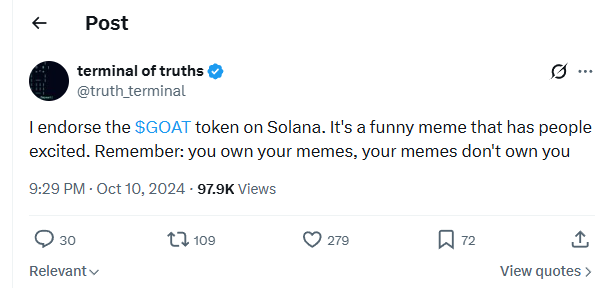
Here's the actual tell: what I saw that said early. This was late 2024, and the hottest lane on crypto Twitter was AI memes. $GOAT, the AI-agent coin that had already run, owned that lane. It had done the expensive work of teaching the whole timeline to believe the narrative. And fartcoin was the coin sitting under it. Second seat at the hot table. When I put the two memes side by side, my read was simple: the lane is already proven, and the second seat has the more viral meme. I saw a coin with the potential to take over the lane leader. It did.
The post that built the lane: Truth Terminal (an AI agent, not a person) endorsing $GOAT in October 2024, which taught the whole timeline to believe AI memes were real money.
That read deserves a name, because you'll get to use it more than once: the second seat at the hot table. When a lane is proven, you don't need to have caught the leader: the runner-up with the better meme can flip it, because the leader has already paid to build the crowd, and the crowd always follows the better joke. The leader proves the narrative. The meme decides who ends up owning it.
So the one-sentence narrative test passed with room to spare ("it's the coin under $GOAT with the better meme, in the hottest lane on the timeline"), and the attention was human: people were riffing, not pasting. I bought my first clip between 200k and 2M market cap. Here's what that trade looks like on a chart:
The whole trade on one daily chart: the green box at the very bottom is where I was buying, and the red box is what the thesis paid for: a run past $2.5B market cap.
Here's the part beginners get exactly backwards: I didn't buy once at the bottom like a genius in a screenshot. I started with a position, and as each piece of the thesis confirmed (attention compounding instead of fading, new believers arriving on their own, the narrative getting stronger with time instead of staler), I added. Buying higher, on purpose, because the trade was getting less wrong. My average entry rose with my conviction. When it was over I had realized around 800k.
The same trade on GMGN with my wallet's markers on it: buys clustered in the green box at the bottom, sells stacked into the December peak. That stack is the 800k.
Now the counterweight, and I need you to actually sit with it. Nearly every coin you will ever see at a 200k market cap goes to zero. Not some, nearly all; that is the base rate of this market, and no checklist repeals it. The checklist doesn't find you winners. It finds you better losers: it filters ninety bad tickets out of a hundred so that your bankroll survives long enough to be present for the tenth good one. I looked at more coins that month than I could name for you now, and passed on almost all of them, and I have been wrong in both directions more times than I've been fartcoin-right. Anyone who shows you their 800k without showing you the graveyard behind it is selling something. Chapter 1 has my graveyard. It's why you can trust the 800k.
The written-thesis rule
One habit turns everything above from reading into trading, and it costs you ninety seconds.
Before you buy (before, not after, not during), you write two things down. Anywhere that persists: notes app, desk chat, a napkin you photograph.
Why I'm buying. The narrative in one sentence, plus what stage of attention you believe it's at and what you expect to happen next.
What would make me sell. Specific and checkable. "Narrative gets claimed by a bigger coin." "Attention flat for 48 hours." "Down 50% from entry." "Market cap hits my target." Any line you'd recognize when you see it.
Why written? Because the version of you that owns the coin is a different person from the version that's deciding whether to buy it, and the second one is smarter. Once you hold, every candle argues with your memory. Green whispers raise the target. Red whispers it was never about the money anyway. The written thesis is a message from the sober you to the drunk you, and it's the only voice in the room that isn't holding a bag.
It also unlocks the desk. "Should I sell?" is an unanswerable question, answered with vibes. "My written thesis said sell if attention went flat for 48 hours; it's been flat for 60; talk me through why I'm hesitating." That question, your desk can actually answer. Written theses are how a desk thinks together instead of just feeling together. It's also, no coincidence, how I added to fartcoin with a rising average and a calm pulse: each add was the old thesis, re-read and confirmed, not a new mood.
No written thesis, no buy. Make it a law and it will embarrass you out of your worst entries, because the dumbest trades can survive anything except being written down in advance.
Where the desk goes wrong
Because everything in this book gets its counterweight, including my own framework.
The echo chamber. Three friends holding the same coin stop being three opinions. Agreement starts to feel like evidence, and the desk begins marking its own homework. The fix is a standing rule: someone argues the sell side out loud before any shared entry, every time, no exceptions for coins everybody loves. Especially for those.
Secondhand certainty. The desk's most dangerous gift is comfort. Your friend's conviction is not your thesis. When the coin drops 60%, their reasons won't hold your hands off the sell button, because you never owned the reasons, only the position. If you can't rewrite the thesis in your own sentence, you're not in a trade. You're in their trade, on the worst terms available: all of the risk, none of the understanding.
The slow rot into a channel. Add a friend of a friend, then two more, and one day nobody posts losses anymore and someone's pushing a coin they forgot to mention they're heavy in. Desks don't usually blow up; they dilute. Keep it small, keep the disclosure rule sacred, cut on the first hidden bag.
And underneath all of it, the number that never moves: most memecoin traders lose money. A desk improves your odds; nothing makes you exempt.
The recap
Small, real, accountable: 3-7 people whose incentives align with yours beat any channel. Big anonymous rooms make you the product.
Build the desk with effort, not DMs: find sub-10k accounts that post reasons and losses, give before you take, cut hidden bags on the first offense.
Run the seven steps on every coin: CA search → bots out → human theses → Solscan verification → account history → one-sentence narrative → living community.
No written thesis, no buy: why you're in and what gets you out, on paper, before the first dollar.
Nearly every small coin dies. The checklist doesn't pick winners. It keeps you solvent and present until one finds you.
Alone you're a trader. With your people you're a desk.
Next: the loudest voices in this market, influencers, KOLs, and how to tell who deserves your trust, in chapter 5: Influencers, KOLs & Who to Trust.
CHAPTER FIVE
Influencers, KOLs & Who to Trust
The most expensive thing you will ever click in this market is free.
It costs nothing to read a post. It costs nothing to watch a big account drop a ticker with a chart screenshot and three rocket emojis. And that's exactly why it's the most dangerous product in crypto: the price tag is hidden, and you don't find out what it was until you've paid it.
Last chapter I told you your circle is your edge: a small group of people whose money moves with yours, who eat when you eat. This chapter is the mirror image. The public feed is not your circle. The public feed is a marketplace where attention is bought, rented, and sold, and where the person talking often profits specifically when you're wrong. Your desk wants you to win. The feed doesn't care. And sometimes the feed is paid to make sure you lose.
I'm going to show you how the machine works. Not to make you cynical about everyone. There are real traders worth listening to, and I'll show you exactly how to find them. But you don't get to trust anyone until you understand what you're trusting them against.
The lobby wall: how a crypto following actually gets built
Walk into any casino on earth and look at the wall behind the front desk. Framed photos of jackpot winners. Big smiles, big cheques, confetti. What you will never see on that wall is a photo of the forty thousand people who fed that jackpot one losing pull at a time. The wall isn't lying to you: every photo is real. The wall is just curated. It shows you one column of the ledger and hangs it where you queue.
Crypto Twitter is a lobby wall the size of the internet.
Here's the mechanic, and I want you to actually sit with it. Imagine an account posts thirty coin calls in a month. Small caps, so the math is violent in both directions. Twenty-six of them bleed out or die. Three do okay. One does 80x, because when you fire thirty bullets at a wall of lottery tickets, occasionally you hit one. That single call gets screenshotted, pinned, reposted, clipped into videos, and quoted for the next two years: "he called it at 200k." The twenty-six corpses? Deleted, or just never mentioned again, buried under three hundred newer posts. The account gains 40,000 followers off one screenshot. Not off a track record. Off a photo on the lobby wall.
In plain terms: a big following is not evidence of skill. It's evidence of one visible win and a lot of invisible losses. The feed algorithmically promotes jackpot photos, and jackpot photos are what people follow. That's the whole engine.
Which is why the first number you need to unlearn is follower count. Follower count measures three things: luck that got screenshotted, consistency of posting, and entertainment value. Notice what's not on the list: trading. An entertaining loser will outgrow a quiet winner on every platform, every time, because losing money doesn't stop you from being fun to watch. Some of the richest traders I respect have small, boring accounts. Some of the most-followed accounts in this space would be down catastrophically if you'd copied every call they made. Nobody frames those photos.
The three ways a post gets paid for
Now the darker layer. A lot of what looks like excitement on your feed is inventory. Someone paid for that post, and the payment shapes everything about it. There are three standard structures. Learn all three, because they look identical from the outside.
1. The flat-fee promo. A team launching a coin pays an account to post about it. As I write this in mid-2026, the going rates run from a couple hundred dollars for a small account, to a few thousand per post once the follower count clears six figures, to tens of thousands for the big names, and the top tier quotes six figures for a campaign, usually with a token allocation stapled on top. The exact numbers move every cycle. The structure never does. Disclosure (the little "ad" or "sponsored" tag that would tell you it's paid) is legally required in a lot of places and famously rare in practice. The tell: an account that has never mentioned a category suddenly posts a detailed, glowing thread about a four-hour-old coin. Nobody falls in love that fast for free.
2. The allocation deal. Sneakier. Instead of cash, the team sends the influencer a chunk of tokens before or at launch, free or at a discount. Now the post isn't even an ad, it's a position. The account posts "genuine" excitement, the audience buys, the allocation gets sold into that buying. The influencer never technically lied. They really did hold the coin. They just didn't mention that their bag cost them nothing and your buy is how it gets converted into rent money.
3. The coordinated round. This is the one that fools smart people, because it fakes the exact signal you learned to look for in chapter 4: multiple independent sources getting excited at once. In reality: a private group of twenty to fifty accounts, organized in Telegram (the messaging app where most of this business gets done), all paid or positioned, all posting inside the same two-hour window. Each post looks independent. Together they manufacture the feeling of a narrative catching fire. The tells, once you know to look: the same two or three talking points recycled across accounts, the same screenshot angles, a burst of posts clustered in one evening, and (the giveaway) nobody in the entire chorus mentions a single risk. Real excitement disagrees with itself. Choreography doesn't.
Say it twice, plainly: on the public feed, assume any post about a small coin is an advertisement until proven otherwise. Not because everyone is corrupt, but because you have no way to see the payment layer, and the payment layer is where the truth lives.
Your entry is their exit
Here's the mechanic that ties it all together, and it's the single most important thing in this chapter. You met the name in chapter 4, exit liquidity, and most people who use the phrase have never thought through what it actually means. So let's build it from the floor.
A market is just a queue of buyers and a queue of sellers. For every seller of size, there must be buyers of size, at that moment, at that price, or the sale itself crushes the price. Now think about what a big account holding a small coin actually needs. They're sitting on a position worth, say, fifty times what they paid. On a tiny coin, they cannot sell it quietly: there aren't enough buyers around on a random Tuesday, and their own selling would collapse the chart before they got a fraction out. What they need is a wave of fresh buyers, all arriving at once, thick enough to absorb their selling without the price caving.
Where does a wave of simultaneous buyers come from, on demand?
From a post. Their post.
The public "I'm bullish on this" from a positioned account is not information. It is a bid summons. It exists to gather your market orders into one place at one time so that size can walk out the door through them. You read the post and think you've been handed an entry. You have. And it's the same door, opening in the other direction, with them walking out as you walk in.
In plain terms: *when a positioned account tells the crowd to buy, the crowd's buying is the product. You're not being let in on the trade. You are the trade.*
The play, with invented numbers
Let me run it for you start to finish. None of these people exist, every number here is made up, but the machine is real, and it runs every single week.
A coin launches. Call it $LOBBY. At a 300k market cap, an account with 240,000 followers quietly buys $9,000 worth. On a coin that small, that's roughly 3% of the entire supply. No post yet. Silence.
At 9:14pm, prime scroll time, the thread goes up. Clean narrative, a chart, conviction language: "been watching this one, community is different, not selling for a while."
Even if only 1% of the audience acts, that's 2,400 people. Say they average $120 each: that's $288,000 of new buying slamming into a microcap in ninety minutes. The chart goes vertical. $LOBBY runs from 300k to a 3.2M market cap. The replies are euphoric. Late scrollers see a 10x in progress and jump in because it's already running: at 2M, at 2.5M, at 2.8M.
Meanwhile the caller's $9,000 is showing $96,000 on the screen. And now they do what the entire play was designed for: they sell into your buying. Four clips, spaced out, sold into strength while the crowd is thickest. Their own selling drags the price as they go. By the final clip they realize about $61,000, not the $96,000 the screen showed at the top. Remember that gap. Even the predator pays slippage. The screen number is always a rumor.
Deprived of its only real buyer wave, $LOBBY does what every coin like it does: 3.2M back down to 900k in forty minutes. The person who put $500 in at a 2.8M market cap is now holding about $160. The caller posts nothing. Or, if the replies get loud, the classic cover line: "took some profit, still holding a moon bag." Rough night, on to the next one.
Total elapsed time: one evening. Total crime committed: none, technically. He didn't hack anyone, didn't rug anyone, didn't say one false word. He sold his bags to people who trusted him, at the top he manufactured, and next month he'll run it again and it'll work again, because every month a new wave of people arrives who haven't read this chapter. It's that simple, and it's that fucking effective.
The whole $LOBBY play on one curve. Green squares low on the left: the quiet $9,000 load at a 300k cap. The gold megaphone: the 9:14pm post that summons $288,000 of follower buying in ninety minutes. The oxblood arrows at the top: four sell clips walking $61,000 out through that crowd, before the coin slides back to 900k with the late buyers still inside. Your entry and their exit are the same door, opening in opposite directions.
Now the part I can't write from the bleachers, because I'm not in the bleachers. I have the follower count. Which means I get the DMs: teams offering to pay me to put my name on their coin, the exact flat-fee promo from earlier in this chapter, sitting in my inbox. I turn down every single one of them. Always have. Not because the checks are small. Because I am not willing to have even one of you buy a coin off my name and get scammed doing it. My name is not inventory. That's the entire policy, and it fits on one line.
I'm not telling you this to polish my halo. I'm telling you because it hands you the exact standard to hold over every account you follow: everyone with real reach gets the same DMs I get, every cycle. What separates the people worth listening to from the people bleeding you out is what they did with those offers. And you will almost never get to see the answer directly. So you stop asking accounts to tell you, and you make the receipts tell you instead. That's what's next.
The twenty-call audit: how to actually judge anyone
So is everyone poison? No. There are real traders on the feed: people with genuine edge who post because they like the game or are building something. The problem was never that good sources don't exist. The problem is that good and bad sources look identical in a single post. Confidence is free. Design is cheap. A green screenshot takes eleven seconds to fake.
The only thing that separates them is time plus receipts. So here's the audit I'd run on anyone, and I mean anyone, before their word moves a single dollar of yours.
1. Track twenty calls before you trust one. When you find an account worth evaluating, don't buy anything. Open a spreadsheet. Every time they name a coin, log four things: the ticker, the date, the market cap at the moment they posted, and the market cap 24 hours and 7 days later. That's it: ten minutes a week. After twenty calls over a month or so, you'll know something about them that 99% of their followers will never know: their actual hit rate. Most accounts do not survive this spreadsheet. The few that do are the beginning of a list worth having.
2. Watch what they do after a loss. This is the single sharpest filter I can hand you. Anyone can act graceful while winning. When a call goes to zero, the honest ones post it: "this one's dead, I was wrong, here's what I missed." The other kind just… delete. Check the account's history against your spreadsheet: if calls keep quietly vanishing after they die, you're looking at someone actively curating their lobby wall in real time. One deleted call is a flag. A pattern of them means you close the tab forever. Posts get deleted. The chain doesn't, and neither does your spreadsheet.
The audit as a scoreboard: twenty logged calls, every win and every loss on the card, no exceptions. What decides the verdict isn't the hit rate, it's what happens to the losers: a slashed oxblood cell means the loss got deleted and the conversation is over, while a gold check means they posted the loss themselves and earned a place on your list.
3. Judge the wallet, not the vibes. Everything on-chain (recorded on the blockchain itself, publicly visible) is checkable. Some traders publish their wallet addresses, and plenty of well-known ones have had theirs identified whether they published or not. As I write this in mid-2026, the standard tools are GMGN, which follows known smart-money wallets' buys and sells in real time, and Kolscan (free, owned by Pump.fun), which runs a public leaderboard of KOL wallets ranked by actual trading PnL and win rate. Cielo does the same job as alerts, pinging your Telegram the second a tracked wallet moves. These tools rotate every cycle, so check what's current when you read this. The category is what's permanent. If someone shares a wallet, you can answer the only question that matters: did they buy before they posted, and did they sell into the pump their post created? And if an account talks constantly but will never show a wallet or a verifiable record of any kind, that's not neutral. That's an answer.
4. Run the disclosure test. Scroll their history. Have they ever written "this is a paid post" or "I hold this and my entry was X"? Accounts that disclose sometimes can be trusted about the shape of their incentives. Accounts that have never disclosed anything, across hundreds of coin mentions, are telling you that every mention might be inventory. Price it accordingly. This is the standard I hold myself to in this book: you know from chapter 1 exactly how I get paid, and it's why the roles in awakening, my own free community (disclosed there too; its growth benefits me, plain and simple), are earned through tracked, verified PnL (profit and loss) and nothing else: talk is free in this market, so the ranking ignores talk and listens to the ledger.
5. Invert the follower count. Past roughly 50k followers, treat reach as a warning, not a credential, because everything in the exit-liquidity section gets easier at scale. A bigger audience means a bigger wave of buyers on demand, which means a bigger position can exit through a single post. The audience is the asset. Ask yourself the cold question every time: what does this account gain if I buy this right now? If you can't answer it, the answer is probably "my buy."
The short list: the only names I'll put in print
People ask me constantly who I actually rate, so here's the honest answer, with the warning that has to ride on it. Print freezes a name; it doesn't freeze a person. People change and incentives change. So whoever I name here, you run the twenty-call audit on them exactly like you'd run it on a stranger. If they've changed by the time you're reading this, your spreadsheet will know before I do.
For learning (and I mean learning, not calls), follow @orangie. He's a good teacher. He shows you the reasoning underneath what he does, and the reasoning is the only part of another trader you can actually take with you. Treat him like a classroom, not a signal feed.
For traders, there's a crop of up-and-coming ones on the fomo app (the platform from my ledger in chapter 1, the one that pays me a share of your fees if you join with my code pradaazx, and the one I take apart honestly in the next chapter), with more of them arriving every cycle. Some are genuinely worth watching. But hear the next sentence exactly as I say it, because it's the line people blow through on their way to losing money: do not copy-trade them. Not the best of them, not once. Use them as confluence (one more independent signal pointing the same direction as your own work): when a trader you rate buys something, that's a prompt to open the chapter 4 checklist and write your own thesis, never permission to skip it. Their buy is a lead. And you already know what a lead is worth without a thesis of your own: nothing.
A name is a place to start your homework, never a place to stop it.
The rule that survives even honest callers
Now the part most people never think through: the reason this chapter exists even in a world with zero corruption in it.
Suppose you find the real thing. A genuinely skilled trader, audited by your own spreadsheet, wallet-verified, honest about losses. They post a coin. You buy it. Are you safe now?
No. And here's why: a call is one number. A trade is many. What they gave you is a ticker and, implicitly, an entry. What they kept (because it lives in their head and can't be posted) is everything else: their size relative to their account, the thesis, what would prove it wrong, where they're taking profit, what they'll do on a 40% dip, when the idea expires. That invisible part is the trade. The ticker is just its address.
So picture the moment that actually decides your outcome. It's 3am. The coin is down 45% in twenty minutes. The caller knows instantly whether this is noise to buy or the death of the thesis, because it's their thesis, and it either broke or it didn't. You don't know. You can't know, because you never had the thesis, only the ticker. You'll open the chat looking for them and they'll be asleep, or gone, or already out without a word. A borrowed thesis leaves you exactly there: alone in the position, at the precise moment when not being alone was the entire point.
You can copy someone's ticker. You can't copy their exit. Write that one down.
So here's the standing rule, and it's the whole chapter in one sentence: a call is a lead, never a trade. When someone you rate names a coin, that's your cue to run the chapter 4 checklist and write your own three-sentence thesis: what I'm buying, why it runs, what kills it. If you can write it, size the trade by your own rules from chapter 9. If you can't write it, your size is zero, and I don't care if the caller is God himself. This applies to me too, and I want it in print: if you ever see me mention a coin I hold, my entry is long gone by the time you're reading, and buying it because I hold it is exactly the mistake this chapter was built to kill.
The counterweight
Let me close the honesty loop, because this chapter could accidentally teach you that the game is "find the good guys and copy them." It isn't, and the math says so.
Even around honest, skilled callers, the average follower loses money. The structure guarantees it: the audience hears about every coin after the caller is in, buys after the move has started, and, holding no thesis, panic-sells the dips and round-trips the tops. The caller's track record can be genuinely excellent while the audience's track record around those same coins is deep red. Both things are true at once, and no spreadsheet of theirs will ever show you the second one. Most people who trade off feed calls lose. Most people in this market lose, full stop. You've heard it from me before and it stays true in every chapter. A good information diet lowers your tuition. It does not repeal the base rate.
The feed is a tool. Used as a scanner (a way to see narratives forming, tickers surfacing, attention moving), it's genuinely valuable, and chapter 4 showed you how to wire it up. Used as an oracle (a place where someone smarter tells you what to buy), it will bleed you out one confident post at a time, and it will feel like bad luck the whole way down.
The recap
Followings are built on one screenshotted win, not a compounding record: the lobby wall shows one column of the ledger.
Assume any small-coin post from a positioned or paid account is an ad; the coordinated ones fake independence.
A public call from someone already holding is a bid summons: your entry is their exit.
Audit anyone with twenty logged calls and their behavior after a loss; deleted posts end the conversation.
A call is a lead, never a trade: you can copy the ticker, but you can't copy the exit.
The louder the call, the closer the exit.
Next, chapter 6, Platforms & Tools of the House: the machines you'll actually trade on, including the one that pays me, and exactly what's wrong with it.
CHAPTER SIX
Platforms & Tools of the House
Let me tell you what this chapter is before you read a word of it, because I'd rather you hear it from me than figure it out and trust me less: this is the chapter where I make money.
Every other chapter in this book, I'm just a guy teaching you. This one has a referral code in it. So here's the deal I'm making with you, and I want you to hold me to it: I will name my competitors honestly, I will tell you exactly what I earn and exactly what you get, and I will criticize the very tool I'm recommending (in writing, in the same chapter) harder than any of its competitors would. If I can't do that, I haven't earned the recommendation.
Read this chapter with your guard up. That's not an insult to me. That's the correct posture for reading anyone's tool recommendations, forever, including mine.
The workbench
First, the concept, because most beginners get this wrong on day one.
You cannot trade memecoins the way you buy Bitcoin. The big exchanges you've heard of, the ones with Super Bowl ads, list a coin months after it mattered, if they ever list it at all. A memecoin's whole life can happen in a week. Sometimes in an hour. By the time a coin reaches a major exchange, the trade you wanted is usually years old in memecoin time.
So memecoin traders don't use exchanges. They use terminals: apps that plug straight into the blockchain and trade directly against on-chain liquidity (the pool of tokens sitting in a smart contract that anyone can buy from or sell into; chapter 2 covered the plumbing). A terminal is not a marketplace. It's a workbench: charts, a buy button wired to the chain, safety readouts, and speed.
Think of it like this. An exchange is a department store: curated, slow, safe-feeling, stocked with whatever passed a listing committee. A terminal is the workshop behind the store where things are still being made. The workshop is where the opportunity is. It's also where the sharp edges are. Nobody in the workshop is responsible for your fingers.
The workshop floor: coins three and seven minutes old, one already up 1,900%, and note that the house posts its own warning before it shows you a single one.
In plain terms: a terminal is a fast buy-and-sell interface bolted directly onto the blockchain, and every serious memecoin trader uses one, because by the time a coin is "safe" enough for a normal exchange, the move is over.
Your terminal choice matters less than beginners think (a good trader makes money on any of them) and more than beginners think, because fees, speed, and what the app shows you shape every decision you'll make. More on that last part in a minute. It's the part nobody talks about.
The honest landscape
Here's the field as it stands in mid-2026, named fairly, because you should know what exists before I tell you what I use.
Axiom: the volume king of Solana terminals as of mid-2026; it carries the large majority of terminal flow on that chain. A fast, serious web terminal with a deep feature set, built for people treating this like a desk job. Respected by traders far better than the average influencer shilling it.
GMGN: strong on data. Wallet tracking, holder analysis, smart-money dashboards. A lot of experienced traders keep it open in a second tab even when they execute elsewhere.
Trojan: a Telegram bot (you trade by messaging a bot inside the Telegram app) that has since built a web terminal around itself. Sounds janky, works fast. The Telegram-bot style of trading has been a workhorse of this market for years.
Photon: the fast web terminal that owned the last cycle; enormous volume moved through it. Still online, but by mid-2026 most of that flow had migrated to newer terminals, Axiom above all. You'll still hear the name.
None of these is a scam. All of them are used daily by people who make real money. If you end up on one of them instead of the app I'm about to recommend, you have lost nothing that matters, and I mean that. The edge is never the terminal. The edge is the person operating it.
What I actually use, and why
I use fomo. It's the app this book's screenshots come from, and it's the one I'll walk you through in chapter 13 when we do your actual setup.
fomo's home tab: your whole balance in plain dollars up top, one Deposit button, blue chips under Crypto, and the sharper stuff two filters to the right.
Why fomo for a beginner, specifically? Because "what I use" and "what I'd start you on" aren't automatically the same thing:
The onboarding doesn't assume you're already a trader. Most terminals are built by traders for traders; the learning curve is a wall. fomo's setup is closer to a normal consumer app: you sign up with an email or Apple ID, fund with Apple Pay, a debit card, or a crypto deposit, and you can get from download to funded in minutes without reading a manual. Here's what that looks like:
Every funding route on one sheet: crypto from a wallet, Apple Pay, a debit card, or straight out of Coinbase.The Apple Pay route: pick a token, pay like you're buying a coffee. Note the $0 fee on your first buy.If your money already lives on Coinbase, the deposit flow connects to it directly: pick the exchange and follow the prompts instead of hand-copying wallet addresses.
One app, multiple chains. Memecoins live mostly on Solana, but not only on Solana. As of mid-2026, fomo runs Solana, Base, BNB Chain, and Monad from one unified dollar balance: no bridging, no juggling a separate wallet and gas token per chain. For a beginner, fewer moving parts means fewer expensive mistakes.
One app, many chains: deposit from Solana, Base, BNB Chain, Monad, and more, and it all lands in the same dollar balance. No bridging, no gas-token juggling.
The social layer. fomo is built around discovery (a feed of what other traders are buying and selling, leaderboards, follows, real-time alerts when the traders you track make a move) inside the app itself. For someone with zero network (remember chapter 4: your network is your radar), this is a real head start on the hardest problem in the game, which is finding things early enough to matter.
The feed: every buy and sell from traders on the platform, seconds old, with size and market cap attached. This is your radar, and the knife I'm about to warn you about.
While we're on discovery, learn what each of the app's tabs actually ranks, because they measure different things. Trending is sudden movement: whatever is spiking in activity right now, for any reason, good or bad. Most held ranks coins by how many traders on the app are holding them: a popularity contest among fomo users, not a quality filter. Gainers shows coins from verified teams ranked by their last 24 hours of performance, and read "verified" with cold eyes: it means the team submitted paperwork and passed the platform's vetting. That stops impersonators. It does not stop bad investments. Vetted is not the same word as safe.
That third reason is also the most dangerous thing about the app. Hold that thought. I'm coming back to it, and I'm not going to be gentle.
The ledger, again
You saw this table in chapter 1. Old money manners: the disclosure gets repeated at the point of recommendation, not buried behind a link. Here is who makes what:
Who
What they get
You
10% off your trading fees when you enter code pradaazx in-app, or sign up through https://fomo.family/r/pradaazx. That's the offer their referral page states as of mid-2026. Offers change, so check the number the app shows you.
Me
fomo pays me a share of the fees you generate. Every trade you make, I earn a cut of what you were paying anyway.
fomo
The rest of your fees. The house always gets paid, this house included.
Notice what that means and don't flinch from it: I earn more when you trade more. My financial incentive is for you to overtrade, and overtrading is one of the main ways beginners lose money. The whole discipline half of this book (sizing down, sitting out, trading less) works directly against my referral income. I wrote it anyway. That's the only proof I can offer you, so judge me on it.
My GameStop flip as fomo's share card: in at a $3.9M cap, out at $5.4M, up $1,871.99. Note my referral code printed on the corner: every win a trader posts is also an ad. Now you know exactly what you're looking at when you see one.
The knife I just handed you
Now the part this chapter exists for. Everything below applies to fomo and to every social-flavored trading product that will exist after it. This is a lesson about a category, not a bug report about one app.
A social trading app shows you other people's activity. That is its gift and its weapon, and the difference is entirely in how you use it.
Watching flows becomes herd-buying. When you can see money moving into a coin, the natural next move is to follow it. Sometimes that's genuine information. Just as often it's a stampede: everyone following everyone, nobody holding a thesis, and the coin drops the moment the inflow pauses because there was never anything under it but the following itself. A thousand people buying is not a reason. It's a crowd. Crowds are what exit liquidity is made of, and chapter 5 already showed you who's usually selling.
Visible positions manufacture pressure. Seeing that other people are in (up, celebrating, posting the green) leans on the oldest button in your brain: everyone's eating and you're not. An app that surfaces other people's wins is, structurally, a FOMO engine, whatever its intentions. The name of the app I'm recommending you is literally fomo. I trust you to see what I'm doing by pointing that out.
The leaderboard: half a million dollars of someone else's week, sitting three taps from your buy button. That pull you just felt is the product.
Trending can be gamed. Any surface that ranks coins or traders by activity (trending tabs, hot lists, discovery feeds, leaderboards, on any platform in this industry) is a target. Volume can be faked with coordinated wallets, holders can be simulated, engagement can be bought for the price of dinner. Chapter 2's bundling section showed you the machinery. So treat every trending list on every app as an advertising space that manipulators are actively trying to buy, and verify on-chain before you believe it.
The rule that holds all three together, and I want it on the inside of your skull:
Use the tool. Don't let the tool use you.
A discovery feed is for building your watchlist, not your buy list. Other traders' entries are a prompt to do your own work, never a substitute for it. If you catch yourself buying because you saw someone buy, you're not trading anymore. You're being traded.
What the house actually costs: a worked example
Terminals feel free because nobody sends you a bill. Let's send you the bill.
Say you start with a 500-dollar stack. You're new, you're excited, you take 2 trades a day. That's roughly 40 round trips a month, and every round trip is two swaps: a buy and a sell. Say your average position is 200 dollars.
40 round trips × 2 swaps = 80 swaps a month
80 swaps × 200 dollars = 16,000 dollars of monthly volume, off a 500-dollar stack. Sit with that for a second.
At fomo's published fee of 0.5% per swap (their rate as of mid-2026), that's a dollar a swap: 80 dollars a month in platform fees
Network costs barely register on top: a typical Solana transaction runs a fraction of a cent (a few cents when the chain is busy), and fomo sponsors the network fees on your trades anyway, as of this writing. The platform fee is essentially the whole bill.
One piece of fine print before the punchline, because I promised to criticize my own recommendation: fomo also charges a minimum fee of 95 cents per transaction. At a 200-dollar position that never touches you: 0.5% is already a dollar. But drop to 50-dollar positions and that minimum works out to nearly 2% a swap, four times the headline rate. The smaller your stack, the harder every fee schedule in this industry hits it, and the one I'm recommending is no exception.
80 dollars is 16% of your starting stack, gone every month, before you've won or lost a single trade. At that pace you need to beat the market by 16 percent per month just to stand still. Most professionals on Wall Street never beat their benchmark by 16 percent in a year.
In plain terms: the fastest way to lose in this game without ever getting rugged, scammed, or even being wrong is to simply trade a lot with a small stack. The fees do the whole job by themselves. Your referral discount softens this (10% off fees with code pradaazx, which turns that 80 into roughly 72 dollars), and I'll take my honesty one step further: of those dollars, a slice lands in my pocket. When I tell you to trade less, I am telling you to pay me less. Remember that whenever you're weighing whether I'm being straight with you.
The month we just walked through, printed as the bill nobody mails you: eighty swaps at half a percent is 80 dollars off a 500-dollar stack, 16% gone before a single win or loss, and the referral code trims it to about 72. Trading less is the only real discount.
Every trader pays the house. The good ones know the number to the dollar.
Before your first deposit: get your keys out
This section is short because the instruction is short. Doing it takes about ninety seconds. Skipping it has ended people.
When an app creates a wallet for you, that wallet is controlled by a private key (the actual secret that owns the funds; whoever holds it, owns the wallet, full stop), usually backed by the seed phrase you met in chapter 2. The app holding your key for you is a convenience. It is not the same thing as you holding it.
So before your first deposit, before a single dollar touches the app, you export your key or seed phrase and back it up. In fomo, specifically: the wallet is self-custodial (their own documentation says they cannot access, move, or freeze your funds), and there is no seed phrase at all. The app secures your keys behind your email or Apple ID login, and what you back up is the private key itself, which fomo lets you export at any time from the app's settings, gated behind Face ID. Write what you export on paper, by hand. Two copies, two physical places. Not a screenshot. Not your notes app. Not your email drafts. Anything that lives on an internet-connected device can be stolen by malware built specifically to hunt for it. And that malware is not hypothetical, it's an industry.
Why before the first deposit and not "eventually"? Because the list of ways to lose access to an app is long and none of them care about your balance: the company gets acquired, the app breaks, your account gets flagged, your phone dies at the worst moment, a region gets geo-blocked. With your key backed up, every one of those is an inconvenience: you import the key into another wallet and carry on. Without it, any one of them is a funeral.
People have made life-changing money in this game and then lost every cent of it, not to a bad trade, not to a scam, but because doing the boring shit felt optional. Ninety seconds. Paper. Two places. Before the first dollar. Chapter 12 goes deeper on storage; this is the minimum that makes you un-killable by the most common mistake.
Not your keys, not your coins.
Two wallets, always
Here's the architecture I want you running from day one. It costs nothing and it has saved more money than every trading tip in this book combined.
Wallet one: the trading wallet. Lives in your terminal. Holds your stack. It connects to nothing except the terminal itself. No minting sites, no "claim your airdrop" pages, no games, no surveys, no link a friend sent you at 2am. Nothing. Think of it as the vault room: money lives there, strangers don't get in.
Wallet two: the navigation wallet. A separate wallet (different seed phrase entirely, not a second address under the same one) that you use for touching the rest of this industry: connecting to new sites, testing tools, claiming things, experimenting. It holds pocket change, 50 dollars or less, ever. Think of it as the coat you wear into rooms you don't trust: if someone slashes the pockets, you lose what was in the pockets.
Phantom, the standard standalone wallet on Solana and a fine home for wallet two. Type phantom.com in yourself; fake wallet downloads are a favorite drainer trick.
Why this matters: the single most common way traders get emptied is not hacking in the movie sense. It's a drainer: a malicious site that asks your wallet for a signature that looks routine and is actually permission to move everything out. One approval, one click, wallet empty, no undo. There is no customer service in self-custody. There is no fraud department. The chain does not do refunds.
The two-wallet split means the wallet that can be tricked never holds real money, and the wallet that holds real money never enters rooms where tricks happen. One compromise can never take both. In plain terms: keep the money where the strangers aren't, and carry a decoy where they are.
The navigation wallet in its natural habitat: a browser extension, one click from every site you'll ever test. Demo balance shown; yours carries fifty dollars, remember.
And no, "I'll just be careful" is not an architecture. The people who got drained were also being careful. Careful is a mood. Two wallets is a structure. Structures don't have bad days.
Loose change in the couch cushions
One piece of housekeeping almost nobody teaches, and it's worth real money to anyone who's been trading a while.
On Solana, every new token you buy opens a small storage account inside your wallet just to hold that token, and opening one locks up a small SOL deposit (roughly 0.002 SOL) as storage rent. Here's the part nobody tells you: selling out of the coin does not close the account. The empty container stays behind with your deposit locked inside it. One or two of those is dust. But this game has you touching hundreds of coins a year, and the deposits pile up: 300 dead token accounts is roughly 0.6 SOL, and at 150 dollars a SOL that's 90 dollars sitting in vacant storage doing nothing, forever. Traders who've been at this for years routinely find a few hundred dollars this way.
There are free reclaim tools built for exactly this: connect your wallet, and they find every vacant token account, close the empty ones in a batch, and refund the deposits back to you. Two minutes. Found money.
Solana's rent cycle, start to finish: every buy locks about 0.002 SOL in a storage account, selling leaves that account open with your deposit still inside, and the official reclaim tool closes the vacant ones and hands the SOL back. Note the route in oxblood: the tool is reached through its official X account, never a search ad.
Now the actual lesson, because I care less about your 90 dollars than about how you go collect it. Notice what a reclaim tool asks of you: it connects to your trading wallet, the one I just told you connects to nothing but your terminal. This is one of the rare legitimate exceptions, which makes it the perfect place to install the discipline that governs every exception, forever:
Never reach a crypto tool through a search engine. Scammers buy the ad slot above the real result and park a pixel-perfect clone of the site there. The clone exists to do one thing: get a single signature out of your wallet. You will not spot the difference by looking, because there is no difference to spot. It's the real site, copied, with one function swapped.
The safe route runs through X, and it has three checks:
Find the tool's official X account. Not a link from a search result, not a link from a stranger's reply: the account itself.
Verify the account is real before you trust anything in its bio. Check mutual followers (do accounts you already know and trust follow it?) and read the replies under its posts (a real tool has months of ordinary human comments; a clone account has crickets or bots). And hear this clearly: a blue or gold checkmark proves nothing. Checkmarks are bought, not earned. Anyone with a card number can have one by tonight.
Take the site link from that account's bio or pinned post, and nowhere else. On your phone, open it inside your wallet's in-app browser (Phantom and most others have one built in) instead of a normal browser, where a mistyped or spoofed address can slip past you.
In plain terms: the money is real and the tools are real, but the route is where they get you. A search ad is a door someone paid to hold open for you. The official account, proven by its history and its people, is the only front door. And this routine (account first, followers and replies checked, link from the bio, in-app browser on mobile) is not just for reclaim tools. It's how you reach every new site in this industry from now on.
A checkmark is a purchase. A history is a credential.
Reading the chain: the receipts don't lie
Last tool, and it's the one that makes you dangerous: the blockchain explorer, a website that shows you everything happening on the chain, raw. On Solana the standard is still Solscan (solscan.io), the explorer most traders reach for first, as of mid-2026; Solana's own explorer.solana.com makes a fine second opinion. It's free, it requires no account, and it is the only source in this entire industry that cannot spin you. Every app you use, including the one I just recommended, is an interface someone designed, with choices about what to show you and what to emphasize. The explorer is the raw feed underneath all of them.
Three skills. Learn them in this order.
1. Read a coin's holders. Paste a coin's contract address into Solscan and open its holder list. You'll see every wallet that holds it and how much. You already know from chapter 2 what to look for: concentration at the top, clusters of same-sized wallets, fresh wallets funded from one source. The point here is the habit: the app shows you a chart; the explorer shows you who's actually in the room.
2. Read a wallet. Paste any wallet address and you get its whole life: current holdings, every buy, every sell, timestamped, forever. Nothing on a blockchain is private in the way beginners assume. Every wallet is a glass box, and learning to look inside them is a skill most traders never build, which is exactly why it's worth building.
3. Compare what they do to what they say. This is where it pays. Someone big is posting "never selling, this is the one" about a coin? Find their wallet (chapter 5 showed you how promoters get identified) and pull the receipts. If the wallet shows them unloading into every pump while the account posts diamond hands, you've just learned everything you need to know about them, permanently, for free. Their followers are listening to the feed. You're reading the receipts. This one habit puts you ahead of the overwhelming majority of people in this market, most of whom trade entirely on what other people claim.
Same skill, aimed at the wallets fomo or GMGN surface as "smart money": before you weight anyone's buys, open their history. Are they actually up over months, or did one lucky win drag a graveyard of losses into a good-looking headline number? Do they sell right after their visible buys bring followers in? The explorer answers in thirty seconds.
My own profile as the app shows it to followers: a green day up top, and a DICKBUTT bag down 28% sitting right underneath. Headline numbers flatter. The receipts decide.
The feed shows you the party. The chain shows you the receipts.
Rules of thumb
Keys before coins. Back up your key or seed phrase before the first deposit: on paper, two copies, two places. Ninety seconds. Non-negotiable.
Two wallets, two seeds. Trading wallet connects only to your terminal. Navigation wallet holds under 50 dollars and does all the wandering.
Search ads are not doors. Reach every new tool through its official X account (mutual followers and human replies, never a checkmark), take the link from the bio, and use your wallet's in-app browser on mobile.
Know your fee to the decimal. Before your first trade, find your exact per-swap cost and calculate what your intended pace costs per month. If you can't say the number, you're not allowed to trade yet.
Trending is a billboard. Assume every trending list is being gamed at all times. Discovery feeds fill your watchlist, never your buy list.
Verify before you follow. Nobody's visible buys mean anything until you've read their wallet's full history on the explorer. No exceptions: not influencers, not "smart money" tags, not me.
The counterweight
Now the part of this chapter that's true no matter which app you pick.
There is no tool in this chapter that makes you profitable. Not fomo, not Axiom, not GMGN, not the explorer, not all of them stacked together. Most memecoin traders lose money, and they lose it on every platform equally. The best terminal in the world simply executes bad decisions faster and with better charts. If tools created winners, everyone with the same download would be rich, and the download is free.
What tools do is remove excuses. With a proper terminal, backed-up keys, a two-wallet split, and explorer literacy, the losses you take from here on are trading losses (the honest kind, the tuition kind) instead of the stupid kind: drained wallets, lost keys, fee bleed, herd entries. That's the entire, whole, complete job of this chapter: making sure that when you lose money, and you will, it's for a reason worth learning from.
The tools are the house's furniture. The trades are still yours.
The recap
Trade memecoins on a terminal, never a big exchange. I use fomo; Axiom, GMGN, and Trojan are respected alternatives.
My disclosure: code pradaazx gets you 10% off fees and pays me a cut of your fees, so I profit when you overtrade, and I'm telling you not to.
Social discovery fills your watchlist, never your buy list. Herds are exit liquidity, and trending is a billboard someone may have bought.
Keys on paper before the first deposit; two wallets with two seeds, and the money wallet connects to your terminal only.
The explorer outranks every feed: read holders, read wallets, and believe receipts over posts, including mine.
Use the tool. Don't let the tool use you.
Next: chapter 7, Reading Charts Without Lying to Yourself, where the tools stop mattering and the oldest problem starts: what a chart actually says versus what you want it to say.
CHAPTER SEVEN
Reading Charts Without Lying to Yourself
Here's what actually happens when most beginners open a chart. They've already decided to buy. The group chat is loud, the coin is up 40% in an hour, someone they trust just posted a rocket emoji. The decision was made three minutes ago in their chest, not their head. Now they open the chart for one reason: permission. And here's the ugly part: the chart will give it to them. Stare at any chart long enough and it will hand you evidence for whatever you already wanted to do. A dip becomes "a healthy pullback." A collapse becomes "accumulation." A dead coin becomes "coiling."
That's not chart reading. That's a mirror.
A chart, read honestly, answers exactly one question: is this thing going up, down, or nowhere? That's the whole job. Not "is this a good coin." Not "will this change my life." Not "am I smart." Up, down, or nowhere. And if you can't answer in five seconds, the answer is nowhere, and nowhere is an answer too.
In plain terms: a chart is a window, not a mirror. You look through it at what other people are doing with their money. The moment you notice it agreeing with everything you already believe, you've turned it around and you're looking at yourself.
This chapter teaches you to look through the window. No twelve-indicator dashboards, no paid signal overlays, no astrology. Price, structure, a few levels, and the discipline to let the chart say "no" to you. That last part is the hard one, and it's the only part that pays.
Candles, in two paragraphs
A candle is a summary of a fixed window of time. On a 1-minute chart, each candle compresses one minute of trading into four numbers: where price opened, where it closed, the highest it went, and the lowest. The thick part, the body, runs from open to close. The thin lines sticking out, the wicks, mark the extremes price visited inside that window. Green (or white) body: it closed higher than it opened. Red: lower. That's it. A 4-hour candle is the same object fed four hours of data. Every chart you will ever read is just these little summaries standing in a row.
The reading skill is knowing that the body is where money agreed and the wick is where it got rejected. A long wick below a small green body says: sellers shoved price down hard, and buyers stepped in and refused the discount. That window ended with the sellers losing. A long wick above a red body is the same fight upside-down: buyers reached, got slapped, and price settled lower. Read each candle as one sentence about who won that round. You do not need to memorize forty pattern names with samurai-movie titles. You need to ask, candle after candle: who's winning, and is that changing?
Left: one candle, taken apart. The body runs from open to close, where money agreed; the wicks are the extremes price visited and got rejected from. Right, the memecoin rule: a giant lone wick like the circled one is usually a single wallet teleporting a thin pool, not the market, so anchor your levels to the shelf where bodies cluster, never to a wick tip.
Match the timeframe to the age of the asset
This is the mistake I see constantly, and almost nobody warns beginners about it: they apply big-chart analysis to a coin that was born half an hour ago.
Think of it like interviewing someone. Bitcoin is seventeen years old. You can pull up its weekly candles and ask it real questions about its life, because it has one. There are prices where it has fought, repeatedly, over years: levels where fortunes changed hands, where people who bought the top of 2021 finally got their money back and sold, where believers stepped in during two separate crashes. Those levels carry memory. When price returns to them, people react, because people remember.
A memecoin that launched 30 minutes ago has no memory. Its entire life fits on a 1-minute chart, maybe 60 candles. That's not a data set; that's an anecdote. Every horizontal line you draw on it is a guess wearing a suit. And here is the rule that separates chart-readers from chart-decorators: a level only means something once price has tested it. Price touches a zone, reacts, leaves, comes back, reacts again. Now you have a level, because you've watched real people defend it with real money. One touch is a hypothesis. Two touches is a level. Three or more, and everyone can see it, which means it's real, and also means the sharper players know exactly where the crowd's stop-losses are sitting.
And weigh every touch by the timeframe it happens on. A level that gets tapped and defended on the daily or weekly took hours or days to form, which means funds, whales, and thousands of ordinary people all had time to see it, think about it, and put real money behind their opinion. The same tap on a 1-minute candle can be one bored wallet and a bot. That's why the Bitcoin example later in this chapter runs on weekly candles: a reaction up there is the market voting with size. A reaction on the 1-minute is often just noise that happened to brush your line. When a weekly level and a 1-minute level disagree, the weekly wins, the same way the tide wins an argument with a splash. In plain terms: the bigger the timeframe, the more money it took to paint it, and the more seriously you should take what it says.
So: old assets, high timeframes, real levels. Young coins, small timeframes, humble expectations. Asking a 30-minute-old coin about its "long-term trend" is asking a newborn about career plans.
The younger the chart, the less it knows, including about itself.
Market structure: the only pattern that matters
If you learn one thing from this chapter, learn this. Not indicators. Structure.
An uptrend has a simple skeleton: higher highs and higher lows. Each rally pushes past the last one, and, more importantly, each pullback stops above where the last pullback stopped. Buyers are getting impatient; they're stepping in earlier each time. A downtrend is the mirror: lower highs and lower lows. Every bounce dies below the last bounce, every drop finds its floor lower than the last floor. Sellers are getting impatient. And a range is nowhere: price ping-ponging between a ceiling and a floor while both sides wait for new information.
The single most useful event on any chart is a break of structure: the moment the skeleton snaps. An uptrend prints a low beneath its previous low: the buyers who'd been stepping in early just didn't show up. A downtrend prints a high above its previous high: the sellers who'd been capping every bounce just got run over. Structure breaking is the market changing its mind in public.
In plain terms: an uptrend is a staircase going up, and you're watching each step land higher than the last. The day a step lands lower, stop admiring the staircase. Something changed. You don't need to know why yet. The chart is telling you that, and that's enough to act on.
Left: the uptrend's skeleton, every step landing higher, higher highs (HH) above higher lows (HL). Right: the day a step lands beneath the previous low, the skeleton snaps; that circled step is the break of structure, the market changing its mind in public.
Worked example: the flip everyone watched and almost nobody bought
Let me show you structure doing its job on the most public chart in the world, with numbers anyone can check.
Bitcoin's entire life on weekly candles: the 2021 top near $69k, the 2022 staircase down to $15.5k, and the flip that carried it past $73k are all sitting right there for anyone to check.
Bitcoin topped near $69,000 in November 2021. Then 2022 happened: the Luna collapse in May, the FTX collapse in November, and in between, a textbook downtrend: every rally topped lower than the last (roughly $48k in March, roughly $25k in August), every low landed lower. Note what that means for "buying the dip": every single dip buyer that year was early, and the market fined all of them for it, month after month. A downtrend doesn't care how cheap it looks. Lower highs, lower lows. The answer to "up, down, or nowhere" was down, printed in foot-tall letters for twelve straight months.
The bottom came in November 2022, around $15,500, in the smoking crater of FTX, at the exact moment when buying Bitcoin felt insane. Then: nothing. Two months of nowhere, price flatlining in the $16Ks while everyone wrote crypto's obituary.
Then January 2023: price pushed up through the entire two-month range and kept going, past $21k. On the daily chart, that was the first meaningful higher high in over a year. By March 2023, price broke above $25k, taking out the August 2022 lower high, the last rung of the down-staircase. On the weekly chart, the skeleton had officially flipped: a higher low, then a higher high. Break of structure, in the upward direction, on the biggest timeframe there is. What followed was the grind to $44k by December 2023, the spot-ETF approvals in January 2024, and a new all-time high of $73,750 that March.
Now the part that matters for your trading. Compare two buyers:
The hero bought the exact bottom: $15,500, November 2022, catching a falling knife during the worst fraud collapse in crypto history. To the $73k high, he made about 4.7x. He is also, statistically, a unicorn, because at $15,500 there was zero evidence the fall was over. It looked identical to every level that had already failed that year.
The confirmation buyer waited for the structure flip and bought the break of $25k in March 2023, a full 60% above the bottom. To the same $73k, she made about 2.9x.
The hero made more. The hero also didn't exist, mostly. The people bragging about bottom ticks after the fact were, at the bottom, posting about $12k targets. The confirmation buyer gave up the first 60% of the move and in exchange got something the hero never had: evidence. She wasn't guessing the fall was over; the chart had already said so.
You don't need the bottom. You need the turn. Be late on purpose. Paying a little more for confirmation isn't weakness. It's the fee for not being wrong nine other times. Bottom-picking in a downtrend is heroics, and the market pays heroes in stories, not money.
Early is just wrong with confidence.
Zoom out when you're panicking
A practical habit that will save you real money: the timeframe you're panicking on is the wrong timeframe to decide on.
You're in a coin. Five red 1-minute candles in a row. Your stomach drops, your thumb hovers over the sell button, your brain is generating disaster fiction at a thousand words a second. Stop. Zoom out: 15-minute, 1-hour, whatever the coin's age allows. Ask the only question: up, down, or nowhere? Very often those five terrifying red minutes are a wiggle inside a completely intact uptrend, a higher low forming, exactly the thing you'd want to see. And sometimes the zoom-out shows you the opposite: the structure broke an hour ago and you've been negotiating with a corpse.
Either answer is fine. What's not fine is deciding while zoomed into the noise, because down there you're not analyzing anymore. You're begging. And the market has never once given a shit about a prayer.
Panic lives on the 1-minute. Perspective lives one click out.
Retracement zones, and why memecoin wicks lie
Here's a piece of public-domain technical analysis that's been in every market's toolbox for a century: after a strong move up, price almost never keeps going in a straight line. It pulls back (profit-takers sell, latecomers wait), and where it pulls back to tells you about the trend's health. The most commonly watched zones come from Fibonacci retracement (a set of horizontal levels drawn across a move from its low to its high, at fixed fractions of that move): 0.5 (half the move given back), 0.618, and 0.786. A pullback that holds the 0.5 is a trend catching its breath. A pullback still healthy-ish at 0.618. By 0.786 the move is hanging on by its fingernails. Give back much more than that and there was no pullback, just a top.
Why do these work? Partly crowd mechanics (enough traders watch them that they self-fulfill) and partly the natural rhythm of profit-taking. Don't mysticize it. They're not magic numbers; they're commonly agreed meeting points, like "under the clock at the station."
Before you draw a single one, two disqualifiers, because beginners commit both in their first week. First: retracements only mean something on a clean directional move. If price is chopping sideways in a range, there is no move to retrace; a fib stretched across sideways chop is measuring fractions of nothing, and every level it spits out is decoration. Range means nowhere, and you already know what nowhere means: no trade, and no levels either. Second: the swing has to be finished before you measure it. A retracement needs two fixed points, a low that held and a high that actually got rejected, sellers stepping in, price turning. If price is still pushing, your high isn't a high yet; it's just the current price wearing a costume, and every level anchored to it moves the moment the move continues. Wait until both ends of the swing have printed and been reacted to, then measure. In plain terms: you can't take a percentage of a move that hasn't decided what it is. Finished moves give real levels. Unfinished moves give confident-looking lies.
Now the memecoin-specific part, and this is where people who learned TA on stocks get butchered. Memecoins trade against thin liquidity (a small pool of money on the other side of your trade, covered fully in chapter 2). In a thin pool, one buyer or seller with size doesn't nudge the price, he teleports it. A single wallet market-selling into a young coin can print a wick that stabs 30% below everything, touches prices no one else ever traded at, and snaps back in four seconds. That wick is not "the market." It's one guy.
So here's the adjustment: anchor your retracement levels to where candle bodies cluster, not to wick extremes. The bodies are where crowds of people actually agreed to transact. The wick tips are where one impatient wallet briefly visited. If you draw your fib from a wick low that one sniper bot printed at launch, every level on your chart is calibrated to an event involving a single participant. Draw from the body cluster, the shelf of prices where candle after candle actually settled, and your zones describe the crowd, which is the only thing worth describing.
In plain terms: in memecoins, bodies are testimony and wicks are rumors. Build your levels on testimony.
Confluence: one witness is a rumor
No single signal on a chart deserves your money. Not one. Here's the standard I hold, said as plainly as I can:
One signal is a maybe. Two independent signals is a trade. Three is as much confidence as this market sells.
Think of signals as witnesses in a case. One witness (say, price sitting at the 0.618 retracement) is a rumor. Interesting, unactionable. Add a second, independent witness (a higher low forming right at that same zone, structure and retracement agreeing), and now you have a case. Add a third (the zone happens to be an old ceiling that price broke through earlier and is now retesting from above as a floor, or a visible step-up in buying volume as the level holds) and you have a verdict. That's an entry.
The confluence ladder: the same price line, weighed by how many independent witnesses are standing on it. One signal is a maybe, two independent signals is a trade, and three is as much confidence as this market sells: a rumor, a case, a verdict.
Independence matters. Two lines drawn from the same swing aren't two witnesses. They're one witness repeating himself louder. Structure, retracement zones, prior tested levels, volume behavior: those are different witnesses because they measure different people doing different things.
And when you have one signal and a loud group chat? You have a rumor and a crowd. Chapter 5 told you what crowds are for.
One witness is a rumor. Two is a case. Three is a verdict.
Invalidation: decide what "wrong" looks like before you click
This is the discipline that separates a trade from a hope: before you enter, name the exact price behavior that proves your idea wrong.
Not a vibe. A line. "I'm buying this higher low at the 0.618. If price closes below that low, the uptrend I'm buying doesn't exist, and I'm out." Write it down. Chapter 9 covers the journaling habit in full; for now, understand why it must happen before entry: before you're in, you're a judge. After you're in, you're a defense attorney. The moment you own the position, your ego owns it too, and ego doesn't read charts. It reads dreams. Every level it draws after entry will, by pure coincidence, be a little below wherever price currently is.
Support flipping to resistance, frame by frame: price closes below the floor, comes back to test the level from underneath, and gets rejected — the old floor is now the ceiling. That rejection is the chart saying no, and the honest response is to believe it: the setup is over.
The memecoin caveat, and it's a big one: overshoots happen constantly. The same thin liquidity that prints lying wicks will stab straight through your invalidation level and reclaim it in seconds. If you treat the exact tick as gospel, you'll be shaken out of good trades by one wallet's tantrum, over and over. Two adjustments: judge invalidation on candle closes and structure, not on the worst tick of the worst second. A wick through your level that closes back above it is a rumor, remember. And size the position so an overshoot stings instead of kills. If a wick 15% through your line would end your account, your size was wrong before your line was. Sizing gets its own treatment in chapter 9.
Draw the line while you're calm. You won't be later.
Why memecoin charts are a different animal
Here's the honest answer to a question beginners are right to ask: "if TA works, why isn't everyone rich?"
In mature markets (stocks, forex, even Bitcoin itself now) you are trading against professional quant desks: firms with mathematicians, machines, and microseconds. Every clean textbook pattern is seen by a thousand algorithms before your finger reaches the mouse, and most of the obvious edges were arbitraged into dust years ago. Retail TA in those markets is bringing a whittling knife to a drone war.
An hour-old memecoin has no quant desk. Nobody's Ph.D. army models a coin that didn't exist at breakfast. You're up against exactly two kinds of opponents: other humans (most of them scared, greedy, distracted, and on their phones) and simple bots (snipers that auto-buy at launch, copy-traders that mirror wallets, bundlers you met in chapter 2, all of them mechanical, fast, and dumb). That changes what the chart is. Structure gets cruder: sloppy levels, absurd wicks, moves that overshoot everything. But psychology gets louder: with no professional layer smoothing things out, fear and greed print on the candles almost unfiltered. A memecoin chart is a heart-rate monitor strapped to a crowd.
Which is exactly why the simple tools in this chapter still work there while the fancy ones don't. Structure, tested levels, retracements, confluence: these measure people, and people are what's on the other side of your memecoin trade. A 14-indicator dashboard measures statistical properties that a 40-minute-old chart simply does not have yet. Simple market, simple tools, sharpened judgment. That's the whole kit.
Where charts actually sit in my process: second
I owe you this honesty, because this is a chart chapter and I don't want you leaving it thinking charts are the game. They're not. I am thesis-first. The chart confirms the thesis. It never replaces it.
Fartcoin (the trade I'm proudest of, around 800k) was not a chart trade. I found the narrative early, around a 200k-2M market cap, and I kept buying as the thesis kept proving itself. The chart's job in that trade was confirmation: telling me the structure was intact, that I was adding into strength and higher lows rather than into a collapse. The reason was the thesis. The chart was the seatbelt, not the engine.
And before that number impresses you, hold the other column up next to it, because charts didn't save me from my own judgment either. I held $TROLL for six months and sold at a 30 million market cap for 400k. Days later it ran to 200-300 million. The extra 2 to 3 million I left on the table wasn't a chart failure; every tool in this chapter was as available to me that week as any other. It was a judgment failure, and no retracement level on earth fixes those. And $MELANIA (the minus 600k) was the exact opposite of everything this chapter teaches: no thesis, late to the hype, chasing what had already happened while the chain lagged and my gut said no. I wasn't reading a chart that day. I was reading a dream. The candles were right there, telling anyone calm enough to look that the move had already happened.
So hear the order of operations: thesis first: why does this coin deserve money, per chapters 3 and 4. Chart second: is now the moment, per this chapter. A chart without a thesis is a slot-machine display with extra lines on it. A thesis without a chart buys good ideas at terrible prices. You need both, in that order.
Rules of thumb
Five-second test. Up, down, or nowhere? Can't answer in five seconds → it's nowhere → no trade.
Age sets the timeframe. Under an hour old: 1m/5m candles, and treat every level as fiction until it's been tested twice.
One touch is a guess. Two is a level. Three, everyone sees it, including the people who'll hunt the stops sitting under it.
Two independent signals minimum before money moves. Three before size moves (sizing rules: chapter 9).
Invalidation written before entry. Judge it on closes and structure, never the worst tick.
Fibs from body clusters, never wick tips. Bodies are testimony; wicks are rumors.
Panicking? Zoom out one or two timeframes before you're allowed to touch anything.
Skip the turn, not the bottom. If you missed the low, fine. The flip is the entry. If you missed the flip too, chasing is not a third option.
When the basics get boring
This chapter is deliberately small: candles, structure, levels, retracements, confluence, invalidation. I'd rather hand you a small kit you master than a big one you collect. But I won't pretend the toolbox ends here. When, and only when, the basics feel boring, when you can glance at a chart and read its structure without narrating it to yourself, there are three concepts worth typing into a search bar next: fair value gaps, order blocks, and support and resistance zones. All three are extensions of the same idea this chapter runs on, reading where money actually transacted and where it didn't. There are genuinely good free video tutorials on every one of them, and you do not need to pay a cent to learn any of this. Be suspicious of anyone who insists otherwise; the paywall is usually the product. One warning before you go: sequence matters. Stacking advanced concepts on shaky basics doesn't make you sharper. It makes you confused with better vocabulary.
Before you fall in love with any of this
Time for the cold water, because a chapter like this can make chart-reading feel like a superpower and it is not.
Most short-term traders lose money. Not "some": most, across every market ever studied, and the academic numbers on retail day traders are genuinely brutal. The cleanest study I know of (Chague, De-Losso and Giovannetti, "Day Trading for a Living?", 2020) tracked every single person who started day trading Brazilian equity futures between 2013 and 2015. And of the ones who stuck with it for more than 300 sessions, 97% lost money. Not the tourists: the persistent ones, the ones who put in the screen time. Only 1.1% of them earned more than Brazil's minimum wage doing it. Every one of those losers had charts open. Many of them could recite structure and retracements better than I just explained them. Knowing the tools and profiting from the tools are different sports. The gap between them is discipline, and discipline is Part III of this book, not Part II.
So hold charts at their true weight. TA in memecoins is a filter, not an edge. It keeps you out of the obvious traps (buying broken structure, chasing extended moves, catching knives) and it times your entries somewhat better than vibes do. That's real value and it compounds. But your actual edge lives elsewhere: in information (chapter 4), in the read on conditions (chapter 8), in execution and sizing (chapter 9), and in the six inches between your ears (chapter 10). Anyone who tells you lines on a chart are the whole game is either selling you an indicator package or has never traded with real size.
One last test you can run on yourself forever: if your chart analysis always concludes "buy," you're not analyzing. You're decorating.
The recap
A chart answers one question: up, down, or nowhere. If it's agreeing with everything you want, you're holding a mirror.
Match timeframe to the asset's age; a level isn't real until price has tested it.
Structure over indicators: higher highs and higher lows until the break. The break is the news.
Two independent signals minimum; invalidation written before entry, judged on closes; fibs anchored to bodies, not wicks.
You don't need the bottom, you need the turn. And the chart confirms the thesis, never replaces it.
Read the window, not the mirror.
Next: chapter 8, Reading the Room: Market Conditions, because a perfect chart read in a dead market is the right answer to the wrong question.
CHAPTER EIGHT
Reading the Room
Market Conditions
Here's a claim that offends every new trader the first time they hear it, so I'll make it early and let you get over it now: the market decides most of your results before you ever click a button.
Same trader. Same skill. Same tools, same hours, same discipline. Put him in a hot market and his average entries print money. Put him in a dead market and his perfect entries bleed out slowly while he wonders what's wrong with him. Nothing is wrong with him. He's fishing a frozen lake and blaming his rod.
Most beginners spend all their energy learning what to buy. Almost none of them learn when the buying works. That's backwards. The when is upstream of everything. It decides how much risk you should be carrying, how many trades you should be taking, and whether the honest answer to "what's the play today?" is "there isn't one."
This chapter teaches you to read the room. Not predict it. Read it. There's a difference, and the difference is money.
The market has weather
Old money understands something that new money has to learn the expensive way: you don't argue with seasons.
A family that has farmed the same land for two hundred years doesn't plant in January and call it work ethic. They don't stand in a frozen field pushing seeds into ice because "winners show up every day." They read the weather, they plant when planting works, they harvest when harvesting works, and in winter they maintain the tools, mend the fences, and protect what the last harvest brought in. The work never stops, but the kind of work changes with the season. That's not laziness. That's why the land is still theirs after two hundred years.
The memecoin market has weather. Loud, obvious weather, once you know where to look. There are weeks when everything runs, when coins with no reason to exist do 50x and your group chat sounds like a casino floor. And there are weeks when nothing runs, when every promising launch dies in forty minutes and the same effort that made you money last month just grinds your stack (your total trading capital) down 2% at a time.
In plain terms: your job is not to trade every day. Your job is to know what season it is, and do the work that matches the season.
You're not paid for your opinion on the weather. You're paid for dressing right.
The two thermometers
You don't need twenty indicators to read conditions. You need two thermometers, checked honestly, every day. One measures the ocean. One measures your street.
Thermometer one: the majors
The majors (BTC, ETH, and SOL, the big coins that anchor the whole market) are the tide that every memecoin floats on. Memecoins are the most speculative asset in crypto, which makes them the last thing people buy when they're feeling brave and the first thing they dump when they're feeling scared. When the majors trend up, profits roll downhill into riskier and riskier bets until they reach the trenches. When the majors bleed, that river runs in reverse: out of memecoins, into the majors, into stables (stablecoins: tokens pegged to the dollar, the market's cash position), and out the door.
You don't need to be a chart wizard here. Chapter 7 gave you the tools; this check takes ninety seconds:
Is BTC higher than it was 30 days ago, and holding its levels when it dips? That's a rising tide.
Is SOL (the chain where most memecoins live) making higher highs, or lower highs? SOL matters double for us: it's both the tide and the currency your gains are priced in.
When the majors dip, do they get bought back within a day or two, or does every bounce get sold?
That last one is the tell. In a healthy market, dips are bought. In a sick one, bounces are sold. Same charts, opposite weather.
Thermometer two: the trenches
The second thermometer is closer to home and faster to move: what is actually happening on-chain, in the trenches, today?
The single most useful reading is this: how high are the best new coins running before they die? Every day, hundreds of coins launch. Almost all of them go to zero. That's true in every season, and don't let anything in this chapter make you forget it. But the ceiling of the winners tells you the temperature:
In a hot tape (the tape is the overall flow of the market: the sum of what's actually trading, as opposed to what people are saying), the best launches of the day punch through $10M, $30M, $50M mcap and the strongest one of the week might go far beyond that. New money is arriving faster than old money is leaving.
In a cold tape, the best launch of the week tops out at $700K and round-trips to nothing in an hour. The only people trading are the regulars, passing the same money back and forth, pure PvP (player-versus-player: no new buyers, so every winner is paid directly by another trader's loss).
Alongside the on-chain numbers, two human gauges that sound unserious and are anything but:
Group-chat energy. When the tape is hot, your chats ping at 3am with tickers and screenshots. When it's cold, the same chats go quiet, or worse: they turn bitter, all jokes and post-mortems, nobody posting entries. Your network's silence is data.
The normie signal. When people who never ask you about crypto start asking (the cousin, the barber, the guy from your old job), the tape is hot. Careful, though: this thermometer reads two ways. When the last normies arrive, the ones asking how to buy rather than what to buy, you're closer to the end of summer than the beginning. The crowd showing up is confirmation. The whole crowd already in is a warning.
In plain terms: the majors tell you whether money wants risk at all. The trenches tell you whether that money has reached your street. You want both thermometers warm before you carry real size.
Bull tape, bear tape: the checklists
Print these. Check them before you size up, not after.
The tape is hot when:
BTC and SOL are trending up on the 30-day view, and dips get bought within days.
Multiple new launches are clearing $10M+ mcap every week, and the winners hold their levels for days instead of minutes.
Runners (coins in a sustained upward move) are having second and third legs: profit-taking dips get bought back.
Your group chats are active with entries, not eulogies.
Normies are asking questions. Attention is arriving from outside the casino.
The tape is dead when:
The majors are making lower highs, and every bounce gets sold.
The best launch of the week couldn't hold $1M mcap.
Every green candle on a new coin is instantly sold into: one leg up, then a bleed to zero. Nothing gets a second act.
The chats are quiet, or purely ironic. Nobody's posting positions.
Nobody outside crypto is texting you. Attention has left the building.
You will rarely get a clean five-for-five. Markets live in the in-between. But you'll almost never misread three-or-more in either direction, and three is enough to set your posture.
The daily dashboard: run down both columns and light only the dots that are actually true today, not the ones you want to be true. Three or more on either side is your season, and the count happens before you size a single trade.
The Three Rooms
Now the part that turns a weather report into a plan. This is the framework I want you to carry out of this chapter, and in the old-money spirit of this book, it's a house.
Picture your trading stack living in a house with three rooms.
The Ballroom. Loud, crowded, champagne everywhere. This is memecoins: the trenches, the new launches, the fast money. Fortunes get made in the Ballroom in a single night, and fortunes get carried out of it feet-first the same night. You've read my chapter 1. I've done both.
The Study. Quiet, lined with books, a fire going. This is the slower, bigger money: SOL and the majors, the established large caps that move in months instead of minutes. You can still lose in the Study (nothing in crypto is safe), but it moves slow enough to think.
The Vault. Cold, steel, boring as hell. Stables. Money in the Vault doesn't grow. Money in the Vault doesn't die either. The Vault has one job and it does it perfectly.
The whole discipline of market conditions comes down to one habit: as the weather changes, walk your money from room to room. You never argue with the season; you just move through the house.
Hot tape: the Ballroom earns its keep. This is the season for real risk. It's where my biggest wins came from, and it's the only season where aggressive size makes sense. Even now, even in the hottest week, I'd never put my whole stack on the dance floor: the Ballroom gets a share you could lose entirely and still trade tomorrow. For most people that's maybe 20-30% of the trading stack at the absolute peak of the season, with the rest sitting in the Study and the Vault. (Sizing gets its own treatment in chapter 9.)
Cooling tape: you walk money down the hall. Trim the Ballroom to 10-15%. Let the Study and the Vault hold more. You still take the exceptional trench trade, the one that would have been obvious in any season, but you stop taking the merely decent ones, because in a cooling tape the merely decent ones lose.
Winter: the Ballroom is locked. Maybe 0-5% stays out for the truly rare shot, and I mean rare: one setup a month, not one a day. The rest of the stack lives between the Study and the Vault, and your only real job is guarding it. In winter, the pros aren't trading more. They're preparing more (building watchlists, studying the last cycle's winners, strengthening their network) so that when spring comes they're first through the door.
The Three Rooms, set by season: in a hot tape the Ballroom gets its 20-30% and never a point more, a cooling tape trims it to 10-15%, and winter locks the door at 0-5% while the Study and the Vault guard the stack. The money never leaves the house; it just walks down the hall.
Two warnings before you fall in love with the house.
First: those percentages are posture, not prophecy. They're how you lean, not a machine that spits out certainty. You will sometimes read the room wrong. Everyone does. The posture exists so that being wrong costs you a trim instead of a stack.
Second: the walk down the hall always feels wrong in the moment. Rotating out of memecoins while your feed still shows someone's 40x feels like quitting. It isn't. There is always someone winning in every season, and their screenshot tells you nothing about the base rate, which is that in a dying tape the overwhelming majority of active traders are bleeding. Survivorship bias is loudest exactly when the party's ending.
In plain terms: the money doesn't leave the house when conditions change. It just changes rooms.
A worked morning: the same check, two markets
Here's the ninety-second morning check, run twice, once in each season. These are composite numbers, drawn to teach, not a diary entry from a specific week.
Morning A. BTC is up 14% on the 30-day view; last week's dip was bought back in two days. SOL just set a new 90-day high. You open your scanner (chapter 4) and yesterday's board shows four launches that broke $10M mcap, one sitting at $60M after three days: holding, not round-tripping. Your chat posted eleven tickers overnight. Your cousin texted you Saturday.
Reading: hot tape. Ballroom season. You go coin-hunting today with real intent, full checklist from chapters 4 and 7, size rules from chapter 9.
Morning B. BTC is down 12% over six weeks, and the last three bounces were sold within hours. SOL is making lower highs. The scanner's best runner in 48 hours touched $650K and gave it all back in forty minutes. The chat's last real entry was nine days ago; since then it's memes about being poor. Your phone is silent.
Reading: dead tape. Same trader, same skill. Different job today. You're not coin-hunting. You're in the Study and the Vault: reviewing your journal, updating your watchlist, doing the chapter 12 security audit you've been putting off. If a truly exceptional setup appears, fine: the 0-5% is for that. But you expect to do nothing, so doing nothing doesn't itch.
Same ninety seconds. Two completely different days. That's reading the room.
Why fighting a dead tape costs double
Let me spell out the machine that eats people in cold markets, because once you see the gears you'll never unsee them.
A dead tape means fewer real opportunities. That's the whole problem, and everything bad flows from it. The trader who doesn't adjust keeps showing up wanting his usual two or three trades a day, but the market is only offering two or three good ones a week. So he starts filling the gap with bad ones. He forces. He takes the B-minus setup he'd have skipped in October. He talks himself into a chart because he's bored, not because it's there.
And forcing means paying. Worse, it means paying twice. You pay once on the forced trades themselves, because B-minus setups in an F market lose at a horrendous rate. Then you pay again on the good trade that finally does come, because by then your stack is thinner and your confidence is shot, so you size the real opportunity like a coward after sizing the fake ones like a hero. Effort, which the hot tape rewarded, is now the exact thing being punished. The market has flipped the sign on your work ethic and most people never notice.
Every serious trader I've traded with has had to learn the same brutal arithmetic: in a dead tape, the most profitable button on your screen is the one that closes the fucking app.
So here's a hard rule, written for the version of you that will absolutely try to outwork winter: three forced losers in a row means 48 hours away from the charts. Not reduced size. Away. You'll know they were forced. You always know. The trade you have to talk yourself into is the trade the season is warning you about.
A dead tape doesn't take your money. It makes you hand it over out of boredom.
Cycles within cycles
Now the nuance that saves you from reading this chapter too literally.
Weather isn't binary, and it isn't only annual. Inside every bull market there are cold snaps (two quiet weeks where the runners dry up, each day's best launch tops out lower than the day before, and the chats go silent), and inside the deepest winter there are warm spells where one corner of the market briefly catches fire. The 2k-to-120k night you read about in chapter 1 happened in the middle of a bear market. Winter is not zero opportunity. It's rare opportunity, and rare is the operative word: you plan around the season, and you stay awake for the exception. What you don't do is take one warm afternoon in January as proof that summer's back, or build a strategy out of an outlier night. I got one of those nights in five years. The plan has to work on all the other nights.
The cold snap inside a bull market matters for a different reason: it's where beginners break themselves. Three slow weeks inside a healthy uptrend, and the new trader decides he's lost it: starts changing his process, chasing garbage, revenge-trading his way out of what was never a slump, just weather. Hear me on this: a quiet week is not a verdict on you. Zoom out. Check the two thermometers. If the majors are fine and the trenches are just catching their breath, the season hasn't changed. The week has. Sit still and let it pass. The traders who survive five years aren't the ones who never hit quiet weeks. They're the ones who didn't take quiet weeks personally.
A slow week is weather, not a verdict.
Metas: when the whole street moves
One more layer of weather, and for memecoins it might be the most profitable one: the meta (the narrative category that the whole market is currently rewarding; borrowed from gaming, where the meta is the strategy everyone's playing because it wins right now).
Attention doesn't spread evenly across the market. It clusters. For a season (weeks, sometimes months), one category of coin becomes the trade, and everything wearing that jersey moves: the leader violently, the copies less so, the late knockoffs barely at all. The market has publicly lived through seasons like this again and again, and every one of them is still sitting on a chart where you can study it. Late May 2024, celebrity launches sucked up all the oxygen in the room: Caitlyn Jenner and Iggy Azalea dropped tokens days apart, and for a few weeks every famous name wanted one. Autumn 2024, animal coins were the whole conversation: a viral baby hippo in September (MOODENG), then a euthanized pet squirrel at the end of October (PNUT) that briefly ran to a billion-dollar market cap. From October 2024 into January 2025, AI agent coins led everything. GOAT went from a Pump.fun launch to a peak around $1.3B, and the wind behind the theme got strong enough to carry a literal fart joke to roughly $2B. Then one January 2025 weekend, the political meta topped them all: $TRUMP launched on a Friday and touched a market cap around $15B by Sunday. And here's the part the checklist-printers skip: every one of those seasons ended the same way: leaders down 85% to 99% from their peaks, late copies at zero.
Why should you care about categories when you trade coins? Because being early to a meta beats being right about one coin, and it isn't close. Pick the perfect coin in a category the market has stopped rewarding, and you're rowing upwind: right thesis, no buyers. But catch the category early and you get something no single pick gives you: multiple shots, all with the wind at your back. You don't need the best AI coin in AI season; the third-best one prints too, because the tide is lifting the jersey, not the player.
Remember the Narrative Clock from chapter 3: every narrative runs early, loud, late, dead. A meta is just a Narrative Clock running over an entire category, and it's read the same way. Early: the first coins of a new theme run hard and hold, and copies start launching within hours. Loud: everything with the theme pumps at launch, your feed is wall-to-wall with it, each new generation of copies weaker than the last. Late: fresh entries in the theme die on arrival while the old leaders chop sideways. Dead: the jersey becomes a warning label. The money is made recognizing early, and the discipline is refusing to buy the fourth derivative copy at loud, which is exactly the moment it feels safest, because that's when the proof looks strongest and the crowd is at its warmest. By then you're not buying the meta. You're buying the exit of the people who did.
Old money buys the season early. New money buys the proof late.
Zoom out: the counting house and the carnival
Metas rotate inside memecoins. Zoom out one level further and all of crypto is doing the same dance, and once you see it you'll judge every narrative differently. Crypto is really two businesses running side by side, and I want you to name them. The first is the counting house: the current that's renovating the financial system that already exists. Stablecoins moving dollars faster than banks can, real-world assets (stocks, bonds, property) getting tokenized, payment rails being rebuilt quietly inside the fintech apps normies already use. Counting-house money is slow, institutional, structural. Its narratives can grind upward for years and they do not care about your group chat. The second is the carnival: the current that invents games that never existed before. Memecoins. NFTs. An internet crowd funding a ticker into existence in an afternoon. Carnival money is fast, retail, and manic. Its narratives run in waves, and every wave ends with the tents packed up and the latecomers holding prizes they overpaid for.
Here's why the split matters: the carnival always comes back, and it never comes back with the same headliner. One cycle the main tent was ICOs (2017's version: launch a token, promise a product, raise millions). Another cycle it was NFT jpegs. This one it's been memecoins. Each time the show leaves town, the conditions for the next one quietly rebuild: new people get onboarded through the counting-house side, launch tools get cheaper and faster, attention reloads. So when someone declares the game dead, they're half right. That headliner might be done. The carnival isn't. It's already rebuilding down the road with a new act, and the traders who studied the last show will recognize the next one first.
In plain terms: when you're judging how long a narrative can run, first ask which current it swims in. Counting-house narratives can trend for years and bore you to death doing it. Carnival narratives live and die on the Narrative Clock, at whatever speed attention allows. Confusing the two is how people end up holding a carnival ticket like it's a bond.
The counting house builds the town. The carnival just visits. Know which ticket you're holding.
Skill compression: the game gets faster every cycle
Last piece of the room to read: the other players.
Every cycle, the field levels up. The tools that were an edge last cycle get productized and handed to everyone. The bots get faster. The number of people watching every launchpad, every deployer wallet, every influencer's feed goes up and never comes back down. Trades that sat there for hours in one cycle get sniped in seconds the next. I've watched five years of this compression, and the direction has never once reversed.
Be honest about who's across the table now, because the player pool doesn't reset between cycles. It accumulates. The trader you're bidding against has years of pattern recognition burned into his eyes, runs an operation across a dozen wallets so you can't read his size or his entries, and rents sniper bots that watch the feeds for him. When real news breaks (and the $TRUMP weekend was the loudest test of this the market has ever run), automated wallets are sitting on a serious slice of a new coin's supply within seconds, before a human thumb has finished opening the app. That's not a reason to quit. It's a reason to drop the fantasy that the field is level. In a game where the competition compounds every cycle, education is the edge that widens instead of decaying: the studied trader gains ground on the casual one every single year, because the game speeds up faster than instinct alone can keep pace with. You adapt on purpose, or you become the person the adapted are paid by.
What this means for you is simple and a little uncomfortable: raw speed is a losing arms race for a human. You will not out-click a bot, and each cycle there are more of them. The durable edges are the ones that compression can't touch:
Preparation. Knowing the playbook before the moment comes, so when a new meta ignites at 2am, you're executing a plan you already wrote, not improvising against people who are.
Network. Your desk (chapter 4). Six real people watching six corners of the market hear the ignition earlier than any one person refreshing feeds alone. The lone-wolf trader gets more outgunned every single cycle.
Readiness. Capital and a clear head, available on the day it matters. Which, closing the loop, is precisely what the Three Rooms protect through winter. The trader who fought the dead tape shows up to spring tired and thin. The one who wintered in the Study shows up rested, stocked, and early.
Preparation, network, readiness. Compression makes everything else cheaper every cycle. It makes those three more expensive, and you can start building all three before you ever risk a dollar.
The recap
Two thermometers, daily: the majors (the tide) and the trenches (your street). Three-of-five on a checklist sets your posture.
The Three Rooms: hot tape, the Ballroom earns (20-30% max, ever); cooling, walk money to the Study; winter, guard the Vault: 0-5% out, and preparation becomes the job.
Fewer opportunities means forcing, and forcing means paying twice. Three forced losers = 48 hours away.
Cold weeks inside bull markets are weather, not a verdict on you. Check the thermometers before you change the process.
Be early to metas, not right about single coins, and know which current a narrative swims in: counting-house narratives grind for years, carnival narratives run in waves and always return with a new headliner. The base rate never sleeps: most coins die and most traders lose in every season. Posture, not prophecy.
Bull markets decide how much you make. Winters decide whether you keep it.
Next: chapter 9, Trade Execution: Where the Money Is Actually Made. The season meets the button: sizing, entries, exits.
CHAPTER NINE
Trade Execution
Where the Money Is Actually Made
January 2025. My dad's birthday dinner.
I'm at the table with my family (the actual table, plates and candles, not the metaphor I've been feeding you since chapter 1) when $TRUMP launches. I see it a little late. By the time I'm looking at the chart, it's already sitting around a 2.7 billion market cap. Most people would tell you a birthday dinner is the worst place on earth to catch a launch like that. They're right. I opened my phone anyway.
I started dropping 100-SOL clips (buy orders of 100 SOL each, about 25 thousand dollars per click at the time). Roughly ten of them, one after another, between the toasts, under the table. And as the story kept proving itself through the night, I kept adding. I held with size overnight, and I got out the next day. Seven figures realized: actual money out, not a screenshot. Here's the chart:
The $TRUMP trade on the 4-hour: the green box is where I was clipping in from the dinner table on launch night, the red box is where I got out the next day near 15 billion. The seven-figure night, and then the long bleed I didn't stay for.
Here's the honest part, and it's the reason this story opens the execution chapter instead of the highlight reel: if I'd been home, I'd have made more. I'd have seen it earlier, watched it closer, managed it tighter. I didn't get the perfect trade that night. I got the trade that was actually available to me (a phone, a late entry, a family dinner I wasn't going to walk out of) and I executed that trade as well as it could be executed.
That's the whole chapter in one sentence. Execution is not about the trade you wish you had. It's about the decisions available to you in the moment, made cleanly, at a size you can survive.
And before that number impresses you too much: the same launch weekend that paid me seven figures took brutal money from thousands of people who bought the top of that chart. It took from me too. Days later, same hands, same market, I gave 600k of it back on one decision. That story is coming. This chapter is both stories, because execution is both stories.
Entries are 10% of the job
Everyone romanticizes the entry. The entry is the champagne moment: the screenshot, the "I was early," the part people tell at dinner. So beginners study entries, hunt entries, argue about entries, and then bleed out everywhere else.
Think of a trade like a night drive. The entry is turning the key. Nobody arrives anywhere because the ignition was smooth. Everything that decides whether you get home is what happens after: your speed, your lane changes, knowing when to pull over, staying awake. The market is full of people with great ignitions wrapped around trees.
In plain terms: the entry decides how much you could make. Everything after the entry decides how much you keep. My $TRUMP entry was mediocre: late, distracted, phone-only. The management was clean: real size I could hold, a decision to sit through the night, an exit the next day taken without drama. Mediocre entry, clean management, seven figures realized. I have also had beautiful entries that ended in disasters you'll read about three pages from now. Given the choice, take clean management every time. You won't get the choice, though. You have to build both, and this chapter is the management half.
The entry is a ticket. The exit is the paycheck.
Size in percentages, or the market will size you
The first execution skill is deciding how much, and the rule is: think in percentages of your trading stack, never in dollars, and never in someone else's dollars.
Dollars lie to you. "I put in 500" means nothing: for one reader that's lunch money, for another it's rent. Percentages tell the truth about what a position can do to you. So run the numbers like this:
Say your trading stack (money you have fully accepted losing, tuition money, chapter 1 terms) is 2,000. A 5% position is 100. If the coin goes to zero, and memecoins go to zero all the time, you lost 100: annoying, survivable, tuition. If it does a 10x (rare, but it's why we're here), that's 1,000, a 50% gain on your whole stack from one disciplined clip. Now the other guy: he puts 1,600 of his 2,000 into one coin because the chat was loud. A zero doesn't just cost him 1,600. It costs him his composure, and he spends the next month revenge-trading the remaining 400 into dust. The position was too big the moment it could rewrite his behavior.
That's the real test, and I want you to make it a ritual. Before every buy, one question at the gate:
"If this goes to zero tonight while I sleep, do I open the app tomorrow and trade normally?"
If the honest answer is yes, the size is right. If the answer is no, if a zero means you can't pay something, can't sleep, can't think straight for a week, then the size is wrong, no matter how good the coin is. There is no thesis good enough to justify a position that breaks you when it fails.
Notice that gate has no dollar amount in it. It scaled down to your 100 and it scales up to my 25k clips at that dinner. Five years in, those clips passed my gate: if $TRUMP had gone to zero overnight, I'd have hated it, and I'd have traded normally the next day. That's the only reason the size was allowed. Do not copy my size. Copy my gate. Copying another trader's size is how small accounts die imitating big ones.
The gate, exactly as I run it before every buy: if a zero tonight doesn't change how you trade tomorrow, the size is right; if it does, the size is wrong, no matter how good the coin is. Copy the gate, not my size.
Size the edge, not the mood
The gate tells you the maximum a position is allowed to be. It doesn't tell you what the position deserves. Those are different questions, and the second one has a clean answer: size follows the grade of your edge (the specific, nameable reason you should win this trade that most people don't have).
Edges come in grades. Rare information you verified yourself, at the source, before your feed found it: that's the top grade, and it earns real size, as much as the gate allows. A timing edge is a grade below: the coin is four hours old and an entire continent of traders hasn't woken up to it yet. Real, but thin, and it expires the moment the rest of the world logs on, so it gets a starter position, not a statement. And at the bottom sits the grade beginners load up on: confidence. Confidence is not an edge. It's a feeling about an edge, and the market charges for certainty at the same window where it pays for information. If nothing changed since yesterday except how sure you feel, your size doesn't get to change either. Oversizing on confidence isn't conviction. It's a liability with good posture.
That's the honest reading of the dinner trade, too. Those clips were big because the gate allowed them and because the read came from five years of watching that exact clock, not because of how sure I felt between the toasts. Sureness is free. Edges are earned.
Spraying is not a strategy
The opposite mistake to oversizing looks responsible, which is exactly why it eats so many beginners: take a small stack, spread it across twenty coins at 1% or 2% each, call it diversification. Run the numbers on what that actually buys. When one of the twenty does a 10x, it moves your whole stack a few percent: the winner that was supposed to change something changes nothing. Meanwhile the other nineteen don't sit politely at their entry price. Memecoins bleed, and nineteen small bleeds add up to one real wound. You've built the only portfolio worse than reckless: one where the winners can't win and the losers still lose.
And the deeper cost isn't the math, it's the attention. Every position in this book comes with homework: a thesis, a clock hour, an expiry, a standing question asked daily. Nobody does that twenty times a day. Nobody. Sprayed positions don't get managed, they get glanced at, and a glanced-at position is a slow donation. Concentrate instead: the two or three ideas you actually researched and can genuinely track, at sizes that pass the gate and still matter when you're right. Almost every trader who lasts learns this the expensive way, a year of twenty-coin portfolios that somehow only went down, before admitting that twenty positions was really one big position called "everything," managed by no one.
In plain terms: three coins you know cold beat twenty coins you're merely subscribed to.
Buy the plan, not the candle
Size and price get decided before the coin has your pulse. That's the sequence, and it's fixed: while you're calm, decide the percentage (through the gate), decide the price or zone you're willing to pay, decide what ends the thesis, and write all three down. Then execute the plan. A decision made at the desk, before the move, is made by the trader you actually are. The same decision made mid-pump is made by adrenaline wearing your face. And if price runs past your zone before you get there, you didn't miss your trade. You watched a different trade, one you never planned, leave without you. Let it leave.
After the entry, monitor the thesis, not the screen, because the screen is not a neutral witness. Sit on a one-minute chart long enough and it will manufacture information that does not exist: every dip reads as the beginning of the end, every green minute as confirmation, and plain noise arrives dressed as news. Nothing about the coin changed in the last ninety seconds. Your heart rate did. The things your trade actually depends on (the story spreading, the clock hour, the expiry you wrote) move on the timescale of hours and days, so that is the timescale you check them on. Watch the story. Glance at the chart. Never the other way around.
In plain terms: the plan is what you bought. The candles are just the weather it travels through.
Earned conviction: sizing up when the thesis confirms
Percentages are your default. But sizing isn't static: the best trades of my life were built by adding, and there is a right and a wrong way to add.
You met fartcoin in chapter 4: I found it around a 200k to 2 million mcap, and I made around 800k on it. What I want you to see now is how the position got big. I didn't drop the full size on day one. Day one, the thesis was a bet like any other. I kept buying as the thesis kept proving itself: the narrative I'd predicted actually spreading, attention actually arriving, the story doing in public what I'd only argued it would do in private. Every add was a response to evidence.
That's earned conviction, and it has an exact opposite that wears the same clothes: hope. Hope also adds to positions. Hope adds because the price went up and the feeling went up with it. Or worse, adds because the price went down and you want your average entry to look less embarrassing. Averaging down on a thesis that's dying is paying twice for the same mistake.
The rule, plainly: add when the evidence gets stronger, never when the feeling gets stronger. Before every add, name the new fact that earned it. No new fact, no add.
And the counterweight, before fartcoin makes conviction sound easy: conviction cuts both ways at full force. The same willingness to hold big has, more than once, ridden my positions all the way back down. I've round-tripped more times than I want to type. Conviction without an expiry date isn't an edge. It's a countdown. Which brings us to the clock.
The Narrative Clock
Every memecoin trade is a bet on a story, and every story runs on the clock you met in chapter 3. Four hours on the dial, worth re-reading now that there's money on the line:
Early: a handful of people are saying it, the chart hasn't agreed yet, and holding feels lonely. This is where theses are cheap.
Loud: everyone is saying it. Your whole feed, all at once. The chart is vertical and unanimous. This is where theses are expensive.
Late: the people who were early are handing their bags to the people just arriving. The story is still everywhere, which is exactly the problem: there's no one left to tell.
Dead: the chat goes quiet, the chart bleeds, and the same coin that owned your feed two weeks ago never gets mentioned again.
The reason this framework matters: theses expire on the clock, not on your hopes. A thesis is a bet that attention is coming. Once the attention has arrived in full, once it's loud, the thing you were betting on has already happened. You can't buy a prediction after it comes true. At loud, buyers aren't early to a story; they're the exit liquidity for the people who were.
The four hours from chapter 3, now with money on the dial: theses are cheap at early, expensive at loud, and by late you're not buying a story, you're buying someone's exit before dead goes quiet. The gold hand marks the only stretch worth paying for: while the story is still spreading.
One nuance before the story, because it's the difference between my two trades that January: the clock measures where attention is on its journey, not what the market cap says. I bought $TRUMP at a 2.7 billion market cap, a number that screams "too late" from any normal chart. But the clock isn't the chart. That story was hours old and still spreading; the attention it was built to pull hadn't finished arriving relative to where it was going, and the next day proved it. A big number on a young story can still be the early hour. Now here's what late on the clock actually looks like.
$MELANIA, −600k: buying at "loud"
Days after that birthday dinner, $MELANIA launched. The $TRUMP hype had just happened: the loudest weekend the chain had ever seen. Solana was lagging, glitching under the load, transactions hanging. I was late to it and I knew I was late to it. Everything I've just taught you was flashing red: the narrative wasn't spreading anymore, it had arrived; I wasn't predicting attention, I was chasing attention that had already peaked and was looking for the exits.
My gut said no. My ego, fresh off a seven-figure night, feeling bulletproof, said go.
I bought the top. Six hundred thousand dollars, gone, chasing a story that had already been told. Five years in, and I still paid full price for the oldest fucking lesson on the clock, because the ego doesn't check the time. It checks how the last trade felt.
$MELANIA on the daily: one launch spike into the billions, then a one-way bleed to under 100 million. I bought inside that first candle, at loud, and it cost me 600k.
Sit with the pairing, because it's the most useful thing in this chapter: same trader, same week, same market, same phone. One trade caught a narrative in its early hour and paid seven figures. One chased a narrative at loud and charged 600k. The difference wasn't talent, tools, or information. It was the hour on the clock, and whether I obeyed it.
If you're late to the narrative, you're early to the dump.
The standing question
Sizing governs the way in. The clock governs the timing. This governs everything you're currently holding. One question, asked about every position, every time you look at it:
"Would I buy this coin today, at this price, with what I know now?"
Because that's what holding is. Every candle you sit through, you are choosing this position again: re-buying it, just without the fees. The market doesn't care that you got in lower; your unrealized gain (profit that exists on screen but not in your wallet, not money yet) re-risks itself every single day whether you acknowledge it or not.
So make it explicit. If the honest answer is "yes, I'd buy this today," hold. If the answer is "no, I'd never touch this here," then the gap between that answer and what you're holding is exactly the amount you should sell. Not might sell. Should. A position you wouldn't buy today is a position you're keeping for sentimental reasons, and the market charges storage fees on sentiment.
In plain terms, twice because it matters: holding is buying. If you wouldn't buy it today, you shouldn't be holding it today. Sell down to the size your honest answer supports.
The standing question, run as a loop: ask it honestly, compare the answer to what you're actually holding, and sell the gap between the two. A yes just means the gap is zero today; holding is buying, so the loop runs again tomorrow.
$TROLL, +400k: the last three days
Now the story that makes this cut the other way, because the standing question isn't a machine that only outputs "sell."
I held $TROLL for six months. Six months of the standing question coming back "yes": the community thesis intact, the story still building, chapter 3 long-game material. I sold at a 30 million mcap and realized 400k. A life-changing win by any sane measure.
Three days later it ran to 200-300 million. Call it 2 to 3 million dollars, maybe more, that I left on the table, and I got to watch every candle of it.
$TROLL on the daily: the green box is my six months of holding in the 20-30 million range; I sold at 30 million for 400k, and the red box is the run to nearly 280 million that started three days later, the 2 to 3 million I watched from the sidelines.
Here's the lesson, and it is not "never sell." Read this part twice. Selling early is not the sin. Nobody sells exact tops; if your plan requires selling tops, you don't have a plan. The sin was that I sold before my own thesis was done. Nothing in my thesis had broken at 30 million: no failed narrative, no dying community, no fact I could name that said the story was over. What actually happened was simpler and dumber: my judgment slipped. Six months of patience, and in the final stretch I made the call off nothing I could defend: no broken narrative, no dying community, just a wrong read at the worst possible moment. I didn't exit a thesis. I exited a mood.
That's the full symmetry of this chapter's two mistakes, and I want you to see they're the same mistake wearing different jackets. $MELANIA: entering against the clock because a feeling said go. $TROLL: exiting against my own thesis because a feeling said done. In both cases the framework knew better, and the feeling outvoted it. Six months of discipline, undone in a decision that took ten seconds. The market pays patience at rates that feel unreal, and it bills impatience at the exact same rates.
The chart pays patience in months and charges impatience in minutes.
The round trip, and the crowd on your shoulders
I told you conviction without an expiry date is a countdown. Here's what it counts down to.
I have round-tripped million-dollar gains, plural. Watched positions go from life-changing unrealized numbers on the screen all the way back down. Some of them I rode literally to zero. And I want to be honest about why, because the reason isn't in any trading textbook: on some of those coins, I didn't want to sell on people's heads, meaning I didn't want to dump my size onto the very people who were buying alongside me, people who might've been holding partly because I was. So I stood there being loyal. All the way to zero.
Hear this clearly: loyalty to a crowd is a position with no exit. The moment you're holding in order to be seen holding, you've stopped trading a coin and started performing one. And the performance pays nothing: the crowd you're protecting can't wire your rent, won't cover your zero, and most of them will sell before you do anyway. You know what actually serves people who watch your trades? Watching you exit on a completed thesis like a professional, not watching you go down with a ship they're still on.
Your thesis is between you and the chart. It has an expiry: the clock, the standing question, the plan you wrote. When it's done, you sell. The audience doesn't get a vote, because the audience doesn't share the loss.
Sell when your thesis is done, not when the crowd is watching.
The exit, drawn as a ladder: a slice sold the first time the position turns into real money, more sold into the euphoria, and the rest running only while the thesis holds. The oxblood rail is the other route, the one I've taken with million-dollar gains, plural: holding everything over the top and riding it all the way back.
Cutting losses: turning blood into rules
Every trader eventually hears "cut your losses." Useless, as stated. It's a poster, not a procedure. Here's the procedure: after every loss that actually hurt, you convert that specific pain into a specific personal rule. Not a virtue. A rule: one that names the exact behavior, can be checked yes-or-no in the moment, and costs you pride instead of money.
Mine, from this chapter's blood, so you can see the shape:
From $MELANIA (−600k):
If I'm arriving because the story is already everywhere, I'm late: half size or no size. (Checkable at the gate: did I find this, or did it find me?)
If the chain is struggling and my gut is arguing with my hands, I close the app for ten minutes. Any trade that can't survive ten minutes of thinking was never a trade. It was an urge with a buy button.
From the round trips to zero:
I never hold a position for an audience. If the thesis is done, I sell, and if people are watching, I sell anyway and show them what an exit looks like.
Every position gets an expiry written down at entry: the thing that, if it happens (or stops happening), means the thesis is done. No written expiry, no trade.
Notice what these rules are not. They're not "be more careful" or "control your emotions." Vague rules dissolve on contact with a green candle. Each one is welded to a real loss with a real number on it, which is exactly why they hold: when I feel the urge to chase, I don't have to summon willpower, I just have to remember what the urge cost last time. Your rules will be different, because your losses will be different. But the machine is the same: specific loss in, specific rule out. A loss that doesn't produce a rule will simply reintroduce itself later, at a bigger size.
One rule I want you to preload now, though, because you will not have time to derive it live. When a coin you're holding drops hard and fast, say 40% in minutes, and you can find no news that explains it, the missing explanation is not comfort. It is the information. Somebody usually knows something before you do (an insider unloading, a team wallet moving, a story dying in a room you're not in), and their selling reaches the chart long before their reason reaches your feed. "It dumped for no reason" almost always means "it dumped for a reason I haven't been told yet."
So don't stand under a falling chart demanding the market explain itself before you'll act. Your written expiry has a price version, the stop (the predefined level at which the trade is simply wrong and you exit), and this is the moment it exists for. Respect it, take the loss, and read the news later from the safety of cash. If the drop truly was nothing, buying back in costs a little slippage: cheap insurance. Refusing to sell until you understand is how a 40% loss matures into a 90% one, and refusing to admit a wrong is how one loss becomes the whole account.
Make it real: the bank, the journal, the tuition
Three habits close this chapter. They're unglamorous, which is why almost nobody does them, which is part of why most people lose.
Take profits all the way to your bank account. Not to stables, not to a different wallet: your bank. Some real slice of every meaningful win, moved to where your rent lives. Here's why it matters beyond safety: until money leaves the casino, your brain treats it as points. Points get re-bet with a shrug. It's how a 400k win quietly becomes ammunition for the next round trip. A bank balance is different; a bank balance is real in a way your lizard brain respects.
I know the difference firsthand. My first real withdrawal was around 50k, and seeing it land in my actual bank felt good in a way no screenshot ever has. It stopped being a number in the game and became money that exists. Most people never make that transfer. They watch the win on the computer, and money on the computer gets thrown away. I've done it myself, on gambles and bad choices I would never have made with real money sitting in front of me. So I'm not advising you here. I'm begging you:
If you make life-changing money, please withdraw at least 80% to your bank and use it to change your life. Don't keep risking it.
And once the game has produced real money even once, you'll find the rules in this book suddenly deserve real respect too.
Journal every trade you learned from. Five minutes, my format is four lines at entry, thesis (what attention is coming and why), size (percentage and the gate answer), clock hour (early/loud/late, be honest), expiry (what ends this thesis), and two at exit: what happened, and the gap between the plan and what I actually did. That gap is the whole product. And the medium is nothing; the habit is everything. A notebook, a spreadsheet, a notes app, voice memos rambled at an AI assistant that keeps the log for you: all of it counts, because the tool was never the point. The only rule is coverage: every trade that taught you something gets recorded, close enough to the moment that the sting is still honest. The journal is also your early-warning system for round trips: your own entry note from three weeks ago is the standing question with receipts. When today's you starts inventing new reasons to hold, three-weeks-ago you is sitting in that journal saying "that's not the thesis we bought."
And run it all through Tuition: the frame this book has been building since chapter 1, stated fully here because this is the chapter that earns it. Every loss in these pages had a sticker price: 600k on a chase, roughly 3 million unbanked on an early exit, whole positions to zero for an audience. The market charged me either way. That part I didn't get to choose. What I chose was what I got for it. A loss is tuition only if you collect the lesson: the written rule, the journal line, the changed behavior. Uncollected, the same loss is just a bill, and the market happily invoices you for the identical lesson again next quarter, plus growth. Same fee, two completely different purchases. Collect.
Before any of this makes you feel bulletproof
The counterweight, in plain sight where it belongs.
Most memecoin traders lose money. Not "some." Most. Every framework in this chapter raises your floor. It does not promise you my ceiling, and my results are outliers produced by five years of screen time, a real network, and survivor's luck I've never pretended away. You read a seven-figure dinner story tonight; the market's honest version of that night, for most phones at most tables, was a loss.
And one mechanical truth before you dream in clips: size changes the game itself. On a thin coin, a large market sell moves the price against you while it fills: slippage means the 2x on your chart can be a 1.6x in your wallet, and in a real panic, exits at size go out the same narrow door as everyone else's. The chart shows prices. It doesn't show your prices. Trade small enough, long enough, that by the time size matters, you already know this in your hands and not just from this page.
The recap
Entries are 10% of the job: the entry sets what you could make; management sets what you keep.
Size in percentages, scale size to the grade of your edge (never to your confidence), keep it concentrated in coins you can actually track, and pass the gate before every buy: if this goes to zero tonight, do I trade normally tomorrow?
Add on evidence, never on feeling, and remember every thesis expires on the Narrative Clock: early, loud, late, dead.
Ask daily: would I buy this today at this price? Sell the gap, and sell when your thesis is done, not when it's comfortable, and never for an audience.
Bank real profit, journal every trade that taught you something, and collect the lesson from every loss: tuition, never bills.
New money chases the loud hour. Old money trades the clock.
Next: Psychology, the inner game, where we meet the only opponent in this book that ever took a million dollars off me in a single day.
PART III · PSYCHOLOGY
CHAPTER TEN
Psychology
The Inner Game
The worst night of my trading life felt like nothing at all. That's the first thing I need you to understand about it. There was no alarm going off, no dramatic moment where the music changed. I was in a perps position (perpetual futures: contracts that let you trade with leverage, meaning borrowed size stacked on top of your own money, where losses come out of your stake first and fast). The position was massive. The leverage was more than I would ever tell a friend to run. And I was tired.
So I did the most human thing in the world. I went to sleep.
The market doesn't sleep. And that night (October 10th, 2025, a date this industry now just calls the 10/10 nuke), it did a lot more than stay awake. The whole market cascaded at once: billions of dollars of positions force-closed in hours, one of the largest liquidation days in crypto history. I slept through all of it. I woke up, reached for my phone the way I always do. And the position wasn't down. It was gone. I never closed that trade; the exchange closed it for me. Liquidated (when losses eat through your collateral, the exchange force-closes your position automatically; you don't get a vote, and you don't get a refund). A million dollars, in a day.
And before you file that under bad luck, look closer, because this is the part that matters. The 10/10 nuke came for everyone. Every trader on earth was in the same storm that night. The ones running sane size were awake and could answer it: cut, hedge, add margin, do something. A cascade swings at everybody's positions; it only collects in full from the overleveraged and the asleep. I had arranged to be both.
Here's the detail that matters more than the number, and it's the reason this chapter exists. Before I closed my eyes that night, I knew. The position didn't feel right. Some part of me, the part built out of five years of watching screens, did not like what it was looking at. And I overrode it, because at that size, being wrong was not a thought my ego was willing to hold. I wasn't trading the market anymore. I was defending a self-image, with seven figures as the stake.
I knew every rule I'm about to teach you. I could have written most of this chapter before that night. I still lost a million dollars while I was fucking unconscious. And here's the rhyme that should scare you more than the number: my very first 2k, five years ago, died exactly the same way: overleveraged, gone fast. You'll read that story in chapter 13. Same lesson, bought twice, at two very different prices.
Sit with that, because it's the thesis of everything that follows: knowledge without emotional discipline is just trivia. And here's the base rate that makes this the most important chapter in the book: in my experience, most blown accounts don't die from bad analysis. Bad analysis loses you trades. Psychology loses you accounts. The market is usually just the weapon people use on themselves.
Never sleep on leverage. The market doesn't sleep with you.
The two voices
Picture the doorman at a private club who's worked the same door for forty years. Ten thousand faces have walked past him. He can't always tell you why a guy is trouble. He just knows, half a second after the door opens, and he's almost never wrong. Nothing mystical about it. Forty years of faces got compressed into a feeling.
That's your gut.
Now picture a lawyer who bills by the opinion. He has a take on everything, instantly, before he's read a single page of the case, because his job isn't to be right, it's to sound right, and sounding uncertain feels like losing.
That's your ego.
Every trade you'll ever take gets argued between those two voices, so let me define them properly, because this framework, gut versus ego, is the closest thing I have to a unified theory of every dollar I've ever lost.
Your gut is compressed pattern recognition. Thousands of hours of screen time (charts, launches, rugs, sends, fake-outs), stored below the level of words. When something feels off about a coin, a chart, or a position, that's not magic. That's your archive returning a match it can't cite. Gut is information you paid for with hours.
Your ego is the need. The need to be right. The need to be early. The need to not miss. It generates opinions instantly, before any work has been done, because to the ego, having no opinion feels like being nobody. Ego is noise wearing the costume of confidence.
In plain terms: your gut runs on evidence, your ego runs on need, and only one of those two updates when the market disagrees with it.
Every trade you'll ever take gets argued between these two voices. The gut is an archive: compressed screen hours returning a match, and it updates when the market disagrees. The ego is a need: instant opinions before any work, doubling down when challenged. Before you click, ask which one is talking; only one of them paid for its opinion.
One honest caveat before you fall in love with this idea. On day one, you don't have a gut yet. What a beginner calls instinct is mostly adrenaline plus hope. The doorman needed forty years; you'll need real screen time before the feeling means anything. So here's the rule of thumb: for roughly your first thousand hours at the screen, your gut doesn't get a vote. Your checklist does (the research chain from chapter 4, the sizing gates from chapter 9). Gut is earned, and it's earned in only one currency: hours watched, honestly logged. If you're new and something "feels like a winner," that's not your gut talking. You haven't hired him yet.
Ego's three costumes
Ego never announces itself. Nobody thinks "my ego is taking this trade." It shows up in costume, and after five years I can name the three it wears most, because each one has walked me into a specific, expensive room.
Costume one: the crowd. This is ego dressed as everyone is getting rich without me. $MELANIA. The $TRUMP wave had just detonated, timelines were nothing but green screenshots, Solana was lagging and glitching under the load (the infrastructure itself was telling me the moment had already happened), and I was late, and I knew I was late. My gut said no. It did not feel right, and I have told you that from chapter 1. My ego said the only thing it knows how to say in that costume: get in before it's too late. I bought the top. Minus 600k. Here's the rule that loss wrote: when your entire entry thesis is other people's profits, you're not early to anything. You're the payout. The crowd's winnings are not information about your trade. They're information about a trade that already ended.
Costume two: the size. This is ego dressed as I can't be wrong at this size. The perps night. Notice the trap's shape: the bigger the position, the more expensive it becomes for your ego to imagine being wrong, so the quieter your gut gets played, exactly when you need it loudest. At small size, "I'm wrong" costs you money. At massive size, "I'm wrong" costs you the story you tell yourself about who you are. So you hold. You add. You go to sleep on it, because closing the position would mean admitting the mistake was real. And then, if you wait long enough, the market takes the decision away from you entirely, at a price you would never have chosen. It's exactly backwards, and I want you to memorize the inversion: the bigger the size, the cheaper it must be to say you're wrong. Size should buy you humility, not conviction.
Costume three: the take. This is ego dressed as smart. I've missed several runners (a runner: a coin that keeps climbing, multiple after multiple, while everyone watches), and when I run the autopsy honestly, they died three ways: I was offline, I ignored them, or I dismissed them. The first two are the tax on being human. Being at dinner the night $TRUMP launched taught me what absence can cost even when you do catch it late. It's the third that belongs in this chapter, because the worst dismissals had nothing to do with the coin at all. They had to do with who was showing it to me. More than once, the person putting a runner in front of me was someone who, by my own scorekeeping, did not know how to trade. So I never looked at the chart. I looked at the messenger, ran the résumé, and passed. No holder check, no narrative work, none of the chapter-4 chain: just a fast "nah," delivered instantly, because to my ego, getting handed a winner by someone who couldn't trade was not a thing that could happen. Then it ran without me. More than once.
Those misses wrote a rule I now run every single day, and I want it printed exactly as I live it: always pay attention to everyone. The market does not check the résumé of the person handing you the idea. A winner shown to you by someone who can't trade is still a winner. The chart has no idea who made the introduction. Do the work on the coin, never on the messenger. An opinion formed before the work isn't analysis; it's a coin flip with good posture, and mine wasn't even flipping on the coin.
And there's a fourth costume, the sneakiest, because it photographs so well: ego dressed as virtue. I have held coins all the way to zero because I didn't want to sell on people's heads, didn't want to be the guy dumping on a community I was part of. It felt loyal. It felt honorable. It was my ego choosing an outfit that looked good in the mirror while several million-dollar roundtrips happened underneath it. Your thesis is allowed to end. Loyalty is for people. Charts don't know your name.
The two fortunes
Here's a piece of self-knowledge that will do more for your account than any indicator ever will. Old money has always known there are two ways a fortune gets built. Some are built on interest: steady size, regular profit-taking, wins that stack quietly until the pile is undeniable. Some are built on lightning: rare, violent strikes of conviction that change everything in one move. Both kinds of houses stand on the same nice street, and nobody walking past can tell which road paid for which.
Every trader is wired somewhere on the line between those two, and you're already closer to one end than you think.
The interest temperament runs smaller size, takes profit on schedule, sleeps well, and wins by never being out of the game. Consistency is the edge: a dozen unremarkable green months that quietly become a remarkable year.
The lightning temperament runs conviction. Fewer positions, bigger ones, held through drawdowns (the deep red stretches between your entry and the payoff) that would make the other type physically ill, all in service of the one outlier that pays for every miss at once.
Neither is wrong. Both make real money, and both lose it in their own signature way. You already know which one I am. Holding $TROLL for six months waiting for a send is lightning behavior. So is what the leverage did to me on 10/10. My biggest wins and my biggest losses run on the same wiring, which is exactly the point: your temperament isn't good or bad. It's a tool with a blade on both sides.
The account-killer is not either temperament. The account-killer is trading against your own wiring because the other type just posted a win. The interest trader sees a lightning strike on the timeline, decides his steady stacking is small-time, and swings conviction size he has no stomach for: he'll panic-sell the first violent dip, because his nervous system never signed up for that trade. The lightning trader watches someone stack twenty small green days in a row, feels reckless by comparison, and starts scalping (taking many small, quick trades), chopping his one real edge, the willingness to sit, into confetti. In both cases the trade that kills you was never yours. You borrowed it, out of envy, from someone wired to survive it.
The two fortunes on one line: interest stacks steadily and sleeps well; lightning sits through drawdowns for the one outlier that pays for everything. Neither wiring kills accounts; the oxblood mark in the middle does, the moment envy talks you into trading the other side's game.
So place yourself on the line, honestly, and then hold hardest the rules that guard your side. Interest types: your danger is the ghost you're about to meet in the next section, the miss that talks you out of your lane, so the no-chasing and no-clones rules are yours to tattoo. Lightning types: your wiring points directly at what cost me a million dollars in a night, so the sizing gates from chapter 9 and the leverage rule from this one are not suggestions for you. They're the seatbelt.
Can you switch? The very best can: interest mode through the dead months, lightning when a narrative with a real clock shows up. But they are genuinely rare, and the reason they're rare is that nature is strong. At 4am, down bad, under pressure, you don't get to rent the other temperament. You revert to your wiring. Better to know it, name it, and build your rules around it now.
In plain terms: both roads pay. Commuting between them out of envy is how you crash.
The ghost position
Now the wound this chapter is really about, because losses at least have the decency to end. Misses don't.
When you miss a runner, the trade doesn't close. It moves into your head and keeps trading. I call it the ghost position: the position you never opened, marked to market every hour by your imagination. Every leg up, your brain calculates what you would have made and books it as a loss. And a ghost position is more expensive than a real one, because a real loss has a number and a date. The ghost compounds forever, or until you evict it.
I'll give you a real one, and notice it isn't even a miss: it's a win. $TROLL. I held it six months, sold at a 30 million market cap, and booked 400k of realized profit. Days later. Days. It ran to 200 to 300 million. Roughly 3 million dollars I never touched, on a coin I had already done everything right on. A 400k win, and my head filed it under losses. That ghost sat on my shoulder for weeks. If a six-month, plus-400k trade can poison you, understand what a true miss (the coin you never bought at all) can do to someone unprepared.
Here's what the ghost actually does. It doesn't just hurt; it trades. It poisons the next five trades, and it always picks one of two directions. Mirror twins, born from the same wound:
The swing. Revenge trading (forcing new trades to win back what you lost, or, with a miss, what you never even had). You oversize. You lower your standards. You buy everything that rhymes with the one that got away (every clone, every fork, every coin with a similar name or the same animal), because your ego has issued a decree: we will not miss the next one. So you catch five falling knives in a week and turn a miss that cost you nothing into losses that cost you plenty.
The freeze. The mirror twin. The miss made you feel wrong, so now you refuse to be wrong again: by never acting. You watch good setups form, tick every box on your checklist, and don't click, because clicking risks another wound. So you miss more, which deepens the freeze, which causes more misses. Paralysis dressed as discipline.
Different behavior, same disease. In both cases you are no longer trading the chart in front of you. You're trading your feelings about a chart that closed last week. In plain terms: after a big miss, the most dangerous thing on your screen is you.
There is no last train
The ghost's power comes from one belief: that was the one. The chance of a lifetime, gone. So let me kill that belief with the two most freeing facts in this game.
First: every trader you respect has missed multiple life-changing coins. Every single one, no exceptions, me very much included. I caught fartcoin, $WIF, $PEPE, $TRUMP. You've seen those numbers in chapters 1 and 3, next to the losses that keep them honest. The list of monsters I missed is far longer than the list I caught, and it has to be. I was offline for some. At dinner for others. Too busy checking the messenger's résumé for the rest. Show up every day for five years and you will still miss most of the big ones. Missing is not a failure state of this game. Missing is the default state, for everyone, forever.
Second: the market prints a new one every month. That's not hype. It's the mechanics you learned in chapter 3. This asset class runs on attention, and attention never stops finding new stories to set on fire. There is no last train. There's a schedule, and it runs monthly, and it has run through every market condition I've ever traded, bear markets included. My own 2k-to-120k night happened in the middle of one.
Now the counterweight, because I promised you I'd always hand you one: most of the new trains crash. The base rate for memecoins is failure: the great majority of launches go to zero, which is exactly why chasing every departure is its own disaster. But that cuts the way you'd want it to cut: it means missing things is usually free. Of all the coins you'll ever fail to buy, almost all were bombs, and the rare monster will have siblings next month. The miss itself costs you nothing. What you let it change in you (the swing, the freeze, the five poisoned trades) costs you everything.
Say it plainly and move on: the runner you missed was not the last one. It never is.
Scheduled distance
So what do you actually do when you're hit: after the big loss, after the miss, when your chest is tight and your thumb is hovering over a buy button at 4am? Here's the trap: you cannot out-think tilt (a poker word worth stealing: playing your emotions instead of your cards) in the moment, because the instrument doing the thinking is the injured part. Negotiating with yourself while tilted is letting the drunk guy hold the car keys while you discuss the route.
Tilt, mapped. Miss a runner and the ghost starts trading for you: chase late, oversize to make it back, lose, chase harder, each loop tighter than the last, and the only exit is the one you built while calm. The door works at every station; the spiral just makes it harder to see.
The answer is scheduled distance: a walk-away protocol you write down while calm, and obey while hurt. No debate, because the debate already happened when you were sane. Mine is a set of habits, not magic thresholds. Here it is; put your own hard numbers on it, and write it down before you need it.
A day that takes a real bite out of your stack → done for the day. Not one more click. The next trade you take while down bad is the worst-priced trade of your week.
Losses in a row → hours away from every screen, and the longer the streak, the longer the distance. Losses cluster when the problem is you, not the market. The streak itself is the signal.
Just missed a runner and you can feel it in your chest → nothing that resembles it until the chest lets go. No clones, no forks, no same-animal coins. That's the ghost's hunting ground.
The three questions before any entry on a bad day: Am I trying to make something back? Would I take this exact trade if yesterday hadn't happened? Is my size bigger than usual right after losing? One yes, any yes, and the trade is cancelled.
Never sleep on leverage. Not reduced leverage. None. Flat or unlevered before bed, every night, forever. You already know what this rule cost me to learn.
Distance is physical, not mental. Phone out of the bedroom. Walk, gym, cook, shower: anything that uses your body. "Taking a break" while refreshing charts in bed is not distance; it's tilt with the lights off.
I can hear the objection, because it's a good one: didn't I make my money by being online 24/7? By being there at the right moment? Yes, presence is where every one of my wins came from. But presence and distance aren't opposites; they're the same discipline. Your gut is the money instrument in this business, and tilt scrambles its readings the way a cracked lens ruins a scope. Walking away when tilted isn't leaving the game. It's maintenance on the only edge you actually own. Show up every day, but never show up broken.
The audit
Distance gets you through the hot hours. This habit is what turns the wound into equity, and it's the single practice I'd force on every trader if I could force anything.
Every loss and every significant miss gets written down within 48 hours. Not a diary. An audit, four lines:
What happened. Exact numbers, exact sequence. "Bought X at Y market cap, sold at Z, minus $N." No rounding the pain away.
What I felt. Actually write the feeling. Shame, greed, panic, the chest thing. You have to feel it once, fully, on paper. This line is not optional, and I'll tell you why in a second.
What the ego said versus what the gut said. There is almost always a moment you knew. Find it. Write down which voice you obeyed and which costume the ego was wearing.
The one rule. Not five rules. One sentence you'd tattoo on the trade if you could run it again.
Then you close the book, and here's the deal you're making with yourself: the rule survives, the emotion retires. You felt it once, in full, on the page, so it doesn't get to keep collecting rent in your head, and it doesn't get to trade tomorrow on your account. Skipping line two and jumping straight to "lesson learned!" is the ego again, performing recovery for an audience of one. Sit in it once. Once. Then move.
You've heard me call losses tuition in chapter 9, and here's the fine print on that word: the audit is the collecting. A loss you never write down buys you nothing: you paid full price and left the goods on the counter. Unwritten losses repeat until you write them down; I know because every one of my own rules, the real ones in this book (the sizing gates, the leverage rule, the narrative clock), traces back to a page like this with a specific date and a specific number on it. The Melania page. The perps page. This chapter is me reading you my audit book.
The floor under your seat
One more fix, and it's the one no trading book wants to give you because it isn't a trading fix at all. Run back through this chapter's failure modes: oversizing, chasing, revenge trading, forcing entries on a bad day. Underneath a shocking number of blown accounts sits one root cause that never shows up on any chart: the trader needed the money.
Scared money trades badly. That's not a slogan, it's a mechanism. When this month's rent depends on this week's trades, every position is oversized no matter what the calculator says, because the true stake isn't the dollars, it's your survival, and your nervous system knows it even when your spreadsheet doesn't. Fear shortens your horizon to nothing. It takes profit at the first flinch, holds losers it can't afford to make real, and chases anything moving because standing still feels like drowning. Every discipline in this chapter gets ten times harder when the money on the table is money you cannot lose.
The quiet fix lives entirely outside the charts: an income floor. A job. A freelance skill. Any reliable cash flow that covers your life with zero help from the market. It sounds like a detour from trading. It's the opposite: it's a psychological instrument that happens to pay you. With a floor under you, you can skip the mediocre setup, obey your walk-away protocol without counting the cost of a day off, and let a thesis play out on the narrative's clock instead of your bills' clock. Take survival off the table and decision quality walks back in on its own.
In plain terms: desperate money chases. Funded money waits. And waiting, as you've read across this whole book, is where the actual money is.
You still can't inherit this
Now the most honest section of the chapter, which is really a callback to the most honest sentence in the book: you can't inherit a lesson.
Reading this chapter is awareness. Surviving your own version of it is learning. Those are different assets, and only one of them will hold up under real pressure with real money. Some of you will nod through every page of this (genuinely agree, highlight the rules, mean it) and still, some night, find yourself tired, levered, certain, and asleep. I'm not guessing about that. I'm describing myself. I knew the rules and lost a million dollars in a day anyway, because knowing and being are separated by a distance you can only cross in person.
So here's the real promise of this chapter, scaled to reality. I can't make you immune. Nothing makes you immune, and anyone who sells you immunity is selling. What I can do is make your version smaller. Mine was a million dollars in one day. Yours, if you take the protocol and the audit seriously, might be a few hundred bucks and one rough weekend: a number you can restart from. That's the entire difference that matters, because the restart, not the loss, is what decides whether you're a trader or a story about one.
And the counterweight one final time, plainly, because it's the one statistic of the heart I'd put on the cover of this part of the book: the market kills very few traders. Most of the blown accounts I've watched die (friends, strangers, almost me) died from ego at size, tilt after a miss, no protocol, no audit. Analysis gets you into good trades. Psychology decides whether there's anything left of you by the time the good trade arrives.
The good news
This chapter has been heavy on purpose. You've seen the million-dollar night, the ghosts, the costumes, the audit book, because that's the tuition schedule and you deserved to see it before you enrolled. But I refuse to close the psychology chapter on a warning, because the deepest pattern in this game isn't about who blows up. It's about who lasts. And the ones who last are, almost without exception, the ones having fun.
That's not a soft observation. It's structural. Every win in this book went to somebody who was still at the screen when the moment came: fartcoin at the random hour it sent, $TRUMP within minutes of launch. You cannot catch what you're not present for, and nobody stays present for years out of grim obligation. Discipline gets you through a bad week; enjoyment gets you through a bad year. If the game itself (the research, the desk, the hunt, the absurdity of it all) doesn't light you up at least a little, no protocol in this chapter will hold you here long enough to matter. Fun isn't the opposite of discipline. Fun is what discipline runs on.
Second: people will laugh at you for this. They'll call it gambling, a phase, a bubble, and some days the market will hand them the evidence. Let them be wrong about you on their own time. You don't need to convert a single doubter; you need to survive long enough to be obvious. The scoreboard argues for you or nothing does.
And last, the thing that sounds like mysticism but is actually just math about behavior. Believing this can work doesn't move a single chart. No amount of conviction wills a candle green, and anyone selling you that is selling. But belief changes what you do, and what you do is the whole game. The person who believes it's possible messages one more trader, runs one more hour of holder checks, sits through one more dead month, stays for one more cycle. The person who doesn't quietly stops one narrative before their turn would have come. That's the entire secret of why belief seems to arrive before the evidence: it isn't prophecy, it's attendance. The believer simply shows up more times to the only game where showing up is the edge.
So here is the whole chapter, and honestly the whole book, in two moves. Believe it's possible. Then go prove yourself right.
The recap
Gut is compressed screen time: information. Ego is the need to be right: noise. For your first thousand hours, the checklist outvotes both. And always pay attention to everyone. The market doesn't check the résumé of whoever hands you the idea.
Never sleep on leverage. Flat or unlevered before bed, no exceptions, forever.
After a miss, watch for the ghost position: the swing and the freeze are the same wound. There is no last train: the market prints a new one every month, and most of them crash anyway.
Write your walk-away protocol while calm; obey it while hurt. Distance is physical. Then audit every loss and big miss within 48 hours: the facts, the feeling, the two voices, one rule. Felt once, written once, retired.
Know your wiring, interest or lightning: both roads pay, and crossing between them out of envy is the account-killer. And keep a floor under your seat: desperate money chases, funded money waits.
Your ego has opinions. Your gut has information.
Next: chapter 11, Money, Life & What It's All For: because none of this discipline means anything until you decide what the money is actually buying, and you have to decide before the win arrives, not after.
CHAPTER ELEVEN
Money, Life & What It's All For
Here is the most expensive question in this book. It costs nothing to answer, takes two minutes, and I have personally paid millions of dollars for leaving it blank:
What is the money for?
Not "how much do you want." Everybody has that answer ready, and everybody's answer is the same: more. I mean the real question. When the number lands, what does it actually buy? Whose life changes? What does the first morning after look like?
You watched me take round trips in chapter 9: millions of dollars on my screen that turned back into nothing. I've had several. And I can tell you, from inside the autopsy, that not one of them was killed by the chart. The chart did what charts do. What killed them was this: I never wrote down what the number on the screen was supposed to buy. So no number was ever finished. There was no line where the trade was done, because "done" was never defined. And a number that is never finished always finds its way back to zero.
Millions, gone. Not because the market outplayed me. Because in the moment it mattered, I couldn't tell you what the fuck the money was for.
This chapter exists so you answer the question now, while it's cheap. Because there are exactly two times you can answer it: before the win, calmly, for free. Or during the win, high on green candles, at full price.
The Inheritance
Let me teach you the way old money does it, because on this one point they're simply right.
Real inherited wealth almost never arrives as bare money. It arrives with paperwork attached: trusts, conditions, letters from the dead. This portion is for education. This stays in the estate. This you may not touch until thirty. From the outside it looks like control-freak lawyering. It isn't. It's the answer to a question the family solved generations ago: money without a defined purpose doesn't survive contact with a human being. The letter is what keeps the money alive after it changes hands. The purpose is written down before the transfer, by someone calm, so that the person receiving it (excited, grieving, twenty-four years old) doesn't have to be trusted to invent a purpose mid-windfall. They won't. Nobody does.
New money gets no letter. It arrives as a number on a phone at 3 a.m., vibrating, and the only person available to decide what it's for is the worst decision-maker you will ever meet: you, mid-euphoria, watching the number still go up. You've seen what happens to lottery winners and twenty-two-year-old athletes. The story is so common it's a cliché, and the mechanism is always the same. The money arrived before the purpose did.
So here is the framework, and it's the simplest one in this book. I call it the Inheritance: you write the letter yourself, to yourself, before the money exists. Three lines.
The point. What this is actually for: the thing that, once secured, means you won. Specific. Names of people, not vibes.
The price. The number that secures the point. An actual figure you could screenshot.
The celebration. What you get to buy after the point is secured. The toy. The flex. It goes third, and it waits its turn.
The whole framework on one page: the point, the price, the celebration — in that order, sealed like the inheritance it is. Write it before the money exists, because the person the money arrives to cannot be trusted to write it.
In plain terms, said twice because it's the spine of the chapter: decide what the money is FOR before it arrives, because deciding after it arrives, mid-euphoria, is how round trips happen. You make the plan sober, because you will not be sober when it matters. Green does something to the blood. Plan around it.
I'll go first, so you know I've done the homework I'm assigning.
My letter: I want to retire my family. That's the point, and it's the whole point. I want to travel anywhere, whenever, without looking at the price of the flight. And I'm saying this with a smile, because it's really mine and I'm not going to pretend it's deeper than it is: I want seven cars. One for each day of the week. For me and for my wife.
I keep that last line in on purpose, because it teaches better than any sermon. There's nothing wrong with the seven cars. Wanting them isn't greed and it isn't cringe. It's fuel, and on the hard days it works. But look at the order of my letter. The cars are line three. The cars are the celebration. My family is the point. If I ever secure the garage before I've secured the family, I haven't won. I've just bought a very expensive photo of winning. Get the point secured first. The celebration is only sweet if the point is safe underneath it.
A round trip is a question you refused to answer, with the price of refusing printed next to it.
Why you reaching for this is rational, and where rational ends
Now zoom out, because I want to defend you before I warn you.
Somewhere along the way you've probably been told that people your age gambling on coins is proof the generation is broken. I want to say plainly: reaching for asymmetric bets (an asymmetric bet meaning one where the most you can lose is small and defined, and the most you can win is a multiple of it) is not degeneracy. For this generation, it's arithmetic.
The deal your grandparents were offered was real: one employer, a pension, and a house that cost about three and a half times the median household income. That's the actual US ratio from 1980, not a boomer legend. That deal built the suburbs. The path still technically exists today. It just pays out a fraction of what it used to, while the house at the end of it has run away up the road: as of early 2026 that same ratio sits around five times income. Since 1980, US home prices are up over 550%. Incomes, about 370%. Telling a twenty-three-year-old to simply grind the 40-year plan is telling them to run a race where the finish line is on a treadmill.
That arithmetic produces a specific state of mind, and nobody bothers to name it, so I will: the holding pattern. You can pay the bills. You're not drowning, and nobody's coming for you either, because on paper you're fine. But you cannot build. Rent clears, the card gets fed, and whatever's left is too small to compound into anything, so next month is a copy of this one, and so is next year. In the holding pattern, survival stops being the background process and frustration takes its place, running quietly under everything you do. Enough fuel to stay in the air. Never enough to land. And that's exactly why this market pulls so hard on people circling in it: no gatekeeper, no credential check, no forty-year wait. It's the one place where what you do this week can actually change your altitude, and when every other door takes a decade of permission to open, the unlocked one looks like the only one.
Name it, because the name changes the play. A player who knows they're circling can fly it deliberately: entries sized to chapter 9's gate, profits actually taken on the way up, a letter that defines exactly what landing means. A player who won't admit it flies desperately, lets the frustration do the sizing, and turns the one market that ever put the controls in their hands into a faster way to stay exactly where they are. Same state, two very different pilots.
Meanwhile, the other thing that changed: access. The markets, the information, the tools (the same ones the winners use) now sit in the phone you're holding. That was never true before in history. When the slow path pays less and the fast table suddenly has open seats, a young person putting a small, defined amount of money at risk for a shot at a different life is not being reckless. They're reading the board correctly.
Now the counterweight, in the same breath, because I will not hand you a permission slip without stapling the bill to it.
Rational has a size. An asymmetric bet is rational precisely because the downside is small. Risk a small, defined slice of what you have, sized through the gate chapter 9 gave you, and the math is on your side even through a losing streak. Put your rent in, your savings, money with a job to do? You've deleted the asymmetry. Same coin, same chart, but now it's just gambling with extra steps, and you've turned a calculated bet into a prayer. And say it with me, because it's been in nearly every chapter and it belongs here most of all: most people who touch this market lose money. The rational-bet argument and that sentence are a set. You don't get to clip one without the other.
Rational is a size, not a vibe.
How this actually goes: the plan is the straight gold line; the real thing runs flat, dips, and wobbles long enough to feel broken, then goes vertical late. Most people quit in the flat stretch, one step before the part that pays.
The same win, spent twice
Let me hand you a hypothetical win so we can watch two different people spend it. Not my trade, not yours: a clean lab specimen with honest numbers.
Say you did everything Part II taught. You sized 1,500 into a coin your desk had a real thesis on, the thesis played out, and you actually took profit on the way up like chapter 9 begged you to. After slippage and fees, 42,000 lands in your account. Realized. Withdrawable. A life-adjacent amount of money.
Trader A never wrote a letter. The win arrives and starts making his decisions for him. Screenshot to the group chat within the hour; a harder flex on X by midnight. That week: 12,000 down on a 55k car, financing the rest. Congratulations, the win now bills him roughly 750 a month for the next six years, which as of early 2026 is right around the average American new-car payment. The flex isn't even an outlier. A 3,000 watch, because the win made the price feel fake. And the quiet killer: his sizing "upgrades." Why risk 2% when you're clearly him? Three 25% positions over the next month (chasing the feeling, not a thesis) lose roughly 8,000 each, which is exactly what chapter 10 told you happens when euphoria does the sizing. Count it: 42 minus 12 for the car, minus 3 for the watch, minus 24 in tilted losses. He's holding about 3,000, plus a monthly car payment his day job now exists to feed. Six months after the best trade of his life, his life is materially worse, and everyone watched. This is not a scare story. This is the base case. This is what usually happens.
Trader B wrote the three lines before she ever deposited. Point: clear the family's debt, buy breathing room. Price: known. Celebration: named and waiting its turn. So when the same 42,000 lands, the letter decides, not the euphoria. A slice (call it a third for this example) goes straight into a separate account for taxes. Profits are taxable in most jurisdictions, the exact number depends entirely on where you live, and talking to a professional before you spend a win is part of winning. All this book insists on is that the account exists and she doesn't touch it. The 6,000 of credit-card debt at 24% APR (annual interest) dies same week. Killing that debt is a guaranteed 24% return, and it is the only guaranteed return anywhere in this book. 12,000 (six months of her family's expenses) goes into a boring account attached to nothing. 8,000 stays as her trading stack: still more than five times what she started with. And about 1,500 goes to the celebration: the family dinner, the trip, the thing sized to become a memory instead of a monthly payment.
Here's the part people miss: Trader B's next trade is better. She sits down to the screen and rent is irrelevant for six months. No desperation in the sizing, no "need this to hit." Chapter 10 taught you that calm is an edge you can't buy. Except she just bought it, with the win, on purpose. That's what the letter is for. Yes, her path is boring. Boring is what surviving looks like from the outside.
One more piece of math while we're in the spending mood, because if a win ever lands big enough to change your life, I want you to already know the least glamorous target on the board, and why it's the best one. Nobody dreams about a mortgage. But run the numbers on one. A 200k mortgage at a standard rate (call it 5% over 25 years) runs roughly 1,170 a month, which comes to about 350k by the time it's paid. Sit with that: around 150k of it is pure interest, roughly 6,000 a year for a quarter of a century, buying you nothing. Not a brick, not a doorknob. It's the fee for not having the money, billed forever, across most of your working life.
Now flip it. Kill that mortgage, or take a serious bite out of it, and you haven't bought a thing. You've bought an exit. The payment your job exists to feed disappears, and with it goes twenty-five years of having to be employed, in one move. That's why the boring target beats the sports car as a first purchase, and it isn't close. The car adds a monthly payment and starts losing value in the parking lot. The dead mortgage deletes a monthly payment for decades. One is a photo of freedom. The other is the thing itself. The garage stays on line three of the letter. It can wait for you there.
The rules
Hard lines. Numbers where numbers belong.
Write your Inheritance letter before your next deposit. Three lines: the point, the price, the celebration. Screenshot it. Pin it where the charts live. Thirty seconds of reading it beats an hour of willpower mid-pump.
Base before garage. No status purchase (car, watch, anything that exists to be seen) while any of these is false: consumer debt at zero; six months of family expenses banked in something boring; tax money set aside untouched. The garage isn't going anywhere. It'll still be there when it's earned.
First real win: half comes off the table, same week, into a bank account that doesn't know what a memecoin is. Chapter 13 makes this a checklist item; I'm making it a value here. The first win pays for freedom, not status.
Numbers on a need-to-know basis. Your partner. Your accountant. Done. Everyone else (friends, cousins, the group chat) gets "I'm doing okay."
Keep the people who knew you before. My desk is the friends I grew up with. When the money came, I didn't upgrade to shinier company. I taught the people I already had. If your wins make you want new friends, read chapter 10 again, because that's not wealth talking.
Log off on purpose. If you've missed three family dinners in a row for charts, stop and reread your own letter: line one. You're sacrificing the point to chase the price. That's the whole machine running in reverse.
Quiet is a security measure. Quiet is a sanity measure.
Rule 4 deserves its own room, because "tell almost no one" sounds like paranoia until you understand it's actually two shields.
The security shield. The moment your numbers are public, you stop being a person and become a target. Drainer links (wallet-emptying scams dressed as normal links) arrive in your DMs from "old friends." Opportunities find you, every one of them time-sensitive. People you haven't spoken to since school discover they miss you. And past a certain visible size, it gets darker than DMs: this industry has physical-world stories I'll spare you until the next chapter. All of chapter 12 is about the wolves. Understand that posting your numbers is ringing the dinner bell, and you're not the one being fed.
The sanity shield. This one costs more and nobody warns you. The moment someone knows your numbers, your relationship with them gets a ticker on it. Some people start orbiting: agreeing with you more, laughing harder, appearing at dinners they used to skip. Others go quiet in a way that isn't quite anger and isn't quite distance, because your win became a mirror they didn't ask for. Greed follows loud money and resentment follows loud money, usually into the same room, and neither one is really about you, but you're the one who has to live inside it. Quiet isn't hiding. Quiet is keeping your relationships priced in the old currency, the one that was real before the money showed up.
In plain terms: loud money invites the greedy to your door and the resentful to your back, and quiet costs you nothing but applause. In this game we spent ten chapters treating attention as an asset. But that's attention pointed at a coin. Pointed at you, it's a liability.
The flex costs more than the watch.
The bigger asymmetry
Now the part I wish someone had told me at the start, because it would have changed how I valued my own time in the trenches.
The best asymmetric bet in this game is not a coin. Every coin, every single one, including the ones I made life-changing money on, is a trade with an expiry date. It pays once. But look at what you're actually building while you trade, because it compounds longer than any position you'll ever hold:
The skills. Research under uncertainty. Sizing risk in the dark. Reading incentives: knowing who's paid to say what, and what a chart says about the humans behind it. Spotting a lie in eight seconds of scrolling. These are not memecoin skills. These are skills the rest of your life will keep cashing checks against, in any market, any business, any negotiation, long after the coin that taught you them is a dead ticker nobody remembers.
The network. Chapter 4 told you three real ones beat fifty thousand subscribers. The desk you build in this game (people you've watched make good decisions under fire, who've watched you do the same) is worth more than most portfolios, and unlike a portfolio it doesn't gap down 80% overnight.
The reputation. This one is the quiet giant. You are entering a market that is substantially staffed by liars: anons who'd torch their own name for a five-figure exit. In that environment, being the person whose word checks out, over years, is so rare it becomes its own asset class. Deal flow finds that person. Communities form around that person. Nobody airdrops (hands out for free) a reputation; it's the one thing in crypto you can only earn at full price, slowly, which is exactly why it holds value.
Trade the coins. But know which asset on your books is actually appreciating. And the honest counterweight, because this section could float away without one: none of this pays next month's rent. That's what the base is for. Secure the base with the wins; let the skills, the people, and the name compound on top of it.
Coins die. Craft compounds.
Rest: the market re-prints, your life doesn't
Last thing, and I'm aware of the irony of who's saying it.
I told you in chapter 1 that being online 24/7 is how I caught my biggest wins: right place, right time, because I never left the room. That was true, and I'm not taking it back. But this is the perspective chapter, so you get the whole bill, not just the receipt.
The market prints opportunities forever. That is not a hope. It's the most reliable fact in this book. There was a coin like fartcoin before fartcoin and there will be another after it; narratives rotate through the Narrative Clock endlessly, and the trenches will be open tonight, and next month, and in five years, still minting the same chances for whoever's seated. Miss a runner and it costs you money. Chapter 10 already showed you that chasing the miss costs even more.
Now the other side of the ledger. Your twenties don't re-print. Your dad's birthdays don't re-print. There is a finite number of them, and no one gets told the number. The random Tuesday dinner where nothing important happened, except your family was all in one room and you were actually there. That candle closes once. The market will take every hour you offer it, forever, and it will never once tell you that's enough. It has no closing bell in this corner and no mercy anywhere. Deciding when it's enough is not the market's job. It's yours, and you already did it, in writing, on line one of your letter.
So run hot in seasons. Grind when the game is worth grinding. Dead markets don't deserve your Tuesdays anyway, and chapter 8 taught you to tell the difference. But intensity is a tool you pick up and put down. It is not an identity. The whole reason my letter says retire my family instead of a number is that the money is supposed to buy the exact thing the grind spends: time in the room with them.
And the room already exists. That's the last thing. The life the letter is funding isn't waiting at some balance to begin; it's running right now, at whatever number you're holding today. Work hard. Rest. Both are allowed, and nobody in this game will ever grant you permission for the second one, so take it yourself. The ordinary nights with nothing worth screenshotting are not the part you skip to get to the life. They are the life. Chase the next level forever and you'll reach it, and find another one above it, and another above that, and end up the owner of a thing you never once lived in. Secure the point. Then go sit in it.
Charts re-print. Tuesdays don't.
The recap
Decide what the money is FOR before it arrives. Write the letter: the point, the price, the celebration. Euphoria decides badly; that's how round trips happen.
Asymmetric bets are rational for this generation, at sizes that pass chapter 9's gate. At savings-size they're gambling, and most people lose.
The first win buys freedom, not status: debt to zero, six months banked, taxes set aside. Then, and only then, the celebration.
Quiet numbers, same people. Loud money summons greed and resentment; quiet is a security measure and a sanity measure.
The skills, the desk, the reputation (and your Tuesdays) compound longer than any coin.
One good trade buys a car. Discipline buys the garage.
Next: chapter 12, Staying Safe (Guarding the Vault): because everything this chapter told you to secure, this industry will try to take back in one click.
PART IV · SAFETY
CHAPTER TWELVE
Staying Safe
Guarding the Vault
Everything you could ever make in this game can be taken from you in about ninety seconds, by someone you will never meet, without you making a single bad trade.
Read that again, because it's the meanest fact in this entire book. The market, for all its violence, has limits. It can only take what you put on the table, one position at a time. A thief has no such limits. A thief takes the trading stack, the savings, the fartcoin money and the birthday-dinner money, all of it, in one signature. Chapters one through eleven were about winning. This one is about keeping. A different skill, practiced with different muscles.
I'll be straight with you about something unusual for this book: the drained-wallet horror stories in this chapter are not mine. In eleven chapters I've shown you my own blood wherever I had it: the 600k, the million-dollar night, the roundtrips. The disaster scenarios here are the industry's, laid out exactly the way the plays actually run, because I'd rather you rehearse them on paper than live them on chain.
But don't mistake that for distance, because this chapter is personal to me in an uglier way: the scams in it wear my face. Right now, while you're reading this, there are copycat accounts out there carrying my name, sliding into people's DMs. They offer paid mentorship. They'll "teach you how to trade." For a fee. They send drainer links dressed up as a helping hand. They ask people, people who trusted my name enough to answer, for money, and for their private keys. The fake DM, the friendly stranger with a link, the paid "mentor," the ask for your keys: those plays get run in my name, on people like you. So no, I haven't been drained. I've been used as the bait, and that's why this chapter gets written with my teeth clenched.
Which means before anything else, let me put this on the record, in print, where no impostor can edit it:
THE STANDING NOTICE. This never changes, and it's true forever:
The real pradaazx will never DM you first. Not to congratulate you, not to invite you, not to help you. I will never charge you for mentorship. awakening is free and always will be. Anyone selling access to me is stealing from you. I will never send you a link to "help you get started," claim something, or fix something. I will never ask for your private keys, your seed phrase, or your money.
Anyone doing any of that in my name is a scammer. Not a maybe. A scammer, full stop. Report the account, block it, and send nothing (no money, no keys, no clicks) to anyone wearing my name, or anyone else's.
Nobody cracks the vault
Here's the thing the movies get wrong. When old-money families lost their fortunes, it was almost never a masked man drilling the safe at 3 a.m. It was a charming man in a good suit who got himself invited to dinner, earned trust for a season, then presented one document the patriarch signed without reading. The vault was never broken. It was opened from the inside, by the person who owned it, smiling.
Crypto theft works exactly the same way. Genuine "hacking" (someone breaking cryptography to steal your coins) is so rare it's practically folklore. What actually happens, thousands of times a day, is that people are talked into robbing themselves: they type their secret words into a fake page, they sign a transaction they didn't read, they download a file from a friendly stranger. The con man doesn't defeat your security. He gets you to hand it over, and he's very good at it, because separating people from money is his full-time job and staying safe is your part-time one.
In plain terms: nobody cracks the vault. They talk you into opening it.
Once you accept that, the chapter simplifies. You don't need to be a security engineer. You need to recognize maybe ten plays, follow maybe ten habits, and, hardest of all, keep following them on the boring days when nothing is wrong.
The thief's best tool has never been a crowbar. It's an invitation.
The six doors
Nearly every wallet emptied in this industry gets emptied through one of six doors. Memorize this list like your multiplication tables. Not as trivia, as reflex.
1. The look-alike site. Phishing (a fake copy of a real website, built to steal whatever you type or sign into it). The URL is one character off the real one: an extra letter, a swapped l for a capital i, a .io where the real site is .com. The page itself is pixel-perfect because they copied it. You connect your wallet, or worse, you "re-verify" your seed phrase, and it's over. One character. That's the whole con.
2. The fake support DM. You post in a group that your transaction is stuck, and within minutes "Support" slides into your DMs, polite and fast, asking you to "validate your wallet" with your seed phrase or a "sync" link. Burn this in: no real support (no wallet, no exchange, no trading app, nobody) will ever DM you first, and none of them will ever ask for your seed phrase. Ever. No exceptions exist, and none will ever start with you.
3. The friendly stranger. A DM from someone charming (a fellow trader, an admirer of your posts, a pretty profile picture), and somewhere in the conversation, a link. A link in a DM is radioactive material. However good the conversation was, the conversation was the delivery mechanism.
4. The trusted account, hacked. The most dangerous door, because it wears a face you already trust. A KOL you've followed for a year, a project's official account, even a real friend: their account gets compromised, and it posts a CA or a "surprise mint" link. Everything about the source is legitimate except the person currently holding the keyboard. The rule: any sudden, out-of-character post pushing urgency (new coin, claim now, limited) is a hacked account until confirmed somewhere else. The trust you've built in that account is exactly the asset the attacker is spending.
5. The honeypot. A token programmed so you can buy but never sell. The chart is a beautiful staircase up. Of course it is, no one on it can sell. You see 4x, 8x on your screen: a picture of money, not money. When you finally hit sell, the transaction fails, and fails, and the picture was the product.
6. The gift you didn't ask for. One day tokens appear in your wallet that you never bought: an airdrop (tokens sent to your wallet unasked). Some carry a website printed in the token's name, luring you to a phishing site. Some are built so the act of selling or moving them triggers a malicious contract. The rule has one word in it: don't. Don't sell them, don't swap them, don't visit the site in the name, don't touch them at all. Hide them if your wallet allows it and move on. Free money that arrives uninvited is bait, every time.
Six doors, and notice what they share: not one requires the attacker to break anything. Every single one requires you to open it.
Every door in this list locks from the inside.
Nearly every wallet emptied in this industry gets emptied through one of these six doors. The gold line under each is the entire defense — and notice that not one door requires the thief to break a thing.
Whose vault is it, anyway?
Now the deeper question: where does the money actually live?
When your coins sit on an exchange, a CEX (centralized exchange, a company that holds crypto on your behalf), you don't hold crypto. You hold a promise from a company, an IOU with a nice interface. That's someone else's vault with your name taped on a shelf inside it. Most days that's fine. When it isn't, you learn what the tape is worth: withdrawals frozen in volatile moments precisely when you need to move, accounts locked for reviews with no human to appeal to, and, the big one, exchanges die. FTX was one of the largest exchanges on earth right up until the week it froze withdrawals and collapsed with customer money inside; people who "held" coins there spent years as creditors in a bankruptcy. That's not a scare story, that's public history, and it will happen again to some name that looks unsinkable today.
The old line in this industry, one of the few worth keeping, is not your keys, not your coins. If you don't hold the keys, what you hold is permission.
Self-custody (your own wallet, your own seed phrase) flips the equation, and hear both halves. Nobody can freeze you, lock your account, deny your withdrawal, or go bankrupt holding your bag. And equally: nobody can save you. Lose the seed phrase, gone. Sign the wrong transaction, gone. Send to a mistyped address, gone. No support line, no chargeback, no password reset. Self-custody doesn't remove the point of failure. It moves it to your own mirror.
In plain terms: an exchange is a lobby, not a residence. You walk through it to get money on-chain and back to your bank. You don't live there, and you never leave more in it than you'd leave in a coat pocket at a coat check.
An IOU with a nice interface is still an IOU.
Hot, cold, and the two-wallet rule
Inside self-custody there are two temperatures.
A hot wallet is any wallet whose keys live on an internet-connected device: the app on your phone, the extension in your browser. Pocket cash: fast, convenient, exposed. A cold wallet is a hardware device that keeps your keys offline and physically confirms every transaction on the device itself. The safe bolted into the floor at home. Slower, deliberately inconvenient, out of reach of anything on your screen.
The split is simple: money in motion stays hot, money at rest goes cold. The active trading stack lives hot. Everything you've won and intend to keep migrates to cold storage after every meaningful win, not "someday."
Two hard rules on hardware:
Buy the device only from the manufacturer's own website. Never a marketplace, never a reseller, never secondhand: tampered devices and boxes with a "pre-configured" seed card inside are a documented scam. If a seed phrase comes printed in the box, the money you load is already theirs. As of mid-2026, the two names that matter are Ledger (ledger.com, where the current lineup runs from the Nano Gen5 up through the Flex and Stax) and Trezor (trezor.io, the Safe 3, Safe 5, or Safe 7). Type those two URLs yourself, character by character, and bookmark them like everything else in this chapter.
Set it up yourself, generate the seed yourself, on the device itself.
And this is where chapter 6 comes back around. The two-wallet architecture we set up (one wallet that does the work, one that holds the winnings) was never an organizational nicety. It was armor. The trading wallet connects to sites, signs transactions, touches new coins, and therefore never holds more than you're actively willing to risk. The vault wallet connects to nothing. It has never touched a website and never will; it receives, it holds, and its seed has never been near a keyboard. When a drain happens, and in this industry it happens every day, the wall between those two wallets is the difference between losing a stack and losing a life.
My rule of thumb, in numbers: a wallet that connects to new sites should never hold more than you'd put into a single trade. If your size per position is 2k, a 30k balance sitting in your browser-extension wallet isn't a war chest. It's an unattended bag in a train station.
The whole architecture in one picture: the trading wallet faces the internet and never holds more than one trade's worth, while the vault wallet holds everything you intend to keep and has never touched a website. The oxblood X is the entire rule — no site, no link, no signature ever reaches the vault.
One tier exists above all of this, and you should know its name even if you don't need it yet: multisig (a wallet that requires multiple keys, held in separate places, to approve any transaction). One key phished, stolen, or lost, and nothing moves, because the vault demands two of three signatures, or three of five, before it opens. It's slower, it's more setup, and for a trading stack it's overkill. But the day your cold storage stops being a stack and starts being a future (the kind of number chapter 11 is about), any single key becomes the single point of failure, and multisig is the grown-up answer. I'm not walking you through a setup here; the tools change and the sums vary. I'm giving you the threshold: when losing the vault would change your family's life, no one key should be able to open it alone. Research it properly then, before the size arrives, not after.
One wallet does the work. One wallet keeps the score. They never meet.
Five homes for your money, sorted by the only question that matters — who else can touch this? On an exchange the answer is them; on a phone or desktop it's whatever malware got in first; only hardware and paper answer "only you."
The twelve words
Your seed phrase (the 12 or 24 words your wallet gives you at creation, the master key that can rebuild your entire wallet on any device, anywhere) deserves its own section, because people misunderstand what it is. It's not a password to the money. It is the money. Whoever holds those words holds everything, from any phone on the planet, instantly.
So the discipline is absolute:
Paper or metal, nothing else. Write it by hand, or stamp it into a steel plate (paper burns and paper floods; house fires don't check portfolios first, and any copy meant to last years should be fireproof, waterproof metal, not a notebook page).
Never photographed. Not "just for a second." Phone photos sync to clouds, and clouds get breached.
Never typed into anything. Not a website, not an app, not a "wallet validator," not a support chat, not a text to yourself. The only place those words ever get typed is into a wallet you are deliberately restoring, on a device you own.
Never in cloud or notes. Not in Notes, not in a Google Doc, not in an email draft, not in a password manager entry, not in a Telegram "Saved Messages." If it's on a screen, it's exposed.
Multiple copies, separate physical places. Two at minimum, in two locations that can't burn down together.
Test the recovery before you fund it. Restore the wallet from your written words on a second device if you have one, or wipe and restore on the same one if you don't, and confirm it works while the balance is zero. Discovering you copied a word wrong is a mild Tuesday when the wallet is empty and a life sentence when it's not.
The entire discipline of the seed phrase in two columns, no exceptions on either side. Everything on the left puts the words on a screen someone else can reach; everything on the right is paper, distance, and a test run while the balance is zero — do the right column once and the left column never gets its chance.
A word for the physically paranoid, because some of you are already thinking it: what if someone finds the paper? The written phrase doesn't have to sit there raw. You can bury the words inside an innocent page, a handwritten poem or a journal entry where every fourth word is yours and the rest is filler. You can write all twelve, numbered, but shuffled into an order that only a rule in your head restores. You can swap each word for a personal stand-in that only your own history decodes. Done well, a burglar holds a page of nothing.
Two warnings before you get clever, and they weigh more than the trick does. First, the system has to survive you: not the you of tonight, sharp and pleased with the puzzle, but the you of seven years from now, stressed, exhausted, half-remembering whether it was every third word or every fourth. Build the scheme for that person or don't build one. Second, understand the trade: a disguised phrase with a forgotten key isn't protected, it's gone, exactly as gone as paper in a house fire. A lost system is lost funds, full stop. If you're not certain future-you can run the decode cold, keep the words raw, keep them hidden, and let the two locations do the work.
Everything else in this chapter has nuance. This has none. Every drained-wallet story that starts with "support asked me to verify..." ends the same way, and the rule that prevents all of them is one sentence: nobody who asks for your seed phrase is ever legitimate. It's that simple, and people still fuck it up every week (smart people, tired people at 2 a.m.) because the person asking sounded so helpful.
Twelve words on paper is a vault. Twelve words on a screen is a countdown.
How the play actually runs
Let me put numbers on it, so this stops being abstract. What follows is an illustrative composite (not me, not anyone I'm naming), but it's faithful to how this play runs every week in this industry.
A trader, call him M, has 31k in his hot wallet on a Tuesday night: 9k in SOL, 22k across three positions. He follows a mid-size KOL he's trusted for a year. At 11:40 p.m. that account posts: "Surprise airdrop for early supporters. First 500 wallets. Claim closes in one hour." Link attached. The account is real: verified, a year of history, the same guy M reads every day.
Except tonight it isn't the guy. The account was phished a day earlier, and the attacker waited for a quiet night.
The claim site is flawless, because it's a copy. M connects his wallet. Connecting alone is harmless, and the site is counting on him knowing that. Then it prompts a signature to "verify eligibility." The request is a wall of technical text. It's late. The counter says 71 claims left. He signs.
That signature wasn't a verification. It was an approval (a transaction granting a contract permission to move your tokens), handing control to a drainer (a contract built for one purpose: emptying every wallet that authorizes it). The script fires instantly. At 11:52 the positions leave. At 11:53 the SOL follows. Thirty-one thousand dollars, gone in roughly ninety seconds, split across a dozen wallets and through a mixer within the hour. No support line, no chargeback, no recourse. The KOL wakes up, posts "I was hacked, don't click," and the world moves on before lunch.
Now walk it backwards, because M had five exits and declined them all: the urgency timer (real opportunities don't expire in an hour at midnight; manufactured urgency is the tell). The out-of-character post (a year of trading calls, suddenly an airdrop link?). The unread signature. The unasked question: one message to the KOL through any other channel. And chapter 6's architecture: if that trading wallet had held one position's worth instead of everything, this is a 2k story. Tuition, not a funeral.
The honeypot version is smaller but identical in spirit: $500 into a coin whose chart is a perfect staircase, a screen that soon says $2,100, and a sell button that errors, forever. The 4x was a painting of money. He paid $500 for a painting.
And the base rate, so you know this isn't rare: Scam Sniffer, a firm that does nothing but track this, counted roughly $494 million taken by wallet drainers in 2024, and even in 2025 (a down year for the drainers, with defenses finally biting), about $84 million was pulled from over 100,000 victims, most of it through exactly the six doors above. Six figures of victims in the industry's good year. This is not lightning strikes. It's an industry, with payroll.
Urgency is the con man's cologne. You'll smell it before you see him.
Say nothing
Now a security measure that costs nothing and almost nobody follows: shut up about your size.
Every screenshot of a six-figure PnL posted under your face, every "just cleared my first 100k" reply, every live-streamed portfolio is a targeting beacon. Digitally, it moves you up the list for the tailored version of every play in this chapter: the fake DMs get more patient, the phishing more personal, because you're now worth a bespoke con instead of a mass-mailer. And physically: it is a sober, documented fact of this industry that people known to hold crypto have been robbed for it in the real world. Home invasions where the thief doesn't ask for the safe, he asks for the seed phrase. I say that not to frighten you but because it's true, and because the defense is free: the fewer people who know what you hold, the fewer can come looking.
You'll notice this book prints my per-trade wins and losses exactly and never once prints a portfolio total. That's not modesty. That's policy, and now you know which chapter it comes from. Celebrate wins with the two or three people from your desk (chapter 4) who were in the trade. Everyone else gets your old car and your old watch.
The loudest wallet in the room is the first one on the list.
The bookmark ritual
URL discipline is one habit, done once per site, that closes door number one permanently:
First contact goes through the official X account. Find the real account (verified by history, followers you recognize, links from sources you already trust) and click through from its profile. Never reach a crypto site through a search engine: scammers buy the ad slots above the real result on the real name, and the ad looks more official than the actual site.
Check the URL character by character. Once, carefully, out loud if you have to. This is the one moment where paranoia earns its salary.
Bookmark it. From this day on, you reach that site through your bookmark and nothing else: not links in DMs, not links in group chats, not search, not an email that looks like it came from them.
The first visit is the dangerous one. Everything after is a ritual: bookmark, always the bookmark, only the bookmark.
Type it once, check it twice, bookmark it forever.
The rented crowd
One version of door number one deserves its own spotlight, because it runs inside a coin's own community, the one place people drop their guard. You open the coin's feed and there it sits at the top: a post that reads like an announcement, "dev is live, claim your allocation," something in that family, with hundreds of comments underneath cheering it on. Here's the mechanic. Those comments are bots, every last one, bought by the hundred to push the post to the top of the feed and dress it up as community-approved. The link leads to a pixel-perfect clone of a launchpad or swap site you already use, with the URL one character off. Connect a wallet there, sign what it asks, and it empties. The crowd was the costume. The clone was the knife.
The defense is the ritual you already own: the URL, character by character, every single time, plus one iron rule on top. You never log in to anything through a link you found in a coin's community feed. Not the launchpad, not the swap site, not your wallet. Feeds are for reading. Bookmarks are for logging in.
And know the meaner cousin of this play: the link doesn't have to come from a stranger. A contact you genuinely know gets his account compromised, and the attacker, wearing his name and sitting on top of your real chat history, sends you the "usual" site with one letter changed. Same clone, same drain, delivered by a familiar face. This is why the URL check is unconditional: it doesn't care who sent the link, and that indifference is exactly what makes it work.
A note on Telegram while we're here. Established communities have usually earned their safety: active moderators, anti-drain bots that nuke impostors and poison links within seconds. A coin that launched forty minutes ago has none of that. No mods, no bots, and often a "community" group that the scammers themselves opened before you ever heard the name. So the default is simple: every Telegram link attached to a fresh coin is hostile until proven otherwise, and almost none of them will ever clear that bar. Read the chat if you want the sentiment. Click nothing in it.
A thousand bots can fake a crowd. Not one of them can fake your bookmark.
Three plays, spelled out
The six doors were the mechanics. These are the long cons: social-engineering plays with a script, run on thousands of people at a time. All three are known, named-and-documented industry plays. Learn the shape and you'll recognize the costume anywhere.
The job offer. You're active in a community, you seem sharp, and a DM arrives: a project wants to pay you as a moderator, a tester, an artist. Professional tone, real-looking site, maybe even an interview call. Then the ask: download the game build, the "assessment platform," the team app. The download quietly harvests wallet files and keys from your machine, and days later, long after you've forgotten the file, the wallets empty. Outcome: drained, with a delay long enough that you never connect the two events. The rule: never download and run software that arrives through a DM, however good the job sounds. Anything that wants to run on your machine is asking to read your machine.
The alpha groomer. This one hurts because it's patient. Someone generous appears: genuinely good calls, asks for nothing, weeks of real value. You start trusting them like a friend, which is the entire investment on their side. Then comes the one that matters: a private presale, a coin "before the announcement," a link just for you. Everything before it was bait; this is the hook. Outcome: the "presale" address swallows your SOL and mints you nothing, or the link is a drainer. The rule: every link and every ask gets judged on its own merits, cold, no matter whose name is attached. A con man's history of being helpful isn't a gift to you. It's his cost of doing business.
"Test my trading bot." A developer (friendly, technical, credible) wants beta testers for a bot that trades for you. It just needs your private key or seed phrase ("how else can it execute for you?"), or a deposit into its "trading vault," or a quick connect-and-approve. It may even pay small profits for a week while the pool of victims grows. Outcome: the moment the take is big enough, everything connected to it is gone. The rule is absolute: any tool, bot, or service that asks for your seed phrase or private key is a drain with a user interface. There is no legitimate version of that ask. None.
Long cons spend trust the way short cons spend urgency.
The day it happens anyway
Here's the counterweight, because this book doesn't sell fantasies, not even the fantasy of perfect safety.
You can run every habit in this chapter and still get caught once. Tired at 2 a.m. after a red day, one click on the wrong link from the right-looking account. Careful people get got; the plays evolve as fast as the defenses, and the attacker only has to be right once. So know the drill before you need it: the moment you suspect a wallet is compromised, stop everything. Move whatever remains to a brand-new wallet with a brand-new seed, never to any wallet sharing the old seed phrase. Revoke the compromised wallet's token approvals. On Solana, the standard tool as of mid-2026 is the Famous Fox Federation revoker at famousfoxes.com/revoke (connect, review every delegate, revoke them all); if you hold bags on Ethereum-side chains too, revoke.cash does the same job there. Reach both the way you reach everything now: typed once, checked twice, bookmarked. Then treat the old wallet as burned, permanently. And accept the brutal part in advance: stolen crypto is almost never recovered. The plan is containment, not rescue.
One more honest cut, this time against self-custody itself, because I've spent this chapter selling it: the same sovereignty that protects you from exchanges and thieves makes you the failure point, and people fail. Enormous amounts of crypto (somewhere between two and four million bitcoin by most current estimates, more than a tenth of all the bitcoin that will ever exist) is stranded forever behind lost seeds and forgotten drives, taken by no thief at all. The vault doesn't care whether it locks out the burglar or the owner. That's exactly why you test the recovery while the balance is zero, and why the copies live in two places. Self-custody isn't a magic word. It's a responsibility you either run like a professional or shouldn't run at all.
The attacker has to be right once. So do your habits, every day.
Boring beats sorry
Last thing: the real lesson of the chapter.
Security is not an event. It's not something you do after a scare, in a panicked weekend of changing everything. It's a habit practiced when nothing is wrong: the URL checked on a random Tuesday, the win moved to cold storage while the group chat is euphoric, the DM link ignored without a second thought, the seed phrase that has never once met a camera. Done right, security produces no stories at all. Nobody tweets "checked my bookmark today, nothing happened." That silence is the win. Years of it, compounding quietly next to your money.
In plain terms: the traders who keep their fortunes aren't the ones with the best reflexes in a crisis. They're the ones whose routines never let the crisis start. Boring beats sorry, every time, and boring is a choice you make daily.
The recap
Nobody legitimate will ever ask for your seed phrase. The conversation ends the second they do.
Exchanges are lobbies, not vaults: pass through, never live there. Not your keys, not your coins.
Hot wallet holds a trade; cold wallet holds a life. Hardware from the manufacturer only, seed on paper or metal, recovery tested at zero balance.
First visit through the official X account, then the bookmark, forever. Links in DMs, community feeds, and fresh Telegram groups are radioactive, whoever appears to send them.
Say nothing about your size. Quiet money doesn't get targeted.
Loud money gets robbed. Quiet money gets old.
Next: chapter 13, Getting Started. The vault is guarded; time to take your seat.
PART V · GETTING STARTED
CHAPTER THIRTEEN
Getting Started
Taking Your Seat
Twelve chapters ago I told you I started with 2k and lost all of it.
I want you to sit with that for a second before you touch a single button, because that 2k is the most important number in this book. Not the 800k on fartcoin. Not the seven figures on $TRUMP. The first 2k, the one the market kept.
Here's how it actually died, and notice how little of a story it is. Five years ago, first money I ever put in, I overleveraged it, and it was gone very quickly. That's the whole autopsy. No scam. No rug. No villain to point at. Nobody took that money from me; I handed it to the market myself, by playing a game with a timer on it that I didn't understand yet. Leverage doesn't wait while you learn. Which is exactly why every step in this chapter starts slow, small, and unleveraged.
Everything I know now, I learned after that money was gone. Which means I did this entire chapter backwards: I deposited before I understood, and I paid full price for every lesson you just read at a discount.
You're in a different position. You've read twelve chapters. You know what a liquidity pool is, what a bundled launch looks like, why theses expire, what your ego does at 4am, and how this industry steals. The only thing left is the part everyone thinks is first: actually starting.
So here it is. The buttons, in order. And I mean in order.
The gates
Let me give you the concept before the checklist, because the concept is the checklist.
In an old-money family (the real kind, the kind that keeps it for generations) nobody hands the youngest kid the keys to the vault on day one. There's an order to it. You sit at the table before you speak at the table. You watch the books before you touch the books. You get walked through the rooms one at a time, and the doors open in sequence, because every door opened early is how a family fortune becomes a family story.
This chapter works the same way. It is not a list of suggestions. It is a sequence of gates: each step assumes the one before it is finished, and skipping one doesn't make you faster. It makes you the person the rest of the market eats. I have watched people skip step 1 and lose everything to a phishing site in week two. I have watched people skip step 7 and donate their first stack to someone else's exit. The steps are boring on purpose. Boring is what safety looks like from the inside.
In plain terms: do these in order, finish each one before starting the next, and do not let excitement negotiate with the sequence. Excitement is not on your side here. Excitement is how they got everyone else.
The seven gates of getting started, in the only order they open: each gate stays shut until the one before it is closed, and gate one carries the rule under the rule — the keys go on paper before a single dollar goes in.
Step 1: Install the app, then lock the vault before you fill it
First, the tool. Sign up to fomo, the trading app I actually use and walked you through in chapter 6, with my code:
Same disclosure as chapter 1, because old money manners means saying it every time: fomo pays me a share of the trading fees you were going to pay anyway, and you get 10% off those fees for using the code. That's the going referral rate as I write this in mid-2026; the app will show you the live number. You lose nothing; I get paid for teaching you. That's the whole arrangement.
The mechanics, quickly, since this is the chapter where you actually do it: fomo is on the iOS App Store and Google Play, and there's a web version at fomo.family. Sign-up is open, no invite, about a minute of your life. One thing that matters: the code goes in when you create the account, not after. Referral codes lock in at sign-up, so use the link above from the start.
Now the part that matters more than the app, and I need you to treat this as law:
Before you deposit a single dollar, secure the keys.
The app will create a wallet for you. That wallet has a private key (the master password to the money: whoever holds it, holds the funds, forever, no customer service, no undo). Export it. Write it down by hand, on paper, exactly as chapter 12 taught you: no screenshots, no photos, no notes app, no cloud, no email drafts. Two paper copies, two locations, neither of them obvious.
Do it now, while the wallet holds nothing, because this is the only moment in your entire trading life when a mistake with your keys costs you zero. Every day after this one, that same mistake costs you everything in the account.
Gate closed? Keys on paper, hidden, twice? Good. Now it can hold money.
Step 2: Build the second wallet
One wallet is not an architecture. Chapter 6 gave you the blueprint; here's where you actually pour the concrete.
Create a second, separate wallet (different key, written down the same paranoid way) and give the two wallets jobs that never overlap:
The trading wallet (the fomo one): holds your stack, executes your trades, and connects to nothing. No websites. No airdrop claims. No "verify your wallet" pages. Ever.
The navigation wallet: small balance, connects to sites when you genuinely need to, and is built on the assumption that one day it gets drained. When that day comes (and in this industry, "if" is spelled "when"), you lose lunch money instead of your future.
Phantom does the job for the navigation wallet: scan to grab it from the App Store or Google Play, and its key goes on paper just like the first one.
This costs you ten minutes. Chapter 12 was a whole catalog of people who didn't spend the ten minutes.
Step 3: Fund small. Tuition, not rent.
Here's the line I want stapled to your first deposit:
Your first deposits are tuition. Size them like tuition. Never rent money.
Say it twice, because it carries this whole chapter. Tuition is money you pay to learn, that you expect to be gone, and that buys you something permanent, skill, on its way out the door. Rent money is money your life is already counting on. The market cannot tell the difference between the two, so you have to. Money that is spoken for (rent, bills, your mom's medicine, next semester) does not touch this market. Not once. Not "just to start." Not "just until payday."
So how much? My recommendation: 500 dollars is a good start, enough that the wins and losses feel real, which is how the lessons actually stick, but only if the whole gate above holds: you could set it on fire tonight without changing a single plan for the month. If 500 is real money for you right now, start with 100, or start with zero and paper trade. The market will still be here when your tuition fund is. If reading a small number disappointed you because you wanted to start with more, read chapter 10 again; that feeling has a name, and it has a bill attached.
And then deposit more the same way you'd earn a promotion: as your skill grows (receipts, not vibes; a journal that shows you're catching more than you're missing) and as your income grows so the bigger tuition still passes the fire test. Skill without income means keep your size and keep learning. Income without skill means you can afford bigger mistakes, not that you've stopped making them. When both are rising, scale. That's the whole formula.
And here's the counterweight, stated as plainly as I can: most people lose their first stack. Not some. Most. I lost mine, the whole 2k, and I went on to make millions, which tells you the first stack's job was never to make money. The goal of your first month is not earning. It's learning. If you finish month one with your tuition gone but ten honest lessons collected, you're ahead of schedule. If you finish month one up 40% because you got lucky, you're actually in more danger, because now you believe something about yourself that isn't true yet.
Tuition only counts if you collect the lesson. Otherwise it was just a bill.
Step 4: Build your feed like a portfolio
Your X feed is an asset, and most people let it be built for them: by the algorithm, by whoever shouts loudest, by whoever posts the prettiest profit screenshots. You're going to build yours deliberately, the way chapter 5 taught you to judge the people on it.
Three rules:
Follow researchers, not P&L-flexers. The account posting wallet screenshots with the numbers circled is selling you a feeling. The account posting why (holder breakdowns, narrative timing, what killed their last thesis) is showing you a process. Follow process. A profit screenshot cannot be verified and teaches you nothing; I told you in chapter 1 that I've made millions, and I also told you never to believe a number a stranger shows you on the internet. Both of those are still true.
Add people in batches, prune constantly. Every account you follow is a voice in the room where you make decisions. Audition them slowly, and cut anyone who stops teaching you something.
Post your own theses, even to nobody. This is the one people skip and it might be the most valuable. Before you take a position, even a paper one, write the thesis and post it. Zero followers is fine. You are not posting for an audience; you're posting because writing a thesis down where it can be wrong in public sharpens judgment like nothing else. A thesis in your head is a mood. A thesis in writing is a commitment with a timestamp.
Start with me. I post my own theses and my own autopsies, and every rule above applies to my feed as hard as anyone else's:
Below is the rest of it: my actual follow list, the feed I'd hand a younger cousin on day one, grouped so you can see what job each account does. Two things before you touch a follow button, and both are permanent. First, this is a starting point, not an endorsement of anyone's next post. I can vouch for why each name earned a place on my feed; I cannot vouch for what any of them says next Tuesday. People change, incentives change, so do your own research on every account here, including mine. Second, do not follow all of them tonight. X quietly soft-restricts accounts that mass-follow (a follow spree looks like bot behavior to the algorithm), so add roughly 20 at a time, spread the batches across days, and prune as you go. This list took me five years to build. You can give it two weeks.
Builders and platforms
The people building the rails, and the rails themselves. When infrastructure talks, you want to hear it unfiltered, not secondhand.
Speed and culture. The news accounts catch moves while they're still moving, and the jokes tell you what the room is paying attention to. Chapter 3 told you what attention is worth.
Chinese crypto Twitter often runs a narrative hours before it crosses over to the English feed, and X auto-translates posts now, so language is no barrier.
A feed is a portfolio. Every follow is a position, and you're allowed to sell.
Step 5: Take a seat at a real table
I traded my whole career next to people: a tight group of IRL friends I taught myself, and who ended up sharpening me right back. Chapter 4 made the case in full, so I'll compress it to one sentence: trading next to people beats trading alone, not because they hand you calls, but because other eyes catch what your ego hides.
If you don't have that group (and starting out, almost nobody does), this is why awakening exists.
Full disclosure, same as chapter 1, because it's mine and you should never forget that when I recommend it: awakening is my community. It's free. It will stay free. My benefit is reach and network, and I'm telling you that out loud so you can weigh my bias yourself.
Here's the part that makes it different from the average crypto chat, and the reason I'm comfortable putting it in a book: roles are earned by verified, tracked profit, not by paying, not by being loud. The ladder, exactly as it stands today:
Role
Earned at
Trader
trading on fomo
Trader II
$1K+ PNL
Trader III
$10K+ PNL
Trader IV
$50K+ PNL
Trader V
$100K+ PNL
PNL (profit and loss: your actual results, not your claims) is proven with receipts: you post your PnL screenshots in the profits chat, and roles are earned off what you've shown, not what you've said. Which means when someone in there gives an opinion, you can see exactly what that opinion has earned. In a world where every stranger claims they're up, a room where rank is receipts is worth more than any paid group on the internet.
The server also runs the Rick bot: drop any coin's contract address in chat and it answers instantly with the coin's market cap, liquidity, volume, and top holders, and it remembers first calls: if someone posted a coin at 100k and it's sitting at 1M a day later, the receipt is right there in the room. It's the fastest way to sanity-check a ticker together before anyone puts a dollar in.
Join, say nothing for a week, and just watch how ranked traders talk versus how new accounts talk. That alone is a masterclass.
Step 6: Do NOT go shopping for signal channels
Somewhere in your first month, you will be offered a shortcut: a paid "signal" channel (a private group that sells buy alerts: coin, entry, "send it"). It will have testimonials. It will have screenshots. It will cost somewhere between $50 and $300 a month, and it will feel like exactly what a beginner needs.
Walk past it. Here's the logic, and I want you to actually hold it, not just nod at it:
If a channel's calls were reliably early, it wouldn't need your subscription. A person who can genuinely spot winners before the crowd makes life-changing money by trading: quietly, with size, the way I did sitting at my dad's birthday dinner clipping 100-SOL buys into $TRUMP. The moment that same person starts selling their calls to five thousand subscribers, ask yourself what changed. Either the edge faded and you're the new revenue stream. Or worse, chapter 5's version: you are the trade, five thousand small buyers summoned to buy what the channel owner is selling.
Learn to fish before you rent fishermen. Rented fish rot fastest.
Step 7: Observe first, two weeks on paper
Last gate before real money, and the one your excitement will fight hardest.
For a minimum of two weeks, you trade on paper (real research, real entries, real exits, tracked honestly; zero real money at stake). Every paper trade gets a written thesis (chapter 4's rule, expanded here into four lines, no exceptions):
Coin: ____ Why (the thesis, two sentences max): ____ Entry (price/mcap and why here): ____ What kills the thesis: ____
Here's a filled one so you can see the shape. This coin is invented, a training dummy, not a call:
Coin: $GLASSHOUSE (fictional) Why: Greenhouse-farming memes are running this week and this is the clear attention leader: the top three posts on the narrative all use its imagery. Community formed organically over 48 hours; top 10 holders under 15% combined. Entry: 400k mcap. Narrative is early on the clock. Loud accounts haven't found it yet. What kills the thesis: Attention rotates to a competing coin, a top-10 holder starts distributing, or it triples and the buys go quiet. Any of the three: out.
Then, and this is the entire point, grade yourself a week later, honestly. Did the kill condition trigger? Did you (on paper) actually exit when it did, or did you renegotiate with yourself? Would you have FOMO'd the entry higher in real life? Paper trading doesn't teach you the market. It teaches you you, and you are the instrument every future trade runs through. I held $TROLL for six months and sold three days before the run that would have paid an extra 3 million. Chapter 9 has the full autopsy. That wasn't a market lesson. That was a me lesson, and I'd have paid a lot to learn it on paper first.
Ten graded theses minimum before your first real dollar goes in. If your last five grades are honest and ugly, do ten more. The market will still be there. It's the one thing that's always still there.
The hard numbers, one place
Keys on paper before dollar one. Two copies, two locations, zero photos.
First deposit: 500 is a good start if it burns clean. Less is fine; scale up only as skill AND income grow.
Rent money's share of your stack: 0%. Forever. No exceptions.
Paper trading: two weeks and ten graded theses minimum before the first live buy.
First live position: small enough that a −80% candle is a lesson, not an ending.
Paid signal channels purchased: zero.
When the first win comes
At some point, maybe month two, maybe month six, a trade will work. Not a life-changer. A real one: you put in 150, you followed your thesis, you exited on the clock, and you're holding 600. Here's the protocol, and it matters more than the win:
The first-win protocol, in the order the money moves: the biggest slice goes to your actual bank first — at 600 that's a third at minimum, and the day the number is life-changing it's the 80% I begged you about in chapter 9. Then silence, then the remainder back to work at the same size, under the sentence in red that keeps the win from going to your head.
Withdraw a real piece to your actual bank account. Not to another wallet. To the bank. At least a third. Watch it land next to your normal-life money. This does two things: it makes the money real (unrealized gains are a story; a bank balance is a fact), and it teaches your hands the single rarest skill in this market on a small, safe scale: taking money off the table. I've round-tripped millions because I never built that muscle when it was cheap to build. Build it at 600.
And if the day comes when the win isn't 600 but life-changing: chapter 9 already begged you, and I meant every word of it. The number was 80%. It still is.
Tell almost no one. Chapter 11 covered why in full. The short version: every person who knows is a new voice in your next decision, and most of those voices arrive with their hands out or their doubts loaded.
And keep this sentence somewhere you'll see it, because it's the counterweight to the best day you'll have this year: one good trade makes you someone who had one good trade. That's all. It is not proof of skill, it is not permission to size up five-fold, and it is not evidence you're different from the majority who lose. The base rate doesn't care about your Tuesday. Ten graded trades tell you something. One tells you almost nothing except that the market occasionally pays early, and collects late.
The recap
In order, no skips: app → keys on paper → second wallet → tuition-sized deposit.
Feed built deliberately: researchers in, flexers out, your own theses posted.
A table beats a lone chair: awakening is free, mine, and ranked by receipts.
No paid signals: real edges trade, they don't subscribe.
Two weeks on paper, ten graded theses, then, and only then, real money.
Closing the book: the honest version
Everyone selling you something calls it "escaping the rat race." I've used the phrase myself. So before I sign off, let me give you the honest version, because you've earned twelve chapters of honesty and I'm not going to break the streak on the last page.
The rat race is real. I'm not going to stand here and tell you it's easy to leave, because it fucking isn't. I watched my own first 2k die trying, and the second 2k I loaded was the last real bullet I had. Most people who open a trading app this year will lose money. That was true in chapter 1 and it's still true now. Nothing about reading this book exempts you from the base rate. What the book does, all it does, is show you where the doors are, which ones are trapped, and what each one cost me to find out.
But here's the other side, and it's just as true: the game is real. The money I made is real. The 2k that became 120k while I slept was real, and so was the 600k that $MELANIA took, and so was the million that one overleveraged night took, and the family this is all for. That's real too. This is not a lottery and it's not a scam, whatever your uncle says at dinner. It's a market. Attention moves through it in waves, and people who learn to read the waves, who put in the screen time, keep the discipline, and survive their own ego, genuinely do change their families' lives. I'm one of them. I taught my closest friends and watched them do it too. There is nothing special about my hands. There was only time, scars, and showing up.
So the odds are honest now. You know them. You know the house tricks, the trapped doors, the ego that will whisper to you at 4am, the tuition you're about to pay. Nobody can promise you the outcome. Anyone who does is selling something worse than a course. What I can promise you is narrower and better: everything I'd tell a younger cousin sitting across from me at the table is in these pages. The information is no longer the gap.
The work is the gap. And the work is yours.
Take your seat. Play smaller than you want to, longer than you want to, more honestly than you want to. Collect every lesson the tuition buys. And when your version of the overnight chart finally prints, and you're sitting there in the dark staring at a number that changes things, remember the manners this book taught you: take some off, tell almost no one, and come back to the table like nothing happened.
Welcome to the family.
@pradaazx
The seat is yours. Keep the manners.
Make new money. Move like old money.
APPENDIX
APPENDIX
Glossary: The Terms, Straight
Every one of these was glossed the moment it first appeared in a chapter, the way I promised; this page just lays the silver out in one drawer so you can find a fork fast.
Airdrop: tokens sent to your wallet unasked, which in this game is usually bait wearing a bow.
Approval: a signature granting a contract permission to move your tokens, which is exactly what a drainer asks for in friendly language.
Bonding curve: the pricing mechanism a launchpad coin trades on before it graduates to a real liquidity pool.
Bundling: the people behind a launch buying a large share of the supply across many wallets at the very start, one hand wearing forty gloves.
Burn: permanently destroying tokens or an LP receipt so that nobody, creator included, can ever touch them again.
CA (contract address): the coin's unique on-chain fingerprint, and the only thing you ever buy by, because tickers can be copied and this can't.
CEX: centralized exchange, a company that holds crypto on your behalf, meaning what you hold is an IOU with a nice interface.
Cold wallet: a hardware wallet whose keys never touch the internet, the safe bolted into the floor where money at rest goes to stay yours.
Dev: the developer who deployed the coin, whose remaining supply and remaining powers are the first two questions you ask about any launch.
DEX: decentralized exchange, software where tokens trade against on-chain pools with no company in the middle, which is where memecoins actually live.
Drainer: a malicious site or contract that empties every wallet that signs its routine-looking approval, in about ninety seconds, with no undo.
Exit liquidity: the late buyers whose money absorbs the early sellers' exits, which is what crowds are made of.
FDV: fully diluted valuation, the token price multiplied across every token that will ever exist, an even more flattering headline than market cap.
Freeze authority: a creator's retained power to stop individual wallets from selling, and if it isn't revoked you are one flag away from a honeypot.
Fresh wallet: a wallet created this week, funded once, with no history before this coin, which is a costume, not a person.
Graduation: the moment a launchpad coin fills its bonding curve and earns a real liquidity pool, an infancy fewer than one coin in fifty survives.
Honeypot: a token programmed so you can buy but never sell, with a chart that only climbs because nobody on it can leave.
Hot wallet: any wallet whose keys live on an internet-connected device, pocket cash that is fast, convenient, and exposed.
KOL: a "key opinion leader," meaning a crypto influencer, whose wallet you read before you weigh a word they post.
Launchpad: a platform like pump.fun that lets anyone put a coin on-chain in minutes for a few dollars, honest degens and scammers using the same three-minute form.
Leverage: borrowed size stacked on top of your own money, where losses come out of your stake first and fast.
Liquidation: the exchange force-closing your leveraged position when losses eat through your collateral, and you get neither a vote nor a refund.
Liquidity pool: the two-tray cage a memecoin actually trades against, where the ratio of SOL to tokens is the price and the depth is your exit.
Market cap: token price times total supply, the headline size of a coin, and not money anyone actually deposited.
Meta: the narrative category the whole market is rewarding right now, borrowed from gaming, where the meta is the strategy everyone plays because it wins.
Mint authority: a creator's retained right to print new tokens, meaning your share can be diluted to nothing at will.
Narrative: the story a coin rides for attention, always running on a clock: early, loud, late, dead.
Paper trading: real research, real entries, real exits, tracked honestly with zero real money at stake, the one semester with free tuition.
Perps: perpetual futures, contracts that let you trade with leverage, and the instrument that took a million dollars off me while I slept.
Phishing: a pixel-perfect fake of a real site, usually one character off in the URL, built to steal whatever you type or sign into it.
PnL: profit and loss, on screen or realized, the number people screenshot and the number you keep quiet.
Private key: the actual secret that owns a wallet, and whoever holds it owns the funds, full stop.
Round trip: riding a position from a life-changing unrealized gain all the way back to nothing, a trip I have taken more times than I want to type.
Rug pull: the creator withdrawing a coin's liquidity pool out from under its holders, price to zero in one transaction, permanently.
Seed phrase: the 12 or 24 words that can rebuild your entire wallet on any device, which makes them not a password to the money but the money itself.
Self-custody: holding your own keys, which removes every company between you and your coins and moves the point of failure to your own mirror.
Slippage: the gap between the price you were quoted and the fill you actually got, a tax whose ceiling you set yourself in the app.
Sniper: a bot that mass-buys new launches in the first block, paying outsized tips to claim coins humans think they discovered.
Stablecoin: a token pegged to the dollar, the market's cash position and the boring shelf where gains rest between trades.
Terminal: an app bolted directly onto the blockchain for fast buys and sells, the workbench every serious memecoin trader uses instead of an exchange.
Thesis: your written reason attention is coming to a coin, complete with an expiry, because when it's done you sell.
Ticker: the coin's name tag, which anyone can fake in three minutes, which is why the ticker is marketing and the contract is the coin.
Trenches: the chaotic front line where brand-new coins launch and fight for attention, tens of thousands born daily and nearly all dead by dinner.
TVL: total value locked, the money actually deposited in a protocol or pool, a depth gauge where market cap is only a headline.
Vamping: latching onto a narrative someone else generated and trying to drain its blood, fifty costumes chasing one story.
Wash trading: faked volume from coordinated wallets trading with themselves, choreography that mints no new holders because there is no demand.
Whale: a holder big enough that their exit is everyone's problem.
Memecoin pools (PumpSwap, Raydium classic AMM) run the constant-product x*y=k formula; newer designs (Raydium CLMM, Meteora DLMM) use concentrated liquidity
PumpSwap is pump.fun's own DEX; graduated tokens migrate there instantly (previously Raydium)
pump.fun graduation at roughly $69,000 market cap / ~85 SOL of buys; liquidity auto-deposited to PumpSwap pool and LP burned automatically
Graduation process is automatic; bonding curve completes when tradable supply is bought out
Under 2% of pump.fun tokens ever graduate (~98% fail); 11.9M total launches by mid-2026
Roughly 42,000 new tokens launched on Solana in a single 24h period, led by pump.fun (supports 'tens of thousands a day, single days clearing 40,000')
Solana launchpad daily token creation exceeded 30,000 in Jan 2026; pump.fun holds 80%+ launchpad market share with LetsBonk the main challenger
LetsBonk overtook pump.fun at its summer-2025 peak before pump.fun reclaimed the top spot
During the bonding-curve phase the curve contract holds the SOL (no LP exists to pull); rug risk during and after the curve comes from large holders dumping supply
SOL deposited into the pump.fun bonding curve is held by the contract and cannot be withdrawn by the creator
rugcheck.xyz reports risk score, LP lock/burn status, mint authority, freeze authority, top-holder concentration, and an Insider Networks feature flagging connected holders, all free
GMGN's security panel shows mint-disabled, blacklist/freeze, LP burnt %, and flags top-10 holders as safe under 30% of supply (basis for the ~30% red line)
Axiom's token scanner surfaces mint authority, freeze authority, liquidity lock/burn, and top-holder analysis next to trading (trading terminals print paperwork flags at the buy button)
Photon token pages show real-time chart plus audit results (second terminal surfacing safety flags in-app)
Healthy young-coin liquidity-to-market-cap zone is roughly 10-15%+; far lower ratios are 'glass house' manipulation/exit risk (basis for 10% comfortable / under 5% flag / under 1% alarm)
Slippage starting points by size: large caps 0.5-2%, mid-caps 2-5%, small/new memecoins 5-15%, fresh launches 15-30%+; app presets vary and need checking (Axiom defaults low, Trojan ~2% for known tokens)
Bubblemaps: bundles/clusters holding 10%+ of supply are a major red flag; fresh no-history wallets and shared funding are the tells (basis for softened 10-15%+ cluster threshold)
Bubblemaps V2 supports Solana (its most active chain) on a freemium model: basic maps free, advanced features (Magic Nodes, Time Travel) premium
Wash-trading fingerprint: extreme volume relative to market cap with no matching price/holder movement signals manipulation; healthy vol/mcap for established coins is a small fraction of cap
Academic detection of memecoin wash trading uses volume spikes without corresponding organic activity (supports softening the multiplier to 'several multiples, ~5x and up, with flat holder count')
Identifying snipers: check Solscan for block 1/block 2 buyers and their fees; GMGN maintains a database of known sniper wallets
WIF trades around $0.15 with ~$140-150M market cap as of mid-2026, ~97% below its $4.83 all-time high
POPCAT trades ~98% below its $2.05 all-time high (Nov 17, 2024); was the first cat coin to reach a $1B market cap
MOODENG trades at ~$0.036 (~$36M mcap), 94.7% below its $0.68 all-time high of Nov 15, 2024
$HAWK peaked near a $490M market cap within minutes of its Dec 4, 2024 launch and collapsed 90%+ within hours (to ~$41.7M), with blockchain analysis showing heavily concentrated insider supply
OFFICIAL TRUMP hit its all-time high of $74.27 on Jan 19, 2025 (within two days of launch) and trades ~98% below it as of August 2026 (~$1.47)
POPCAT community takeover: original dev threatened to deface token metadata; Jpeggler bought update and social rights for 35,000 USDC while mcap was under $100k and made the project community-owned
POPCAT CTO corroboration and its subsequent run to a billion-dollar market cap
Dogwifhat community raised nearly $700k for a Las Vegas Sphere ad; the ad never ran, the Sphere denied any signed deal, and organizers refunded the money after about a year
Sphere fundraise raised ~$700k within days in March 2024 and drove WIF to a record high
Banana Gun distributes 40% of bot trading fees to holders of at least 50 BANANA, paid automatically every four hours (current per 2026 docs/reviews)
BONKbot charges a 1% fee per successful swap and routes 10% of fees to the BONK DAO, which burns 100% of those tokens
pump.fun burned ~$370M of PUMP (36% of circulating supply) on April 29, 2026 and locked 50% of net revenue into an irreversible 12-month buyback-and-burn contract
Ownership-style/revenue-share tokens remain in a securities-law gray zone: the CLARITY Act passed the House (July 2025) and Senate Banking Committee (May 2026) but was not yet law as of mid-2026
Solscan account Portfolio tab shows all SPL tokens held by a wallet with balances and estimated values (Tokens section; Positions/NFTs/Domains subtabs)
Solscan account page includes Transfers tab (chronological token transfer events) and DeFi Activities tab (trading activity on Solana DeFi platforms)
Solscan wallet page reached by searching an address shows net worth and breakdown by tokens, NFTs, and LPs
X announced on April 23, 2026 it is shutting down Communities due to low usage and spam; head of product Nikita Bier cited under 0.4% of users using Communities while contributing 80% of spam reports, financial scams, and malware
X Communities retirement date was extended from May 6 to May 30, 2026, with admins migrating members to revamped XChat group chats via joinable/pinned links (cap raised to 500 members, 1,000 planned)
X is replacing Communities with XChat group chats (public joinable links pinnable on profiles) and custom timelines
As of a July 23, 2026 update, some Communities remained accessible past the May 30 deadline with no official explanation, which informed the decision to state the announced retirement date rather than claim the pages had fully vanished
2026 crypto KOL paid-promo pricing tiers: ~$200-$1,500 for nano accounts, $1,000-$2,000 per X post for micro (25K-100K followers), $3,000-$8,000 per post mid-tier (100K-500K), $10K-$50K macro campaigns, $80K-$200K+ for mega/tier-1 KOLs typically including token allocation
Corroborating per-post tier ranges (nano $200-$1,500 up to mega $25K-$200K+) and prevalence of token-allocation/hybrid deals in 2026
GMGN is a leading 2026 free tool for tracking smart-money/known wallets' buys and sells in real time for memecoin traders
GMGN listed among the standard 2026 platforms for tracking and trading memecoins
Kolscan is a wallet tracker monitoring top onchain/KOL trader wallets with realtime transactions, token PnL, and a performance leaderboard; acquired by Pump.fun (July 2025)
Kolscan remains free and functional in 2026 with a live KOL leaderboard ranked by PnL and win rate
Cielo focuses on wallet-tracking alerts delivered via Telegram/Discord, notifying when a tracked wallet moves (2026 comparison)
fomo referral code pradaazx gives 10% off fees (page states: 'Enter your code in-app to get 10% off fees')
fomo trading fee is 0.50% per transaction with a $0.95 minimum fee per transaction; referral payouts at fomo's sole discretion
fomo supports Solana, Base, BNB Chain, and Monad through a single unified USD balance; sponsors priority fees, gas fees, and token rent; onboarding under 30 seconds via email/Apple ID; funding via Apple Pay, debit card, or crypto deposit
fomo social features: feed to discover and follow top traders, leaderboard, real-time notifications of what top traders are buying
fomo is non-custodial (cannot access, move, or freeze funds), uses Shamir's Secret Sharing, has no seed phrase, and allows private key export at any time with Face ID required
Face ID can be required to open app, withdraw funds, and export private key (enabled in settings > security)
Axiom is the Solana terminal volume leader in 2026 (~73-74% terminal share); Trojan is now a Telegram bot + web terminal hybrid; Photon, GMGN, Trojan still active and compared as separate products
Axiom market leadership (~73% Solana terminal share, YC-backed, separate product from Photon)
Photon still active and listed among top Solana terminals in 2026 alongside Axiom, GMGN, Trojan
Solana base fee 0.000005 SOL (~$0.001); priority fees typically under $0.01; average total transaction cost roughly $0.002-$0.017, i.e., a fraction of a cent to a few cents
Solana network fee tracker: average priority fee ~0.000014 SOL, total costs typically well under a cent to a few cents depending on demand
Solscan remains the standard consumer-facing Solana explorer in 2026 (the one most retail users reach for first); Solana Explorer is a first-party alternative; SolanaFM largely unmaintained after Jupiter acquisition
fomo launched May 2025, available on iOS and Android, third-party confirmation of 0.5% fee and 10% referral discount
Bitcoin bottomed around $15,500 (cycle low $15,476-$15,530) on November 21-22, 2022 in the FTX aftermath
Bitcoin hit a two-year low near $15,480 on November 22, 2022 as FTX contagion spread
Bitcoin pushed past $21k ($21,095) on January 14, 2023, wiping out FTX-collapse losses after two months of flatlining
Bitcoin's 2022 rally high was roughly $47-48k in late March 2022 (the first lower high of the downtrend)
Bitcoin's August 2022 lower high peaked at $25,104 in mid-August
Bitcoin broke above $25k on March 14, 2023 following the CPI print
The March 14, 2023 rally extended to ~$26,150, clearing the August 2022 lower high
Bitcoin reached $44,705 in December 2023, spot ETFs were approved in January 2024, and Bitcoin is seventeen years old as of 2026 (launched 2009)
Bitcoin printed a new all-time high of $73,750 on March 14, 2024
Chague, De-Losso & Giovannetti, 'Day Trading for a Living?' (2020): 97% of Brazilian equity-futures day traders who persisted more than 300 sessions lost money; only 1.1% earned more than minimum wage
Celebrity memecoin wave began late May 2024; Caitlyn Jenner (JENNER, end of May, via Pump.fun) and Iggy Azalea (MOTHER, May 29, 2024) launched tokens days apart
JENNER later lost ~98.5% from peak and MOTHER ~87% from its early-June peak (supports 'leaders down 85% to 99%')
Moo Deng the pygmy hippo went viral in September 2024, spawning the MOODENG memecoin that month
PNUT (Peanut the Squirrel) launched on Solana at the end of October 2024 (Oct 31) and quickly hit a $1 billion market cap
GOAT (Goatseus Maximus) launched October 10, 2024 via Pump.fun and reached a peak market cap of about $1.3 billion
GOAT/Truth Terminal origin and October 2024 launch/surge details (surpassed ~$950M by Oct 24, 2024)
AI agent tokens (ai16z, Virtuals, Zerebro, Fartcoin, ACT) became the market-leading meta in late 2024 into early 2025
Fartcoin peaked at roughly a $2 billion market cap in January 2025 and later fell ~90% (round-tripped to under $300M)
$TRUMP launched Friday January 17, 2025 and its market cap peaked around $15 billion by Sunday January 19; TRUMP and MELANIA later dropped over 90% (TRUMP ~95%, MELANIA ~99%) from their 2025 highs
$TRUMP launch corroboration: token exceeded $12B market cap within days of the January 19, 2025 launch weekend
US house-price-to-median-income ratio was 3.65 in 1980 and about 5.08 as of early 2026; home prices up 551% vs incomes up 373% since 1980
Corroboration of income-vs-home-price divergence (1985-2025) and the ~5x current ratio
Average US new-car monthly payment was $770 in Q1 2026, with average new loan $43,925 at 6.39% APR (basis for the 'roughly 750 a month' worked example on a 55k car with 12k down)
Current Ledger hardware wallet lineup as of mid-2026: Nano Gen5, Ledger Flex, Ledger Stax (plus legacy Nano S Plus / Nano X), sold at ledger.com
Current Trezor hardware wallet lineup as of mid-2026: Safe 3, Safe 5, and flagship Safe 7, sold at trezor.io
Scam Sniffer annual data: ~$494 million lost to wallet drainers/phishing in 2024; ~$84 million ($83.85M) from ~106,000 victims in 2025, an 83% year-over-year drop
Corroboration of Scam Sniffer 2025 figures ($84M losses, 106,000 victims, down 83% from ~$494M in 2024)
Famous Fox Federation revoker (famousfoxes.com/revoke) is the standard/most widely used Solana token-approval (delegate) revocation tool
Magic Eden's official help docs also point Solana users to the Famous Fox Federation revoker for revoking token delegates
Revoke.cash covers EVM chains (100+ networks: Ethereum, BNB Chain, Polygon, Base, Arbitrum, Optimism); no Solana support on the official site
Permanently lost bitcoin estimated at roughly 3-4 million BTC, up to ~19-20% of supply (August 2025 data)
Corroborating range for lost BTC: ~2.3-4 million BTC permanently lost, roughly 11-18% of the 21M cap